Lesson 3: Elements and Compounds
Part b: Words, Symbols, and Particle Diagrams
Part 3a: The Periodic Table of Elements
Part 3b: Words, Symbols, and Particle Diagrams
The Big Idea
This page will foster fluency in the language of chemistry by helping students represent matter by words, chemical symbols, formulae, and particle-level diagrams. Learn to master elemental symbols, subscripts, coefficients, and how they visually represent atoms and molecules.
Elements, Atoms, and Molecules - in Words and Particle Diagrams
One of the challenges for the student of Chemistry is to learn the language. Words like element and compound and atom or molecule have precise meaning and must be used correctly. Let’s have a language lesson!
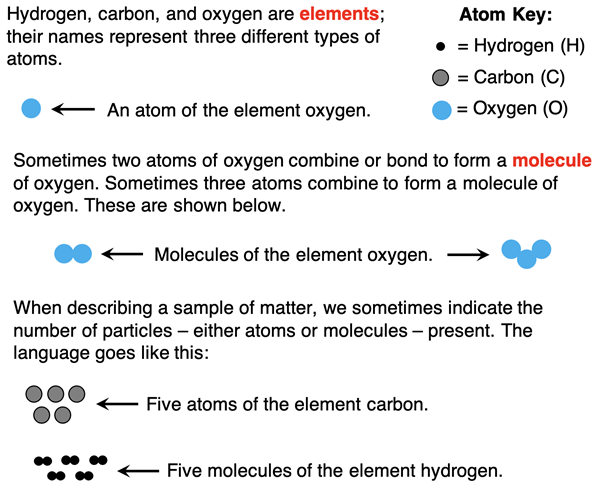
Matter is composed of atoms - the individual units that form the building blocks from which all things are made. There are many types of atoms, each with a different name (like copper or aluminum or oxygen or nitrogen). These types of atoms are referred to as elements. Elements can consist of individual atoms or of groups of the same type of atoms bound together. When two or more atoms bind together to form a multi-atom particle, we refer to the particle as being a molecule. Particle diagrams like the ones below often help students to keep the language straight.
Compounds and Molecules - in Words and Particle Diagrams
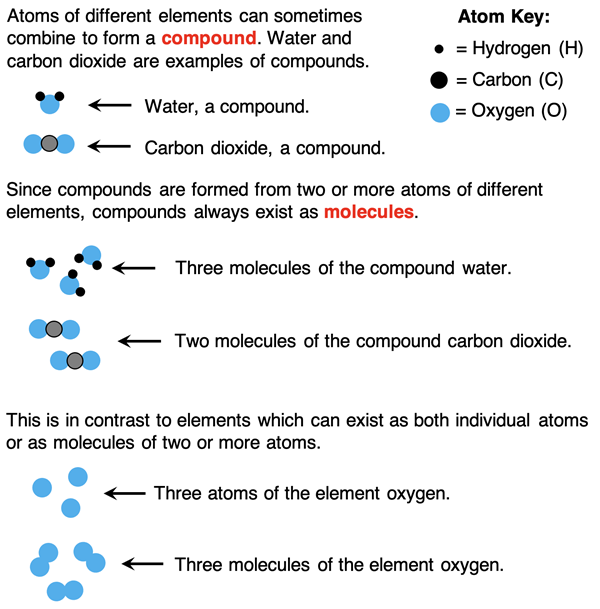
We saw in the diagram above that two or even three oxygen atoms can bond together to form a molecule of oxygen. But molecules can also be formed when groups of atoms of different elements bond. When atoms of two or more elements bind together, a compound is formed. For instance, water (H2O) is a compound formed when two atoms of hydrogen bind to one atom of oxygen. We refer to this grouping of three atoms as a molecule of water.
Think of a molecule as a particle that contains two or more atoms bound together. If all the atoms in a molecule are the same type, then it is a molecule of an element (O2, O3, N2, etc.). If the atoms in a molecule are of different types, then it is a molecule of a compound (CO, CO2, H2O, H2O2, etc.). Think of a compound as a type of substance that contains two or more elements. Once again, particle diagrams like the ones below can be very helpful.
 In Chemistry, we will frequently talk of particle-level ideas. That’s the small stuff. And we will also talk of the macroscopic. That’s the big stuff … the observables. In our language of Chemistry, atoms and molecules are used to refer to particles or the individual units that make up a sample of matter. Elements and compounds are used to refer to the sample of matter. The language can be confusing. But it will grow on you. Like any language, you will need to practice using it – reading about it, listening to it, and speaking it.
Symbolic Representations of Matter
 Fluency in Chemistry class requires more than being fluent in the language of Chemistry. You must also be fluent in the use of symbols to represent chemical systems. Every element has its own elemental symbol – like H, C, O, N, Na, He, etc. And every compound can be represented by a chemical formula – a collection of symbols and numbers and parenthesis (if you’re lucky). You’ll need to be able to make sense of formulae such as H2O, CO2, AlCl3, HNO3, (NH4)2SO4, and so on. As time continues, you will see complex formula expressions like Pb(NO3)2 + 2 KI.
Nobody is born with an understanding of these symbolic representations. Learning them will take some time. And some practice. And some instruction. That’s what this Chemistry Tutorial is for.
The Meaning of Symbols, Formulae, and Coefficients in Chemistry
The elemental symbols used in formulae (plural form of formula) indicate what types of atoms are present. The numbers are either coefficients or subscripts and they indicate the number of atoms or molecules present.
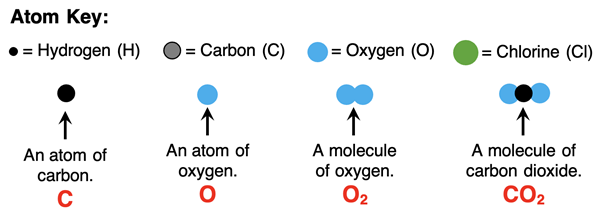
Subscripts are used to indicate the number of each atom present. The 2 in CO2 indicates there are two atoms of oxygen in the molecule. If you don’t see a subscript, then you can assume there is just 1 atom.
Here are more examples using the same Atom Key shown above:
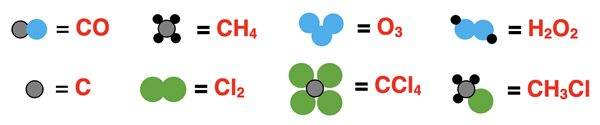
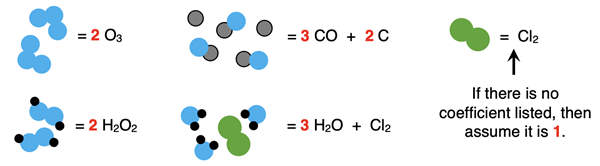
So, the subscripts in formulae indicate the number of atoms of each element in a molecule. Formulae also include numbers known as coefficients. The red numbers in the formulae below are examples.

The coefficient 5 as in 5 C indicates that there are five of whatever symbol it comes in front of – in this case, there are five C atoms. The 4 of 4 H2O indicates that there are four water molecules. And the 3 of 3 Cl2 indicates that there are three chlorine molecules. The particle diagrams would look like this:

Here are some more examples of formulae containing coefficients:
Parentheses are sometimes included in the chemical formulae for a type of compound known as an ionic compound. Here are three examples:

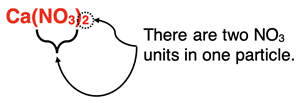 There is always a subscripted number after a parenthesis. A subscript of 2 means that there are 2 copies of whatever is inside of the parenthesis. We will discuss formula writing for ionic compounds in great detail in Chapter 4 of this Chemistry Tutorial.
Counting Atoms from Symbolic Representations
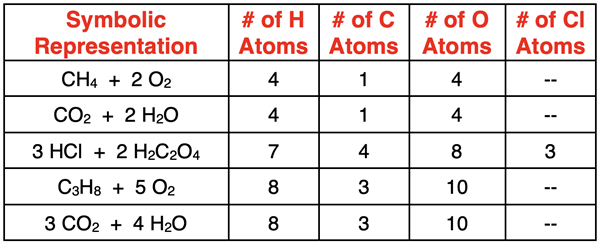
In Lesson 1, we discussed how Chemistry was a quantitative science. Numbers matter. And many concepts have a numerical slant. Symbolic representations are one of many demonstrations of the numerical nature of Chemistry. Subscripts and coefficients allow us to count the number of atoms of each element represented by a formula. Consider the atom counts shown in the table below for a variety of formulae.
Sense-Making Tools
This page has discussed three related tools – language, symbolic representations, and particle diagrams. These are tools. Like any tool, you don’t use it once and throw it away. The best tools are those that you use all the time. In Chemistry, language, symbolic representations, and particle diagrams will be our frequently used tools to for making sense of Chemistry. Don’t throw these tools away! You’re going to use them all the time.
Before You Leave - Practice and Reinforcement
Now that you've done the reading, take some time to strengthen your understanding and to put the ideas into practice. Here's some suggestions.
Check Your Understanding of Words, Symbols, and Diagrams
Use the following questions to assess your understanding of the language of Chemistry, symbolic representations, and particle diagrams. Tap the Check Answer buttons when ready.
1. Identify the following particle diagrams as representing either an pure element, a pure compound, a mixture of two elements, a mixture of two compounds, or a mixture of an element and a compound.
Check Part A Answer
Answer: Pure Element
There is only one element in every particle - oxygen. So it is an element. And it is pure because there is no other substances with the oxygen.
Check Part B Answer
Answer: Mixture of Two Compounds
There are two types of substances here; so it is a mixture.
Both types of substances have two or more elements. So each is a compound.
Therefore, it is a mixture of two compounds.
Check Part C Answer
Answer: Mixture of an Element and a Compound
There are two types of substances in the diagram; so it is a mixture.
One of the substances consist of only one element - diatomic chlorine.
The other substances consists of two different elements - hydrogen and oxygen. This is a compound.
Therefore, it is a mixture of an element and a compound.
2. Classify the following formulae as representing either a pure element, a pure compound, a mixture of two elements, a mixture of two compounds, or a mixture of an element and a compound.
- 3 H2O
Check Answer
Answer: Pure Compound
H2O contains two different elements so it is a compound. There is no other formulas accompanying it so we know it is a pure substance.
- 3 Zn + 2 H2
Check Answer
Answer: Mixture of Two Elements
The + sign is an indicator that this represents a mixture; there are two substances in the mixture - zinc and hydrogen. Zn is an element. H2 is an element. We know this because there is only one elemental symbol on each side of the + sign.
- 3 H2C2O4
Check Answer
Answer: Pure Compound
H2C2O4 contains three different elemental symbols in the formula so it is a compound. There is no other formulas accompanying it so we know it is a pure substance. If we did see a + sign, then we would know that there was a second substance and it would be a mixture. There is no such + sign.
- C8H18
Check Answer
Answer: Pure Compound
C8H18 contains two different elemental symbols in the formula so it is a compound. There is no other formulas accompanying it so we know it is a pure substance. If we did see a + sign, then we would know that there was a second substance.
- 2 C8H18 + 17 O2
Check Answer
Answer: Mixture of a Compound and an Element
The + sign is an indicator that this represents a mixture; there are two substances in the mixture - C8H18 (known as octane) and oxygen. C8H18 is a compound; we know this because we see two elements in the formula. O2 is an element. We know this because there is only one elemental symbol shown.
- S8
Check Answer
Answer: Pure Element
S8 contains a single elemental symbol so it is an element. There is no other formula accompanying it so we know it is a pure substance.
3. Use the language of Chemistry to describe the following particle representations.
Check Part A Answer
Answer:
The sample contains a mixure of an element and a compound. The element is oxygen; it exists as diatomic molecules (O2). The compound is CH4. There are 8 molecules of the element oxygen and four molecules of the compound CH4.
Check Part B Answer
Answer:
The sample contains a mixure of an element and a compound. The element is hydrogen; it exists as diatomic molecules (H2). The compound is HCl. There are 5 molecules of the element hydrogen and 5 molecules of the compound HCl.
Check Part C Answer
Answer:
The sample contains a mixure of two different elements; there are no compounds in the sample. One of the element is chlorine; it exists as diatomic molecules (Cl2); there are three of these molecules. The other element is carbon. There are 3 molecules of the element chlorine and 6 atoms of the element C.
4. Explain how the symbols
2 O3 is different than
3 O2.
Check Answer
The symbol 2 O3 refers to two molecules of triatomic oxygen. The molecules have three oxygen atoms bonded together. There are two such molecules.
The symbol 3 O2 refers to three molecules of diatomic oxygen. The molecules have two oxygen atoms bonded together. There are three such molecules.
For the record, both O2 and O3 exist. The O2 form of oxygen is considerably more prevalent and is how we naturally observe elemental oxygen in nature. The O3 form, known as ozone, is produced when a diatomic oxygen molecule is split into two isolated atoms by a bombarding photon of ultraviolet light. The isolated O atom can quickly bond to a neighboring O2 molecule to produce O3. The O3 molecules are unstable and will quickly decompose back into O2.
5. Use a symbolic representation to describe the following particle representations.
Check Part A Answer
Answer: 8 O3
There are eight different particles. Each particle contains three atoms of the element oxygen. So the coefficient is 8 and the formula is O3.
Check Part B Answer
Answer: 5 CH4 + 3 CCl4
There are two types of particles. Using the atom key we notice that one of particles has one C atom and 4 H atoms bonded together. We would represent this by CH4. There are five of these particles so we represent this by 5 CH4. The other particle type has one C atom and four Cl atoms. We would represent this by CCl4. There are three of these types of particles so we represent this by 3 CCl4.
It does not matter what order you put the two terms in. You are just as correct if you write 3 CCl4 + 5 CH4.
Check Part C Answer
Answer: 7 H2O2 + 3 Cl2
There are two types of particles. Using the atom key we notice that one of particles has two O atoms and 2 H atoms bonded together. We would represent this by H2O2. There are seven of these particles so we represent this by 7 H2O2. The other particle type has only Cl atoms. It is an element. There are two Cl atoms in each particle. We would represent this by Cl2. There are three of these types of particles so we represent this by 3 Cl2.
It does not matter what order you put the two terms in. You are just as correct if you write 3 Cl2 + 7 H2O2.
6. Fill in the table, indicating the number of atoms of each indicated element.
7. Rank the following samples in terms of which has the greatest number of oxygen atoms (O), from the least number to the greatest number.
Check Part A Answer
Answer: C < B < A
Sample C has the least # of O atoms (7).
Sample B has 10 O atoms.
Sample A has the most # of O atoms (12).
Check Part B Answer
Answer: A < C < B
Sample A has the least # of O atoms (14).
Sample C has 15 O atoms.
Sample B has the most # of O atoms (36).
Check Part C Answer
Answer: A < B < C
Sample A has the least # of O atoms (3).
Sample B has 4 O atoms.
Sample C has the most # of O atoms (8).