Two Expressions for Angular Momentum
In each lesson of this chapter, we have uncovered another parallel between translational (linear) motion and rotational motion. We’ve seen, for example, that there are four kinematic equations for rotational motion that look strikingly similar to those of translational motion. We’ve learned that moment of inertia and torque are the rotational counterparts to mass and force. We’ve even explored rotational kinetic energy and saw how we could pretty much predict its equation given what we already know about the links between translational and rotational motion. That brings us to momentum--the last of the mechanics concepts we’ll explore. Is there also a rotational counterpart to momentum, too? Indeed, there is! We’ll call it angular momentum. That is what this lesson is all about.
Let’s imagine a rotating disk. We say that this disk has angular momentum with respect to an axis of rotation through its center. Physicists use the letter L to represent angular momentum. Like its translational counterpart that depends on mass and velocity, the angular momentum of the disk depends on the disk’s moment of inertia and its angular velocity. Here’s the comparison that we can make between these translational and rotational quantities.
It is important to note that a rotating object has angular momentum with respect to an axis. For example, if we spin the same disk with the same angular velocity about an axis other than through its center, it will have a different angular momentum. This makes sense since the moment of inertia about a new axis is different. It is also important to note that angular momentum is a vector. Like its translational counterpart, it has direction.
We’ll describe the direction of angular momentum as clockwise or counterclockwise.
Let’s consider an example to see how this works.
Example 1: Angular Momentum of a Rod About Two Different Axes
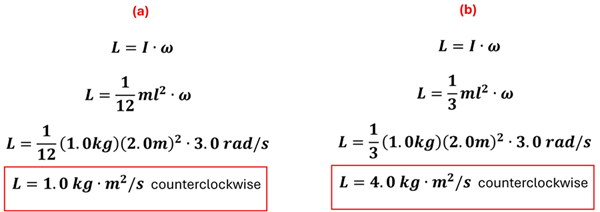
Problem: A thin rod 2.0 m long with a mass of 1.0 kg is rotating with an angular velocity of 3.0 rad/s counterclockwise. Determine its angular momentum if it is rotating about an axis through (a) its center of mass, and (b) its end.
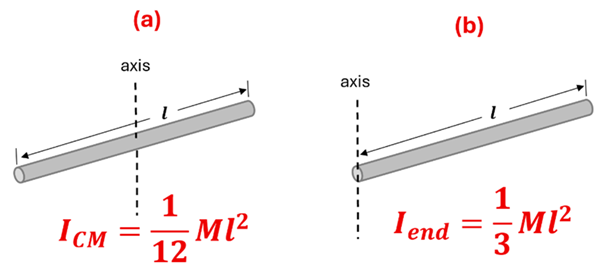
Solution: Multiplying the moment of inertia by the angular velocity gives the angular momentum of (a) 1.0 kg·m2/s, and (b) 4.0 kg·m2/s. The direction of the angular momentum will be the same as the direction of the angular velocity. In this example, the direction of the angular momentum is counterclockwise.
While the above equation for angular momentum can handle any situation, there is an equivalent expression that is useful in certain situations—such as a ball moving in a straight line. You might be thinking, "Does an object moving in a straight line have angular momentum?" The answer is…it depends. It depends on the direction it is moving with respect to its axis of rotation. To illustrate this, let’s consider a baseball moving in a straight line parallel to the +x-axis.
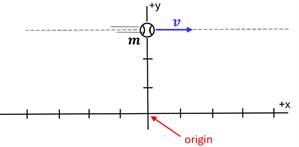
Does this baseball have linear momentum? Absolutely. Its linear momentum is p = m·v. To determine if it has angular momentum, let’s pretend that you are standing at the origin of the xy-coordinate grid. To keep your eye on the ball, you would have to rotate your head as the ball zips past you. In that sense, we can say that the ball is rotating about the origin and thus has angular momentum. Contrast this to the baseball traveling along the y-axis toward you. You wouldn’t need to rotate your head in this case, and thus we would say that the ball does not have angular momentum with respect to the origin. We can make sense of this by using another equation for angular momentum that we’ll find helpful.
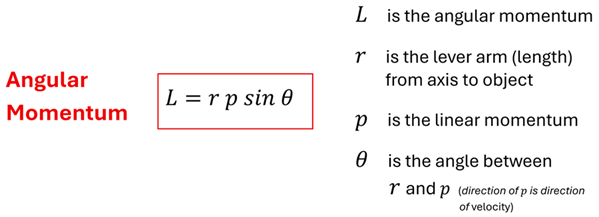
To see how we would apply this equation to find the angular momentum of a baseball traveling in a straight line, let’s consider our next example.
Example 2: Angular Momentum of a Baseball
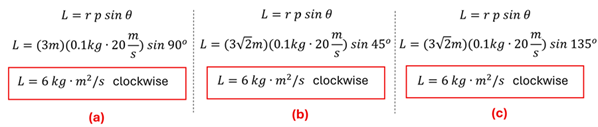
Problem: A 0.1 kg baseball travels in a straight line at 20 m/s at 3 m above the x-axis. Find the angular momentum of the ball with respect to the origin when its coordinates are (a) (0, 3m), (b) (-3, 3), and (c) (3, 3).
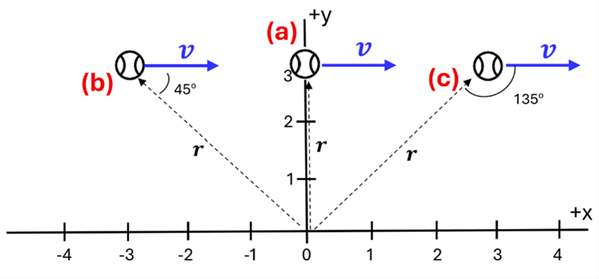
Solution: Applying the angular momentum equation, we find that the angular momentum is the same value (6 kg·m2/s clockwise) at each of the three coordinates. While r is bigger at (b) and (c) compared to (a), the sin 45o and sin 135o are proportionally smaller than sin 90o so that the angular momentum stays constant. We’ll see later in this page that the only way to change the angular momentum of an object is to have a torque acting on it. Since that is not the case here, it makes sense that the angular momentum stays constant.
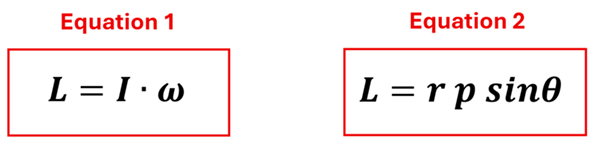
You might be wondering, “Why would we have two expressions for angular momentum? How do I know which one to use?” If you know the moment of inertia of a rotating object and angular velocity, use the first equation (on the left below). If you have an object that can be treated as a point mass moving with some velocity at a distance from a reference axis, use the second equation (on the right below).
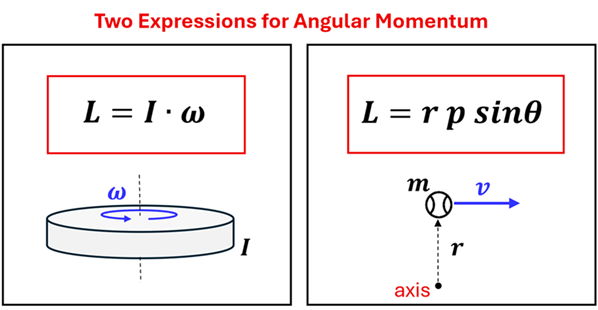
In the next section, we’ll see why it is helpful to have these two different expressions for angular momentum. While both work, you’ll decide which is the best one to use when you consider what is given in a problem.
Example 3: Hockey Pucks and Angular Momentum
Problem: Two hockey pucks, each 0.2 kg, are traveling with a constant velocity of 3 m/s across the ice in the directions shown. Using the origin as the axis of rotation, determine the angular momentum of the puck with coordinates (a) (4, 0) and (b) (0,4).
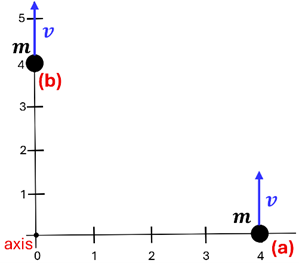
Solution: (a) Using our second expression for angular momentum, we find L = r p sin θ = (4 m)(0.2 kg · 3 m/s)(sin 90o) = 2.4 kg·m2/s. (b) Using the same equation, we find L = r p sin θ = (4 m)(0.2 kg · 3 m/s)(sin 0o) = 0 kg·m2/s. When an object is heading directly toward or directly away from the axis, it will not have angular momentum with respect to that axis.
Angular Impulse
In Lesson 1 of Momentum and Its Conservation, we learned that we change the momentum of an object by delivering an impulse to it. Two quantities impact the size of the impulse—the force and the time over which that force acts. We saw that this impulse = change in momentum relationship really follows from Newton’s Second Law.
As you might expect, we change an object’s angular momentum by delivering an angular impulse to it. Not only do the two quantities that impact the amount of angular impulse (torque and the time over which the torque acts) parallel those of linear impulse, the angular impulse = change in angular momentum relationship follows from Newton’s Second Law for Rotational Motion. These parallels just keep coming!
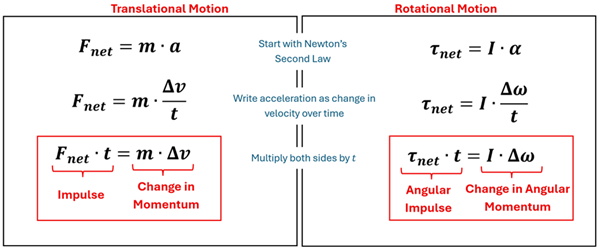
This concept, that...
Angular Impulse = Change in Angular Momentum
is a fundamental concept in physics and helps us understand how we change an object’s angular momentum. Let’s try a couple of example problems to see how we can apply the angular impulse-change in momentum relationship for rotational motion.
Example 4: Starting a Lawnmower
Problem: Starr Tidup was getting ready to mow the lawn. In an effort to get the lawnmower running, she pulled with a 100 N force on a rope which is wrapped around a pulley of 0.15 m radius. If the rotational apparatus (ICM = 0.5 kg·m2) inside the lawnmower gets rotating at 10 rad/s, the mechanism will fire within the piston, and the spark will start the engine.
(a) What magnitude torque does she apply?
(b) If she applies this torque for 0.4 seconds, what angular impulse does the mower’s rotational apparatus receive?
(c) Is Starr successful in firing up the lawnmower? Why or why not?
Solution:
(a) We can find the torque by using τ = r F sin θ = (0.15 m)(100 N) sin 90o = 15 N·m. We know that θ = 90o since the rope always pulls tangent to the pulley so that r is perpendicular to the direction of the force.
(b) The angular impulse delivered to the rotational apparatus is τ · t = (15 N·m) (0.4 s) = 6 N·m/s or 6 kg·m2/s.
(c) Since the lawnmower’s rotational apparatus requires a change in angular momentum of ∆L = I · ∆ω = (0.5 kg·m2) (10 rad/s – 0 rad/s) = 5 kg·m2/s, the 6 kg·m2/s angular impulse (which equals the change in angular momentum) is enough to start the engine.
Example 5: Wind Power
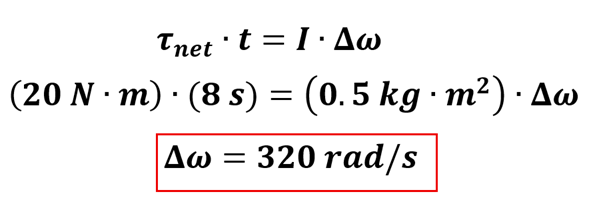
Problem: When a fan is turned on, a motor supplies a 20 N·m of counterclockwise torque for 8 seconds to start the blades spinning. If the moment of inertia of the fan blades and shaft is 0.5 kg·m2, what is the angular velocity at which the fan blades are rotating after these 8 seconds?
Solution: Using the angular impulse equal change in angular momentum equation, we can solve for the change in angular velocity. Since the fan started from rest, ∆ω = ωf = 320 rad/s counterclockwise.
Check Your Understanding
Use the following questions to assess your understanding. Tap the Check Answer buttons when ready.
1: The two equations below can be used to solve for the angular momentum of an object about an axis. For each case, rather than solve for the angular momentum, simply identify which of the two equations (Equation 1 or Equation 2) you would use.
(A) A disk (ICM = 2 kg·m2) is rotating at 3 rad/s. What is the angular momentum of the disk with respect to its center of mass?
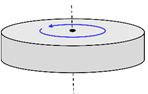
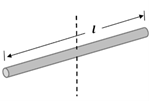
(B) A thin, uniform rod of mass 2 kg and length 1 m has an angular velocity of 2π rad/s about an axis through its center of mass. What is its angular momentum with respect to its axis of rotation?
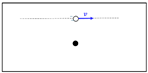
(C) A 0.16 kg white pool ball travels at 8 m/s. What is its angular momentum with respect to the stationary black ball that is 0.4 m away?
Check Part A Answer
Answer: Equation 1
I and ω are given.
Check Part B Answer
Answer: Equation 1
ω is given and I can be determined.
Check Part C Answer
Answer: Equation 2
r is given, p can be found since p = m v, and the angle is 90o. You can, however, also use Equation 1 with some additional work. You’d need to determine the moment of inertia of a point particle (the white pool ball) and use the link equation to determine ω given v and r.
2: Consider the three cases mentioned in question 1 above. Use the identified equation to determine the angular momentum of the object.
Check Part A Answer
Answer: 6 kg·m2/s
L = I ω = (2 kg·m2) (3 rad/s) = 6 kg·m2/s
Check Part B Answer
Answer: 1.0 kg·m2/s
L = I·ω = 1/12·m·l2·ω=1/12 (2 kg ) (1 m)2 (2π rad/s) = 1.0 kg·m2/s
Check Part C Answer
Answer: 0.51 kg·m2/s
L = r p sin θ = (0.4 m) (0.16 kg) (8 m/s) sin 90º = 0.51 kg·m2/s
3: A spinning platform (ICM = 3kg·m2) experiences a net torque of 10 N·m for 2 seconds.
(A) What is the platform’s change in angular momentum?
(B) What is the platform's change in angular velocity?
Check Part A Answer
Answer: 20 kg·m2/s
Since the angular impulse equals the change in angular momentum, ∆L = τnet · t = (10 N·m) ( 2 s) = 20 kg·m2/s
Check Part B Answer
Answer: 6.7 rad/s
Since ∆L = I Δω, Δω = ∆L / I = (20 kg·m2/s) / (3kg·m2) = 6.7 rad/s
4: A 0.10 kg dart travels through the air at 20 m/s. When it is at the location shown, what is its angular momentum with respect to...
(A) Point P?
(B) Point O, the launch point?
Check Part A Answer
Answer: 1.39 kg·m2/s clockwise
L = r p sin θ = (0.8 m) (0.10 kg) (20 m/s) sin 120º = 1.39 kg·m2/s
Check Part B Answer
Answer: 0 kg·m2/s
Since r is in the same direction as p, sin 0o = 0.
5: When an angular impulse acts on an object, it changes the object's angular momentum. Use this principle to determine the unknown quantity in each situation.
| |
Net Torque
(N·m) |
Time
(Sect) |
Moment of Inertia
(kg·m2)
|
Initial Angular Velocity
(rad/s) |
Final Angular Velocity
(rad/s) |
| A |
6 |
|
3 |
0 |
2 |
| B |
|
4 |
6 |
5 |
3 |
| C |
10 |
2 |
5 |
5 |
|
| D |
-8 |
1 |
2 |
|
0 |
Check Part A Answer
Answer: 1 s
Using τnet · t = I · ∆ω, we find t = 1 s.
Check Part B Answer
Answer: -3 N·m
Using τnet · t = I · ∆ω, we find τ = -3 N·m.
Check Part C Answer
Answer: 9 rad/s
Using τnet · t = I · (ωf – ωi) , we find ωf = 9 rad/s.
Check Part D Answer
Answer: 4 rad/s
Using τnet · t = I · (ωf – ωi) , we find ωi = 4 rad/s.
Figure 1 Image generated using some MS Word Iconography.
Figure 2 Borrowed from Wikimedia Commons (From LLeyDavis) https://commons.wikimedia.org/wiki/File:Starting_Lawnmower.jpg under license Creative Commons
Figure 3 Dart icon in picture borrowed from Wikimedia Commons (From Delapouite) https://commons.wikimedia.org/wiki/File:Dart_-_Delapouite_-_game-icons.svg under license Creative Commons