Describing Pressure from Everyday Life
If you have ever had to pump up a bicycle tire, you know something about pressure. If the pressure is too low, the tire is soft and goes flat when you try to ride your bike. You know that to get the tire to the proper pressure, you must add air to the tire. Adding air increases the pressure.
If you are a swimmer, you know about pressure, too. As you swim to the bottom of the pool, you feel the pressure increase as the water pushes in on you. Perhaps you notice this most in your ears as the increased water pressure pushes your eardrums harder and harder. As you descend, the increased pressure on the outside of your eardrum causes it to bow inward, and a "pop" is the sound of air moving through the Eustachian tube to balance this pressure.
But what exactly causes this thing called pressure that inflates bicycle tires and makes your ears pop? Answering this question is the goal of this section. We’ll find it helpful to zoom in on the air and water molecules themselves. As we consider what is happening at the molecular level, we’ll start to understand where pressure comes from.
Pressure at the Molecular Level
Let’s model the air molecules inside a tire with the animation shown here. The particles of air are in constant, random motion inside the tire (which is modeled by this box). The blue dots might represent one type of air molecule and the red dots another. These dots will continue moving until they encounter the walls of the container or another particle crossing its path. Upon meeting up with a container wall or another particle, they collide and change directions. As we discussed in Lesson 1, this constantly-on-the-move behavior explains why gases expand to fill the entire volume of the container. And the collisions with the container walls are the source of air pressure.
Consider the left figure below that represents the ‘flat’ tire’s air molecules at one instant in time. At this instant, we see four molecules colliding with the walls of the container. Each of these molecules exerts a force on a container wall that pushes it outward. Maybe this isn’t enough to keep the tire inflated, however. We could say that this tire is underinflated. Now let’s say we pump more air into the container (which is what you do when you pump up your bicycle tire), as shown in the right figure below. We see that at any moment in time, we’ll likely have more collisions occurring with the walls of the container. We have more collisions simply because there are more molecules of air. More collisions mean more force outward. This outward force, over the area of the container wall, is what we mean by pressure.
In reality, there are not just 30 or 60 molecules in the tire (approximately the number of dots shown above), there are ~1023 air molecules (that’s 100,000,000,000,000,000,000,000 molecules)! With so many molecules, there will be many collisions occurring with the walls of the tire at any moment in time. As a result, the collisions will, on average, be spread evenly across all parts of the tire walls.
You might be thinking, “Doesn’t the speed of these moving molecules affect the force as well? After all, the faster a particle moves, the bigger its kinetic energy and the greater the force it will exert when colliding with a wall.” You’re exactly right. We say that temperature is the way we measure the average kinetic energy of these molecules. That’s why on hot days tires expand, and on cold days tires tend to be a little flat. If you are interested in learning more about how temperature affects pressure for gases, you might want to check out Gases and Gas Laws in our Chemistry Tutorial.
This leads us to our definition of pressure. Pressure is the total force of all these collisions over an area. In other words, pressure = force / area.
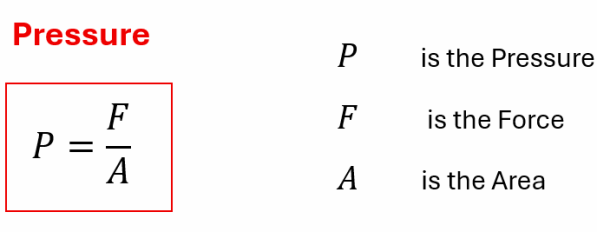
Here, F represents the total force acting on a surface at a particular moment in time. A is the area of that surface. Pressure P, then, is this force divided by this area.
Calculating Pressure
Now that we’ve explored where pressure comes from at the molecular scale, let’s consider some everyday scale examples.
Example 1: Calculating Pressure with Different Forces
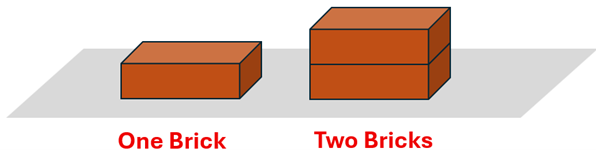
Problem: A brick weighs 24 N and is resting on the floor. The bottom of the brick has a surface area of 0.10 m2.
(A) What pressure does this one brick exert on the floor?
(B) If a second brick were stacked on top of the first brick, now what pressure would the bricks exert on the floor?
Solution:
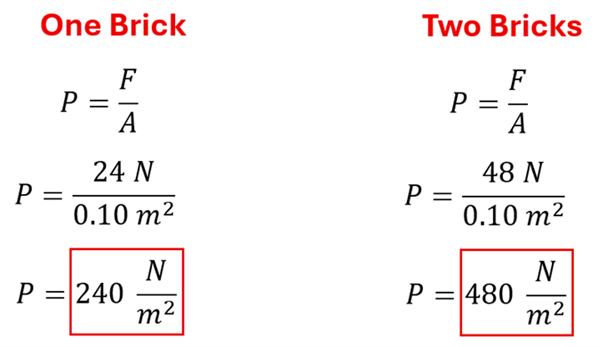
(A) The one brick exerts a pressure of 240 N/m2 on the floor since it exerts 24 N of force (called a normal force) on the ground over an area of 0.10 m2.
(B) Since the two bricks exert twice the force on the ground (since they have twice the weight, and thus twice the normal force) but still over an area of 0.10 m2, the pressure is doubled to 480 N/m2.
Example 2: Calculating Pressure with Different Areas
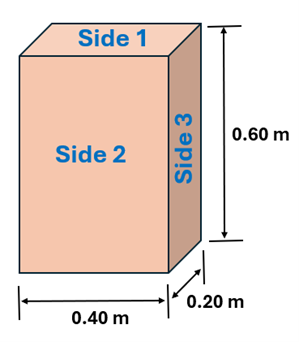
Problem: A rectangular block weighs 12 N and has dimensions of 0.20 m x 0.40 m x 0.60 m. When placed on the floor...
(A) which side (1, 2, or 3) will exert the greatest force on the floor?
(B) Which side will exert the greatest pressure on the floor?
Solution:
(A) Since the block weighs 12 N, when resting on the floor, it will exert a force (called a normal force) of 12 N on the floor, regardless of the side on which it is resting. In other words, Side 1, Side 2, and Side 3 all exert the same force on the floor.
(B) To find the pressure exerted by each side, however, we’ll need to divide this force by the area of that side. After doing so, we can see that Side 1 offers the biggest pressure since it has the smallest area over which that force acts. Side 2 offers the smallest pressure since it has the largest surface area. Side 3 offers a medium pressure since its area is between that of sides 1 and 2.
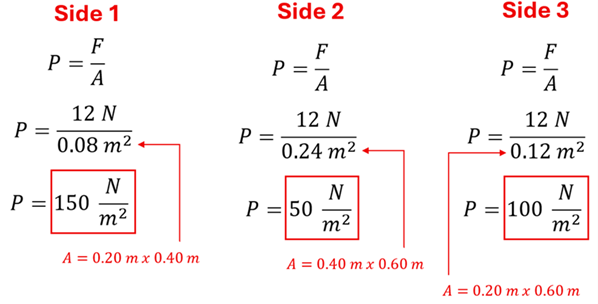
We see from the above two examples that as the force is increased over a given area, the pressure increases. We also learned that as the area increases for a given force, the pressure decreases. Can you see why snowshoes (very large surface area) are helpful for hikers who do not want to break through the surface of the snow? Can you also see why a nail is pointy (very small area) so that it does break through a piece of wood? Pressure is the key to explaining both!
Units of Pressure
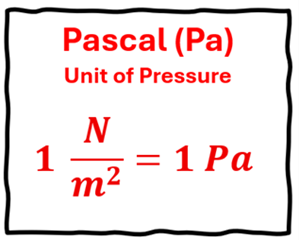
In the above examples, we calculated pressure in units of Newtons/square meter (N/m2). In physics, we give a shorthand name to 1 N/m2, which is called 1 Pascal (Pa). This unit is named after Blaise Pascal, a French mathematician, physicist, and theologian who contributed significantly to our current understanding of fluids. We’ll encounter a principle of his later in this lesson.
The Pascal (or N/m2) isn’t the only unit that we use for pressure, however. Scientists often use a bunch of different units. The table below lists many of the units used.
| Unit |
Abbreviation |
| Newton/meter2 |
N/m2 |
| Pascal |
Pa |
| kiloPascal |
kPa |
| atmosphere |
atm |
| millimeters of mercury |
mm Hg |
| Torr |
torr |
| Bar |
bar |
| pounds per square inch |
psi |
Along with the Pascal, another common unit that we’ll use in the sections to come is the atmosphere (atm). 1.00 atm represents the average air pressure at sea level. It provides a helpful standard reference point for pressure measurements. Here are the conversion factors between many of the units that we’ll encounter in our study of pressure.
1.00 atm = 101325 Pa = 101325 N/m2 = 760 mm Hg = 760 torr = 14.7 psi
Let’s look at a couple of examples using the Factor Label Method that we introduced in the previous lesson.
Example 3: Pressure at Mt. Everest Peak
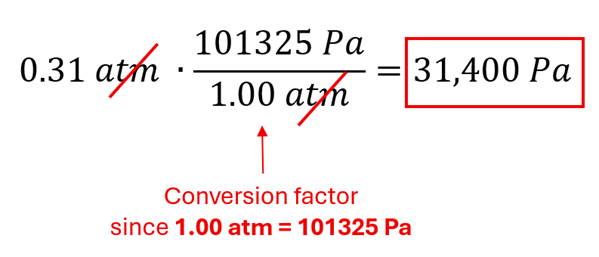
Problem: While air pressure at sea level is around 1.00 atm, air pressure at the top of Mt. Everest has been measured to be approximately 0.31 atm. How many Pascals is this?
Solution: Since 1.00 atm = 101325 Pa, we’ll use this conversion factor to convert atmospheres to Pascals. Since we start with units of atmospheres, we’ll put this in the denominator of our conversion fraction so that the atm units will cancel, and we’ll end up with roughly 31,400 Pa.
Example 4: This is Getting Deep
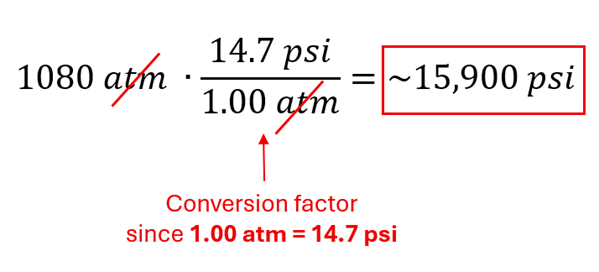
Problem: The deepest place in the Ocean (about 7 miles deep) is the Mariana Trench, located south of Japan. Water pressure at this depth is about 1080 atm. How many pounds per square inch (psi) is this?
Solution: Since 1.00 atm = 14.7 psi, we find the pressure at the bottom of the Mariana Trench to be about 15,900 psi. This means that the water is pushing with 15,900 pounds of force on every square inch at this depth. This is equivalent to having an adult elephant stand on the top of your head!
Check Your Understanding
Use the following questions to assess your understanding. Tap the Check Answer buttons when ready.
1. In which situation would a tire experience the greatest air pressure?
(a) A tire with a relatively small number of molecules on a cold day
(b) A tire with a relatively small number of molecules on a hot day
(c) A tire with a relatively large number of molecules on a cold day
(d) A tire with a relatively large number of molecules on a hot day
2. A hiker uses snowshoes to cross a region with deep, soft snow. Why do snowshoes help her from sinking into the snow?
(a) They increase her weight
(b) They decrease her weight
(c) They increase her area of contact
(d) They decrease her area of contact
3. Rank (from greatest to least) the pressure exerted in each case, given the forces exerted over the given areas.
| |
Force Exerted (N) |
Area (m2) |
| Case 1 |
20 |
1.0 |
| Case 2 |
40 |
4.0 |
| Case 3 |
10 |
0.4 |
| Case 4 |
40 |
1.0 |
4. At a certain depth in the water, the top surface (area = 0.30 m2) of a box experiences a force of 2900 N from the air and water above it. What pressure (in Pa) does the top of this box experience?
5. Convert the following pressures from one pressure unit to another.
(A) 2.00 atm = ___________ Pa
(B) ________ atm = 506,600 Pa
(C) _______ atm = 1520 mm Hg
(D) 482,500 atm = ________ psi
Figure 1 Borrowed from Wikimedia Commons (From Eddie Kips) https://commons.wikimedia.org/wiki/File:Mensenstraat-band_oppompen.jpg under license Creative Commons
Figure 2 Borrowed from Wikimedia Commons (From Reg Mckenna) https://commons.wikimedia.org/wiki/File:A_girl_in_a_swimming_pool_-_underwater.jpg under license Creative Commons
Figure 3 Borrowed from Wikimedia Commons https://commons.wikimedia.org/wiki/File:Translational_motion.gif
Figure 4 Modified from Wikimedia Commons https://commons.wikimedia.org/wiki/File:Translational_motion.gif
Figure 5 Borrowed from Wikimedia Commons https://commons.wikimedia.org/wiki/File:Panoramique_mont_Everest.jpg