Pressure and Depth
If you’ve gone swimming, you know that water exerts pressure on you. You might have noticed that the pressure increases the deeper you go in the water. This pressure can make your ears pop as you swim to the bottom of a pool. This is because the water pressure is related to the weight of the water above you. When you swim to the bottom of the pool, there is a lot more water above you than when you are just under the surface.
Similarly, air pushes in on you from all sides. In fact, at sea level, the air pushes in on you from all sides with approximately 14.7 pounds of force on every square inch of your body. You might say, however, “I don’t feel the air pushing in on me.” That’s because the insides of us also push out with such a force to keep our bodies intact. An interesting demonstration can be done to illustrate this concept with a soda can. An empty soda can sitting on a table is pushed inward from the outside air with 14.7 pounds per square inch. The reason it doesn’t get compressed is because the air inside the can is also exerting the same force on the inside walls of the can with an equal pressure. If you were to remove the air from inside an empty soda can, however, you would see the significant force that air does exert as the can crushes due to the pressure of the air outside the can pushing inward. Where does this pressure come from? Like the water that is above you when you swim to the bottom of a pool, there is about 14.7 pounds of air above every square inch of us. At the surface of the Earth, we are actually ‘deep’ in our atmosphere of air.
Since the principle of increased pressure in air is the same as in water, let’s unpack why this happens in water, knowing that we can apply this same concept to air. After all, both are fluids, right?!
Consider a container filled with water. Now, imagine we examine a portion of this water by constructing an imaginary box outlined with the dotted lines as shown below. Let’s say that the top and bottom of this box have area A. Let’s say that the box has a height h. The volume of the water inside this box, then, would be V = A • h. Let’s also say that the mass of the water inside this imaginary box is m. Since the weight of this water is the force of gravity on this water due to the Earth, we can calculate the water’s weight using Fg = mg.
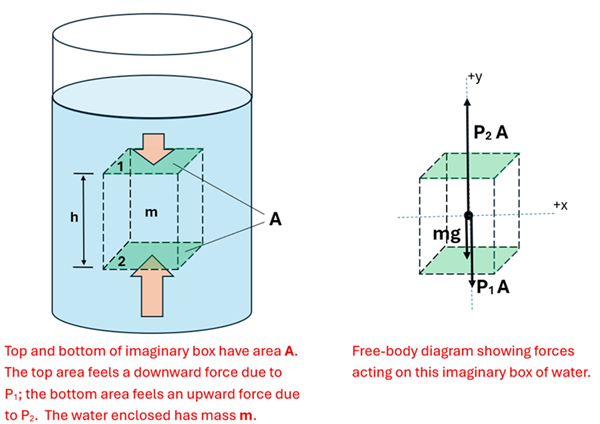
The force of gravity isn’t the only force this water experiences, however. The top area is being pushed down by the weight of the water above it. Since we learned that Force = Pressure • Area in the last section, we can say that the force pushing down on the top of our imaginary box of water is given by F1 = P1 • A. The bottom of the box also experiences water pressure. As water molecules from below collide with the bottom of the imaginary box, they exert a force upward. For the same reason, we can F2 = P2 • A. So, we have three forces acting on our imaginary box of water:
- Fg = mg (pointing downward)
- F1 = P1 • A (pointing downward)
- F2 = P2 • A (pointing upward)
An important note: There are also forces that push inward from both the left and right sides along the x-axis as well. The x-direction forces will end up cancelling, however. As a result, we did not show them here.
Let’s assume that the water in our imaginary box is at rest. If that is the case, we’ll call this a static fluid. We learned back in our study of Newton's Second Law that for any static object (that is, not accelerating), the forces must be balanced. Said another way, the net force on the object must be zero. As a result, we can write:
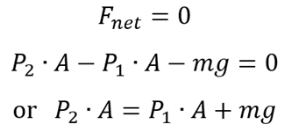
Recall from our density equations in the previous lesson that we can write the mass of our imaginary box of water as m = ρ • V. Then, since the volume of the box is V = A • h (see above), we can write the mass of our box of water as m = ρ • V = ρ • (A • h ). Substituting this into our pressure equation above, we get:
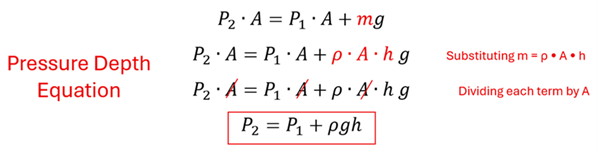
In other words, if we know the pressure P1 at some location in a fluid, we can determine the pressure P2 at a point deeper in the fluid using this equation. This equation is the way we can calculate the pressure at the bottom of a pool given the pressure at the surface. It’s how we can, in theory, find the air pressure at one depth in the atmosphere, knowing the pressure at a ‘less deep’ location.
An important note: Since air (like other gases) is compressible, it is not an ideal fluid. As a result, its density changes from less dense at the top of the atmosphere to more dense at sea level. Thus, ρ changes at different depths. The above equation is only accurate for fluids that have a uniform density throughout. It is because most liquids (like water) are not very compressible that we chose to use water as our example in developing this equation, as opposed to air.
Let’s apply this equation to a couple of examples to see how this works.
Example 1: Water Tower
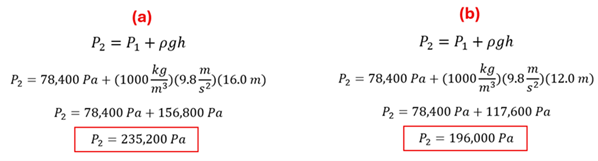
Problem: Water towers supply high-pressure water in pipes delivered to area homes. The water pressure at the bottom of the large ball is 78,400 Pa. What is the water pressure (in Pascals) at the closed faucets of the two homes shown?
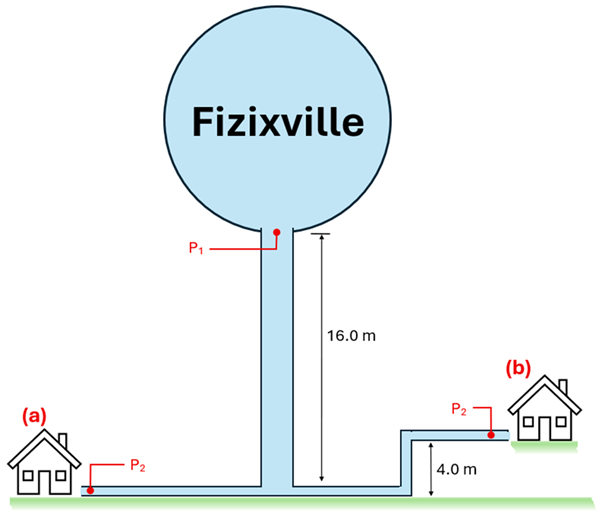
Solution: Using the pressure depth equation and that water's density if 1000 kg/m3, we find that the hydrostatic pressure at (a) is 235,200 Pa and at (b) is 196,000 Pa. From this problem, we can understand why water towers are used. They use gravity to create water pressure for the faucets in your home. The lower your home is, the greater the water pressure will be.
Example 2: Blood Pressure
Problem: Even though blood flows through the arteries, as an approximation, we can treat it as a static fluid. Estimate the pressure difference between the base of the anterior tibial artery (in the foot) and the heart when a person is (a) standing, and(b) lying down. Assume the density of blood is 1050 kg/m3.
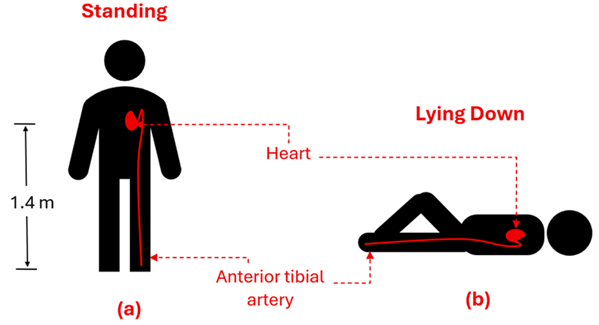
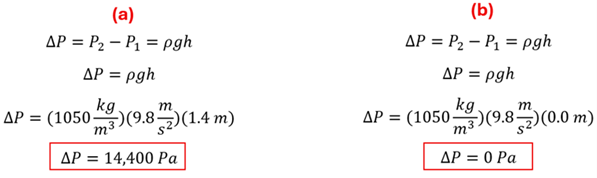
Solution: The pressure difference, ΔP = P2 – P1 (which means ΔP = ρgh) can be found using the pressure depth equation.
(a) Using this equation, we find that the pressure difference between the base of the anterior tibial artery and the heart is 14,400 Pa.
(b) Since there is no appreciable height difference when lying down, the pressure difference is approximately 0 Pa. Incidentally, this also means that, when lying down, the pressure difference between your heart and your brain is approximately zero. This is why you should lie down if you start to feel faint.
Pressure Gauges
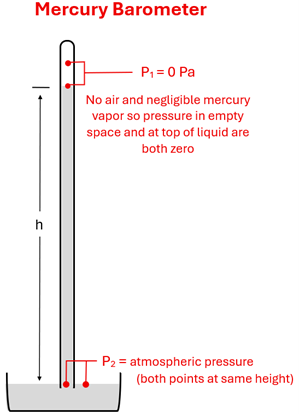
A simple device used to measure pressure is a mercury barometer. This device consists of a pool of liquid mercury with a long, inverted tube that has a vacuum (no air) at the top. Since there is no air (and negligible mercury vapor), the pressure in this empty space is zero. Since the pressure at the top of this closed tube is zero, the mercury will climb up the tube until the pressure difference between P1 and P2 equals the atmospheric pressure. In other words, since:
ΔP = P2 – P1 = ρ g h
ΔP = Patm – 0 = ρ g h
ΔP = Patm = ρ g h
By simply knowing the density of mercury (13,546 kg/m3), that g = 9.8 m/s2, and measuring the height of the mercury in the column, we can measure the atmospheric pressure.
Example 3: How Tall Does the Barometer Need to Be?
Problem:
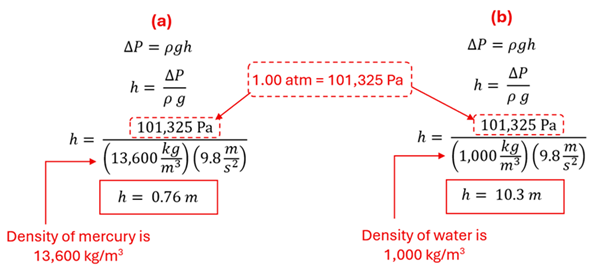
(a) How tall does a mercury barometer need to be so that the pressure difference from the empty space at the top of the barometer to its bottom is 1.00 atmosphere (1.00 atm)?
(b) Since mercury is dangerous to work with, a barometer could be filled with water instead. How tall would a water barometer need to be such that the pressure difference from the empty space at the top to its bottom is 1.00 atm? (Recall that 1.00 atm = 101,325 Pascals, that the density of mercury is 13,600 kg/m3, and that the density of water is 1,000 kg/m3).
Solution:
(a) A mercury barometer needs to be 0.76 m tall.
(b) A water barometer would need to be 10.3 m tall. Since 10. 3 m is about three stories tall, water barometers are not practical. It is because mercury is so dense that a mercury barometer can be much shorter. This is why barometers have been made using mercury rather than water.
Open-tube Manometer
While a barometer is a common device used to measure pressure, there are other devices that can measure pressure. Shown below is a device called an open-tube manometer. Here’s how it works. The right side of the tube is ‘open’ to the atmospheric pressure of the air. The tube is filled with some liquid (which may be mercury, as is often the case with a barometer). The left side of the tube is then connected to a closed container that has a pressure we want to measure.
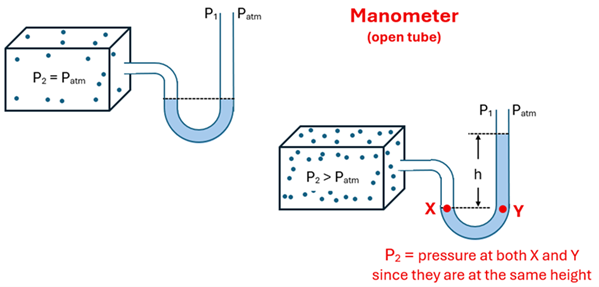
For the case on the left, we see that the level of liquid on each side of the U-shaped tube is equal. This tells us that the pressure inside the container (P2) is equal to the pressure of the atmosphere (P1). For the case on the right, however, we see that the liquid level on the right side of the U-shaped tube is much higher than on the left side. This implies that the pressure inside the container is greater than atmospheric pressure. Since the pressure inside the container is greater than atmospheric pressure, it pushes down on the liquid on the left side of the U-shaped tube, resulting in the liquid rising on the right side of the tube.
How does it ‘know’ how far to push the liquid up on the right side? Since Point X is at the top of the liquid on the left side, it is experiencing the pressure inside the container (P2). Since Point Y is at the same depth in this same liquid, it must also be at the same pressure P2. And since the atmospheric pressure (Patm) above is at a lower pressure, there must be additional liquid above Point Y to make Point Y in the liquid have the same pressure P2. This pressure difference, P2 – Patm, which is equal to ρ • g • h according to the pressure depth equation above, is called the gauge pressure. The gauge pressure is simply the pressure difference between the pressure in the container and the atmospheric pressure. The actual pressure inside the container (P2) is called the absolute pressure. Absolute pressure can be thought of as being compared to that of an empty vacuum—which has no pressure at all.
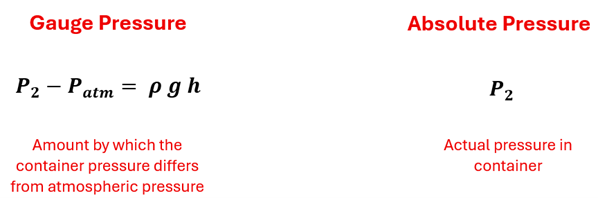
When calculating pressure, it is important to note whether you are speaking of the gauge pressure (how different the pressure is compared to the atmospheric pressure) OR if you are speaking of the absolute pressure.
Example 4: A Sphygmomanometer
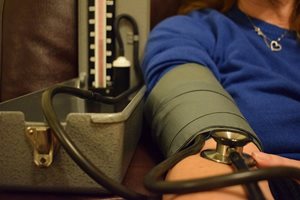
A sphygmomanometer is a special manometer used to measure blood pressure. When a rubber bulb is squeezed, it forces air into the arm cuff until the blood flowing through the artery is stopped. When the valve on the bulb is opened, the cuff pressure starts to drop. When the cuff pressure drops just below the maximum pressure (systolic) produced by the heart, the artery opens again momentarily. The manometer pressure at this point is about 120 mm of mercury for a normal heart. As the pressure in the cuff continues to decrease, a point will be reached where the blood will flow continuously through the artery even when the minimum pressure (diastolic) is produced by the heart. The manometer pressure at this minimum point is about 80 mm of mercury for a normal heart.
(a) Why do you suppose a nurse measures your blood pressure around your upper arm?
(b) If the nurse were to measure your blood pressure around your lower leg, would you expect it to be different? How so?
(c) Are these blood pressure readings gauge pressure or absolute pressure readings?
Solution:
(a) When sitting upright, your upper arm is at the same height as your heart. Therefore, this is a position most appropriate for measuring the maximum and minimum pressures produced by your heart.
(b) Yes, blood pressure around the lower leg is generally higher than that taken around the arm since it is at a lower height in your body. The systolic pressure can be as much as 12-20 mm of mercury higher.
(c) These are gauge pressures, as they read how much higher your blood pressure is compared to atmospheric pressure.
Example 5: Absolute Pressure
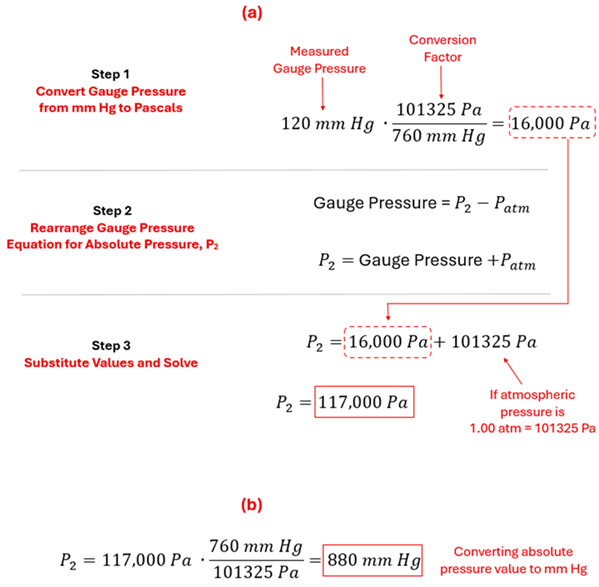
Problem: Maximum (systolic) blood pressure is typically 120 mm of mercury. As we saw in the example above, this is the gauge pressure. If a column of mercury were 120 mm high, what would the absolute pressure be in...(a) Pascals and (b) mm of mercury? Assume atmospheric pressure is equal to 1.00 atm (which is equivalent to 101325 Pa or 760 mm Hg).
Solution: Since absolute pressure is gauge pressure + atmospheric pressure, we find the absolute pressure to be (a) 117,000 Pa or (b) 880 mm Hg.
The fluid pressures we’ve discussed in the situations above are sometimes referred to as static pressure. Static pressure is the pressure in a fluid that is not flowing. We make this distinction because, in the next lesson of this chapter, we will investigate what happens to the pressure in a fluid that is flowing.
Check Your Understanding
Use the following questions to assess your understanding. Tap the Check Answer buttons when ready.
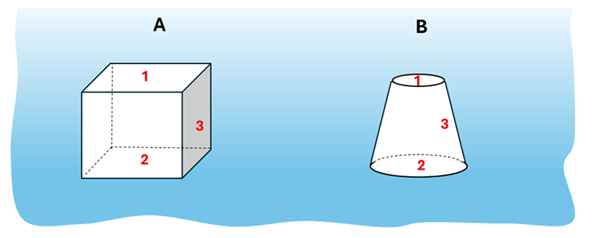
1. For each of the shaped containers below, determine which side (1, 2, or 3) had the greatest pressure pushing in on it.
Check Part A Answer
Answer: 2
The deeper in the fluid, the greater the pressure.
Check Part B Answer
Answer: 2
Regardless of the shape, the deeper in the fluid, the greater the pressure.
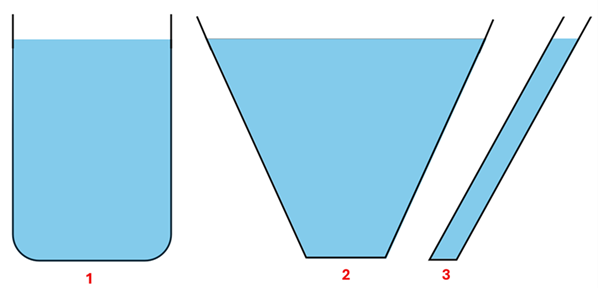
2. Three containers are filled with water to the same level. Rank the pressure at the bottom of the containers from greatest to least.
Check Answer
Answer: 1 = 2 = 3 (All the same)
Since all are at the same depth, the pressure at the bottom is the same in each case.
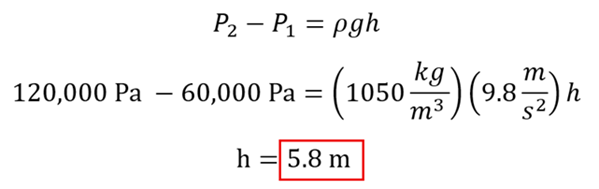
3. The water pressure at a location inside the ball of a water tower is 60,000 Pa. How many meters high would this point need to be so that the static (not moving) water pressure in a pipe below is twice this value? (Assume the density of water is 1050 kg/m3).
Check Answer
Answer:
Using the pressure depth equation, we know that P2, the pressure in the below pipe is 120,000 Pa. Since P1 is 60,000 Pa, and we know the density of water and the acceleration due to gravity, we can solve for h. We find the height to be 5.8 m.
4. Equal volumes of two fluids (1 and 2) of different densities are poured into a U-shaped tube as shown below.
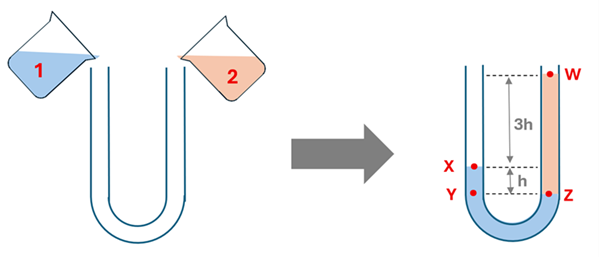
(A) Which fluid has the greater density?
(B) Which point (W, X, or Y) will be at the same pressure as Point Z?
(C) How many times more dense is the denser fluid compared to the less dense fluid?
Check Part A Answer
Answer: 1
The denser fluid will sink to the bottom. (We’ll explore sinking and floating later in this lesson).
Check Part B Answer
Answer: Pressure at Y = Pressure at Z
Since both Y and Z are at the same depth in fluid 1, they will be at the same pressure.
Check Part C Answer
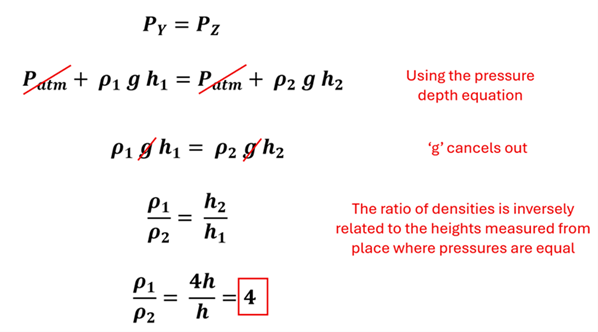
Answer: 4 times
5. Why is absolute pressure always greater than gauge pressure?
(a) Absolute pressure = gauge pressure + atmospheric pressure
(b) Absolute pressure = gauge pressure - atmospheric pressure
(c) Absolute pressure = gauge pressure / atmospheric pressure
(d) Absolute pressure = gauge pressure • atmospheric pressure
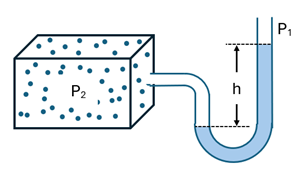
6. A box containing a gas of pressure P2 is connected to a U-shaped tube containing a liquid. P1 represents the atmospheric pressure at the top of the tube.
(A) Which is at a higher pressure: P1 or P2
(B) What would h be if P1 = P2?
Check Part A Answer
Answer: P2
The pressure at the top of the liquid on the left side of the tube (which is at pressure P2) must be greater than P1 since it is ‘deeper’ in the liquid.
Check Part B Answer
Answer: h = 0
If P1 = P2, the pressure at the top of the liquid on both sides would be the same. Since pressure increases with depth, the liquid would have to be at the same height on each side.
Looking for additional practice? Check out the CalcPad for additional practice problems.
Figure 1 Borrowed from Wikimedia Commons https://commons.wikimedia.org/wiki/File:Know_your_blood_pressure._(43811315094).jpg