Open and Closed Systems
We saw back in Lesson 2 of Work, Energy, and Power, that we can do such things as predict the speed of a roller coaster car at the bottom of a hill just by knowing the height of the hill from which the coaster car started moving. We saw that we can predict the height that a ball on the end of a string will swing up to just by knowing the speed at the bottom of its swing. To make such predictions, we took advantage of one of the most fundamental laws of science—the conservation of energy.
When applying the conservation of energy, scientists often refer to the system being analyzed. We’ll define a system as an object or group of objects that we want to analyze. A system can be as simple as a block of wood to something as complicated as the entire human body. Our systems will be pretty simple.
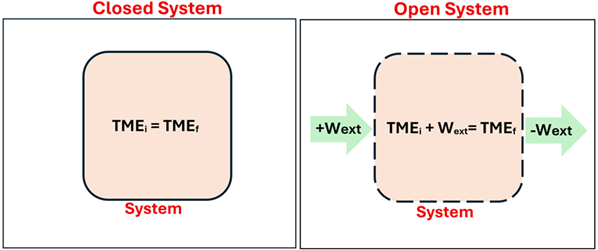
As you might expect, conservation of energy holds true for rotating systems as well as translating systems. The aim of this section is to apply conservation of energy to rotating systems to see how powerful this mathematical tool is and add it to our problem-solving toolchest. As we did back in the chapter on Work, Energy, and Power, we’ll do so here by considering two categories of problems. First, we’ll consider closed systems. These are situations where there are only conservative forces acting on our system. You may recall that conservative forces are those such as the force of gravity and the spring force which we account for by including their effects through potential energy. Second, we’ll consider open systems. These are situations where non-conservative forces act on our system. These external (outside of our system) non-conservative forces do work on the system and that changes the energy of the system. These are forces such as tension in a string, a normal force, an applied force, and friction. You might think of it this way:
Conservation of Energy - Closed Systems
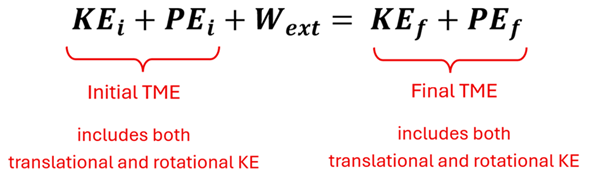
Back in Lesson 1 of Work, Energy, and Power, we described total mechanical energy (TME) as the sum of the potential energy (stored energy of position) and kinetic energy (energy of motion). Since it is this total mechanical energy that is conserved in a closed system, we wrote:
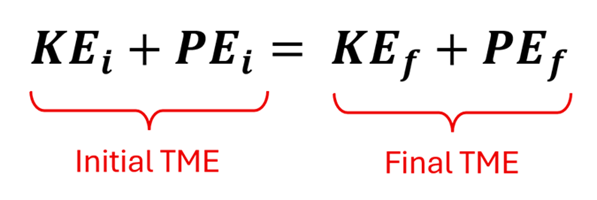
This is the same equation we’ll apply to rotating system. The only difference is that we can now have two types of kinetic energy (translational and rotational) for the KE terms. To be explicit, we can write:

While nobody doubts the conservation of energy, the fun comes when we get to apply this law to predict things. Previously we used it to predict the speed of a roller coaster car or the height of a pendulum. Now, with our understanding of rotational motion, we’ll be able to tackle situations where things are both rotating and translating. Let’s look at a couple of examples to see how we apply this mathematical relationship.
Example 1: Predicting Speed
Problem: As a physics class studies rotational motion, each group is given a spool (ICM = 0.3 kg·m2) with a light string wrapped around it that pivots on an essentially frictionless bearing about its center. A lab group attaches a 1.0 kg mass to the end of the string 2.0 m above the ground, and then they let go. Their task is to predict the speed of the falling mass just before it hits the ground. How might they do this?
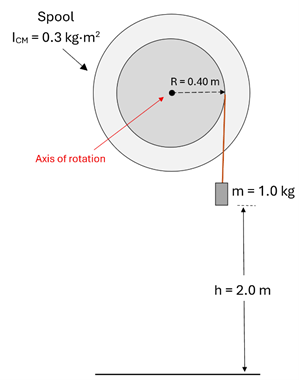
Solution: Probably the best approach is to use conservation of energy. First, let’s define our system and attach a coordinate system. Let’s make our system the spool, the string, the hanging mass, and the Earth. Why define our system this way? Any forces that do work to get the objects moving (such as the spool spinning and the mass falling) are internal forces caused by other objects within the system OR they are conservative forces such as the force of gravity. Therefore, this is a closed system which allows us to use the conservation of mechanical energy equation above. Next, let’s define our zero height to be the ground. We know the Initial Kinetic Energy (both translational and rotational) is 0 and the Initial Potential Energy of the weight = mass · g · height, and we also know that the final Potential energy will be 0 (weight on the ground - 0 height). After beginning with the conservation of mechanical energy equation, making substitutions, and then solving, we find that the speed of the mass just before hitting the ground is 3.7 m/s.
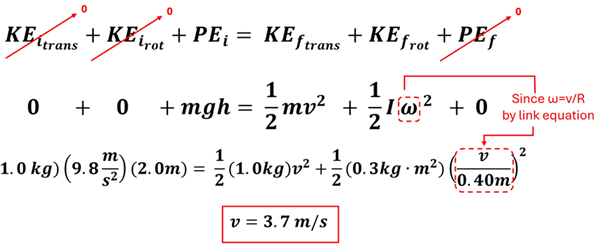
There are a couple of important notes to make about our process above. First, we called the PEi and PEf of the spool zero even though it was above ground level. Why can we do this? It turns out that we could have included a potential energy term that accounts for the PE of the spool. Do you see, however, that including this on the left side of the equation would mean that we’d need to include the same value on the right side of the equation? So, since this part of our system did not change its potential energy, we’ll end up canceling out these two terms anyway.
It's also worth explaining why, on the right side of the equation, we say the falling mass has translational KE while the spool has only rotational KE. Simply put, the center of mass of the falling weight is only translating, and the spool is only rotating about its center of mass.
In Lesson 2 of this chapter, we worked through an example problem called the Speeding Down Hills Race. We learned that Solid spheres beat Disks which beat Hollow spheres which beat Rings. We were able to predict these results based on the moment of inertia for each. In our next example, let’s revisit this race and use conservation of energy to derive an equation for their speeds at the bottom of the hill.
(View moment of inertial of common objects)
Example 2: The "Speeding Down Hills Race" Revisited
Problem: A disk, a ring, a solid sphere, and a hollow sphere race as they roll downhill. Derive an expression for the translational speed (linear speed of the center of mass) of these four objects at the bottom of the hill when allowed to roll from rest from the top of a hill of height 'h'.
(View moment of inertial of common objects)
Solution: We’ll let our system be each rolling object and the Earth, and let’s call the bottom of the hill our zero height. Initially, our objects only have potential energy and end with both translational and rotational kinetic energy. Since rotational kinetic energy is the kinetic energy when purely rotating about its center of mass, we’ll use the moment of inertia about the center of mass. After substituting ω = v/R (from our link equation), we are able to solve for the speed in each case.
Since 10/7 > 4/3 > 6/5 > 1, the solid sphere beats the disk which beats the hollow sphere which beats the ring.
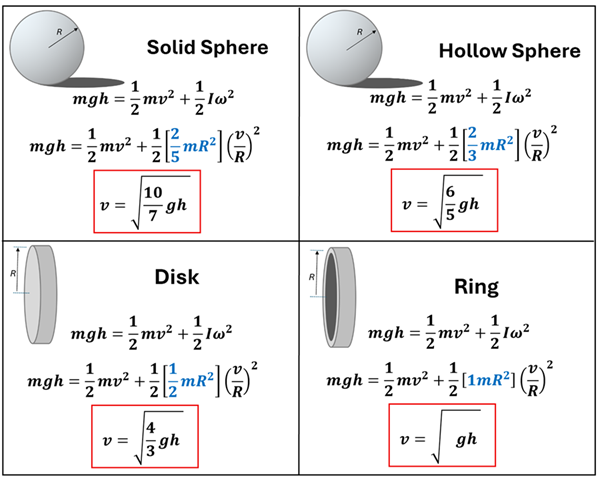
It’s important to point out that the mass and radius in these equations cancel out. This is significant. This means that ALL Solid spheres beat all Disks which beat all Hollow spheres which beat all Rings. If you had two solid spheres of different masses and radii they would get to the bottom of the hill at the same time, and they would beat all disks regardless of their masses and radii.
Conservation of Energy - Open Systems
Next, let’s broaden the situations that we can analyze by considering open systems. As mentioned above, these are situations where external (from outside our system) non-conservative forces do work on our system. In these cases, the final total mechanical energy will be different from its initial value. If positive work is done on the system by a non-conservative force, then energy is added to the system. If negative work is done by a non-conservative force, then energy is removed from the system. Thus, our conservation of energy equation must account for this by including Wext. This work done by an external non-conservative force represents the energy added to or taken from the system.
Since friction is a very common non-conservative force, negative work done on a system by friction removes energy from the system. Let’s consider a rotational motion example where this is the case.
Example 3: Predicting Speed with Friction
Problem: Consider the same situation we investigated in Example 1 above, with one caveat—the pivot is no longer frictionless. Suppose the axle provides a frictional torque of 1.3 m·N as the spool turns. What is the new speed of the falling mass just before it hits the ground?
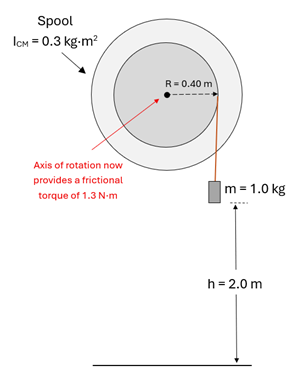
Solution: Our system will be the same as it was in Example 1—the spool, the string, the hanging mass, and the Earth. We’ll also call ground level our zero height. What makes this problem different than Example 1, however, is that there is an external frictional torque that does work on our system. We learned in the previous section that the work done on a rotating system can be found through the equation W = τ·∆θ. Since the frictional torque will be opposite the direction of the angular displacement of the spool as the string unwinds, we’ll call this torque negative. Using the link equation Δs = r Δθ , we can also see that the angular displacement is the arc length (which is equal to the distance the mass has fallen) divided by the radius of the spool.
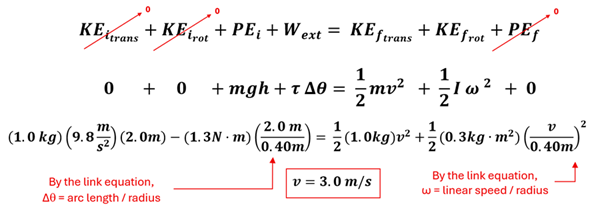
As we might expect, the mass hits the ground with a smaller speed than in Example 1. Since this is an open system, work done by the frictional torque removes energy from our system, leaving less kinetic energy remaining to be shared between the spinning disk and the falling mass.
Example 4: Rolling Revisited
Problem: A ring rolls across a horizontal surface and then up ramp. Friction between the surfaces and the ring allows it to roll without slipping. If the velocity of the ring’s center of mass is 0.50 m/s on the horizontal surface, to what height does the ring roll?
(View moment of inertial of common objects)
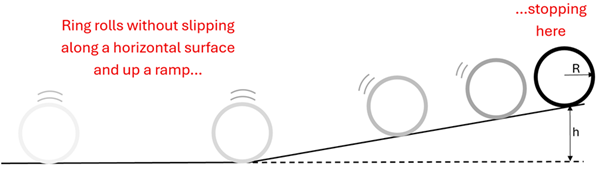
Solution: Let’s define our system as the ring and the Earth. Let’s also define the horizontal surface as our zero height. Initially, the ring has both translational and rotational kinetic energy. Recall that the moment of inertia of a ring is ICM = mR2 and that, from the link equation, ω=v/R. All this energy ends up as gravitational potential energy. Writing out the conservation of energy equation, we find the height to be 0.026 m.
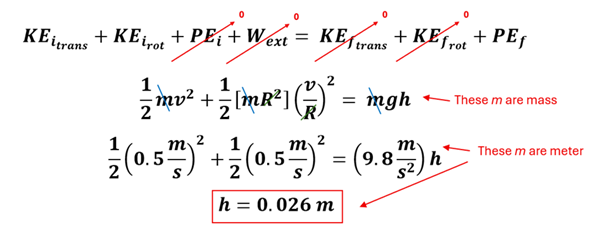
You might be thinking, "The rolling ring experienced both a normal force and a frictional force. Aren’t these non-conservative forces which give energy to or take energy away from our system?" While these are non-conservative forces, the key is that they did not do any work on our system. The normal force is perpendicular to the displacement, so it does not do work. Since the object is rolling, the point where friction acts is at the bottom of the object, which is at rest with respect to the ground. In other words, there is no relative motion between this point on the ring and the surface. So, the force of friction doesn’t do any work either. We also notice that since the mass and radius cancel, ANY ring moving at this speed will climb a ramp to this same height.
Check Your Understanding
Use the following questions to assess your understanding. Tap the Check Answer buttons when ready.
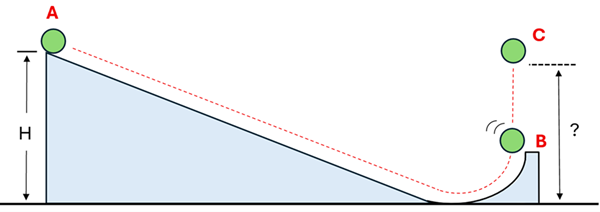
1: A solid ball is let go from position A at the top of a hill of height H. The ball rolls without slipping down the hill and exits a curved portion of the ramp so that it leaves position B traveling vertically. Position C is the maximum height the ball reaches in the air. If no work is done by friction or other non-conservative forces, is position C equal to height H? More than H? Less than H? Explain your reasoning.
Check Answer
Answer: Less than H
While the ball will still have the same total mechanical energy throughout its motion—including when it rises to position C—it will still be spinning and have the same rotational kinetic energy at C that it had when it left position B. Since some of the total energy at position B is rotational kinetic energy, only a fraction of the total energy will be potential energy at C. Thus, it will rise to a height less than H.
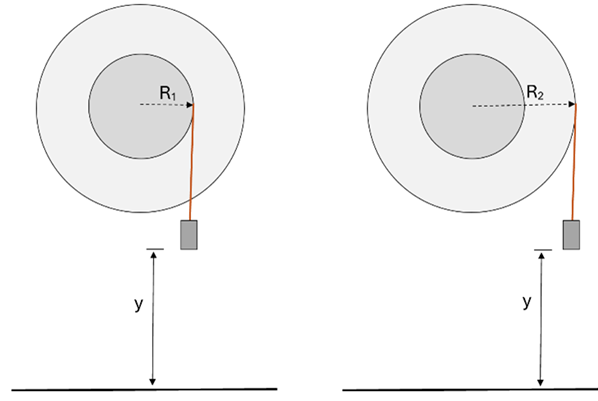
2: A disk has two different radii around which a string can be wrapped. In Case 1, a mass is released from height 'y' which pulls a string wrapped around the disk’s inner radius as it falls. In Case 2, the same mass is released from the same height 'y' but pulls the string which is now wrapped around the outer radius. In which case will the mass-disk system have a greater total kinetic energy just before the mass hits the ground?
Check Answer
Answer: Both Case 1 and Case 2
Since both cases start with the same potential energy (the masses start at the same height above the ground), and since no work is done by a non-conservative force, in both cases the total kinetic energy in the end must be equal to the initial potential energy.
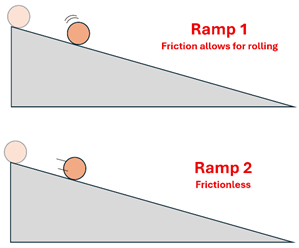
3: A solid sphere rolls without slipping from the top of Ramp 1. The same solid sphere is placed atop Ramp 2 which is identical but frictionless. The sphere gets to the bottom quicker when traveling on Ramp 2. Two students argue about why this is the case. Which student offers the best reasoning?
Student 1: Friction between the solid sphere and Ramp 1 removes energy from the system, leaving less total energy at the bottom.
Student 2: For Ramp 2, none of the solid sphere’s energy goes into rotational kinetic energy, leaving all the energy in the form of translational kinetic energy.
Check Answer
Answer: Student 2
Student 1 is incorrect in that, since the point where the sphere touches the ramp is always at rest with respect to the ramp, no work is done by friction. Thus, no energy leaves the system. Student 2 is correct since, without friction, the sphere will not roll—it will only slide down the ramp. As a result, all the kinetic energy will be in the form of translational kinetic energy, and it will make it to the bottom first.
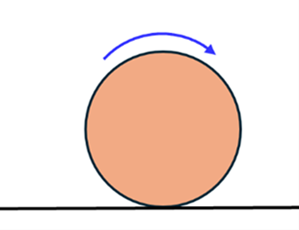
4: A solid sphere rolls on a horizontal surface.
(A) What fraction of its total kinetic energy is in the form of rotational kinetic energy?
(B) Does this answer change if this were a hollow sphere?
(View moment of inertial of common objects)
Check Part A Answer
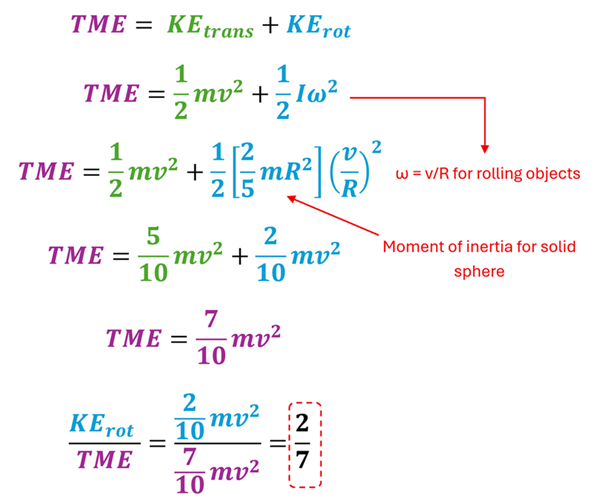
Answer: 2/7
We see that for a solid sphere, the rotational kinetic energy is 2/10 mv
2 whereas its TME is 7/10 mv
2. Putting KE
rot over TME gives 2/7 as the fraction of the total mechanical energy that is in the form of rotational KE.
Check Part B Answer
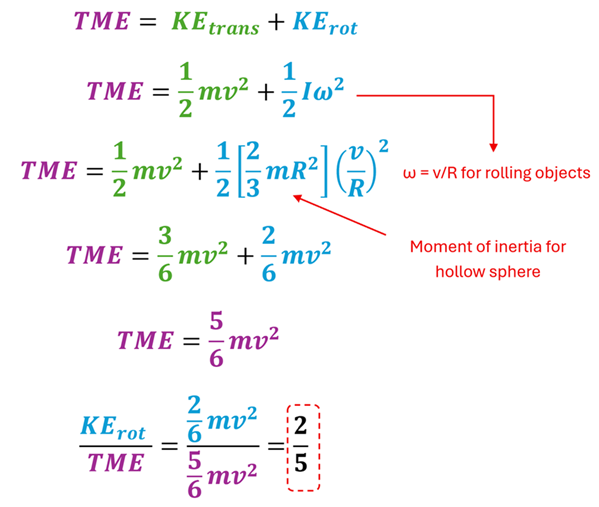
Answer: Yes, the fraction increases
Since the moment of inertia of a hollow sphere is greater than that of a solid sphere of similar mass and radius, a bigger fraction of the TME will be in the form of rotational KE. For a hollow sphere, a similar derivation can be done to show that the rotational kinetic energy is now 2/5 of its total mechanical energy.
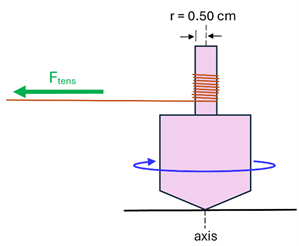
5: A top has a moment of inertia of 6.0 x 10⁻⁴ kg·m2 and is initially at rest. A string wrapped around the top peg (radius = 0.50 cm) is pulled with a constant horizontal tension of 4.0 N for 10 complete rotations of the top. If the top spins about the vertical axis shown,
(A) How much work did the tension force do on the top?
(B) What is the kinetic energy of the top now?
(C) What is the magnitude of the top’s angular velocity?
Check Part A Answer
Answer: 1.26 J
In 10 revolutions, the top will have turned through 10·2π radians = 20π radians. Since W = τ·∆θ = (r·F) · ∆θ = (0.005 m)·(4.0 N)·( 20π rad) = 1.26 J.
Check Part B Answer
Answer: 1.26 J
Since the net work done on the top equals its change in kinetic energy, the top is now spinning with 1.26 J of rotational kinetic energy.
Check Part C Answer
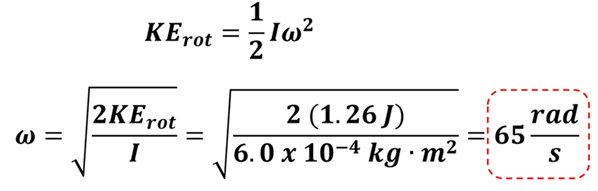
Answer: 65 rad/s (rounded from 64.72)
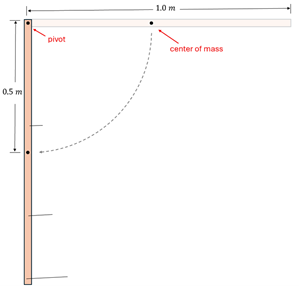
6: A horizontal meterstick is hinged about one end. It is released and allowed to swing freely. When it gets to the vertical position, what is its angular velocity? Hint: the center of mass of the meterstick falls half a meter.
(View moment of inertial of common objects)
Check Answer
Answer: 5.4 rad/s
Let’s define our system as the meterstick. Let’s also set our zero height at the location of the center of mass when the stick is in the vertical position. While we could define it as the bottom of the meterstick, setting it at the location of the center of mass allows us to ignore any final gravitational potential energy. Next, we need to decide if we write the moment of inertia about the center of mass or if we write it about the pivot. Writing it about the pivot—which does not translate—allows us to ignore any final translational KE and only consider rotational KE.
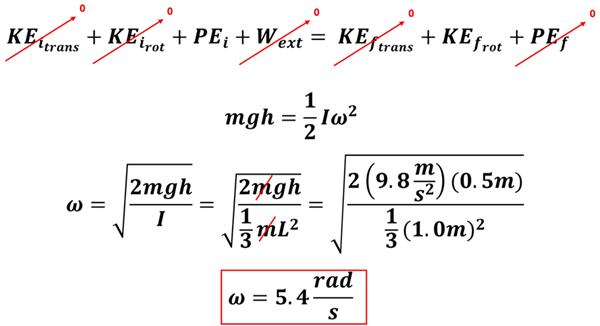
Figure 1 Borrowed from Wikimedia Commons https://commons.wikimedia.org/wiki/File:Rolling_Racers_-_Moment_of_inertia.gif