Three Common Circuit Components
Our study of inductance in this lesson has shown us once again that electricity and magnetism are fundamentally connected. So, in this last section of our chapter on electromagnetic induction, it seems appropriate to highlight still a few more of these connections and how they help us understand the physics behind so many electronic devices.
Electrical engineers often use three common components in electric circuits. While each of these components serves an important function on its own, as we’ll see, circuits can take on a whole new behavior when two of these components are combined in a circuit. In this section, we’ll begin by exploring each of these three common circuit components individually and then we’ll see what happens when we put them together.
The Resistor
An important component of our study of electric circuits is the resistor. We’ve seen that a resistor is a device that hinders the flow of charge in a circuit. This can be a manufactured resistor like the one shown in the picture, but it can also be a light bulb, a heater, or any device that converts electrical energy to another form of energy which can be radiated from the device—such as heat or light. We’ve also seen that physicists like to use schematic diagrams to draw electric circuits with these components. You may recall that the schematic symbol for a resistor is a zigzag line like the one shown here.
The Capacitor
Another important component in electric circuits is the capacitor. A capacitor is a device that is used to store charge. Capacitors are typically made of two parallel metal plates with an insulating material between them. Because we can increase the capacitance when the plates have a large area, manufacturers often roll up these parallel plates into a cylinder shape and then put a cover over this that hold them together. The schematic symbol for a capacitor reminds us that what’s inside this cover is really just two parallel plates that are not electrically connected to each other.
Because capacitors are able to store positive charge on one plate and negative charge on the other, capacitors are also energy storage devices. They store energy in the electric field created between the two charged plates.
The Inductor
In this chapter on electromagnetic induction, we were introduced to a third circuit component, the inductor. An inductor is a device that seeks to keep ‘status quo’ when it comes to current. In other words, it works to maintain whatever current is in the circuit now. The most common inductor is a solenoid. In fact, the schematic symbol for an inductor clearly illustrates this.
When there is already a steady current in a circuit the inductor just acts like a wire. When the current is changing, however, the inductor acts like a battery with its own emf that works to keep the current steady.
Where does the inductor get the ability to create its own emf and act like a battery? Like capacitors, inductors can also be thought of as energy storage devices. However, they store energy in the magnetic field that is created by the current in the wire.
Now that we’ve looked briefly at these three circuit components, we’re ready to consider the interesting circuit behaviors that occur when we put any two of these together in the same circuit. That’s what we’ll investigate next.
Putting Two Together
Resistor-Capacitor (RC) Circuit
Let’s imagine a circuit with a resistor and capacitor in series. We’ll investigate the unique properties of this circuit by considering both the charging and discharging of the capacitor.
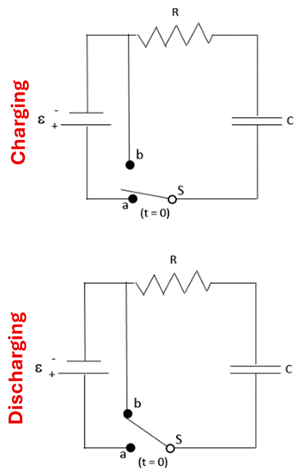
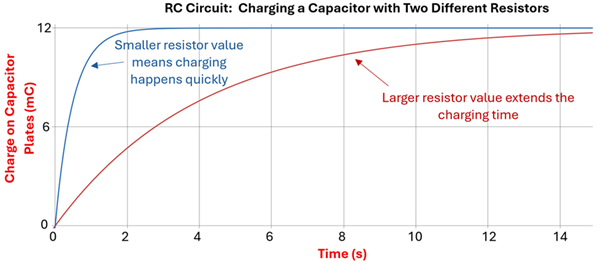
The top circuit shows a battery (with emf ε) , a switch (S), a capacitor (C), and a resistor (R). When the switch is moved to position ‘a’, the circuit will begin charging the capacitor. Because the resistor limits the current, its function in this circuit is to slow down the charging process. The capacitor will eventually store the same amount of charge whether or not the resistor is present, but by selecting a particular resistor value we can control how quickly the charging process occurs.
The bottom circuit shows the switch moved to position ‘b’. Once the capacitor is charged, moving the switch to this position begins the discharging process. Again, the resistor’s function is to control how quickly or slowly this discharging process occurs. A resistor with a bigger resistance means that it will take longer to discharge.
Put the resistor and the capacitor together in the same circuit and you have a timing device. You get to control the time that it takes the circuit to do something by merely selecting just the right resistor and capacitor values. RC circuits are used in a host of electronics (timers, clocks, oscillators) as timing instruments. In some cars, for example, the delay mechanism for intermittent windshield wipers is controlled by an RC circuit. Once the capacitor is charged up to a certain value, it will discharge which allows the wiper blades to move. By using a different resistor value for each setting, we can control the time delay between wipes.
RC circuits are also filtering devices. RC circuits are used to either allow or block specific frequency ranges in audio devices such as equalizers. If you’ve ever turned a bass/treble control knob on a stereo system you’ve used an RC low-pass/high-pass filter. RC circuits are also used in radio receivers, power supplies, and data communication devices to filter out noise or unwanted frequencies from a signal.
Inductor-Resistor (LR) Circuits
Next, let’s create a circuit with an inductor and a resistor connected in series. We’ll consider the unique properties of this circuit by looking at both a rising current situation and a falling current in this circuit.
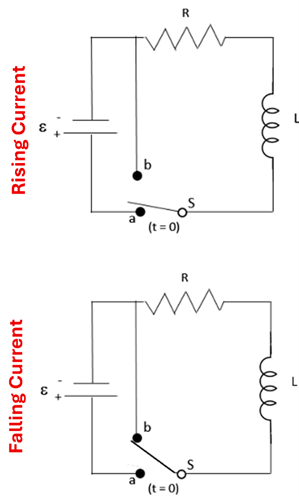
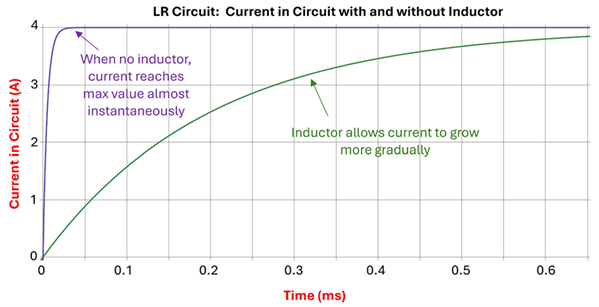
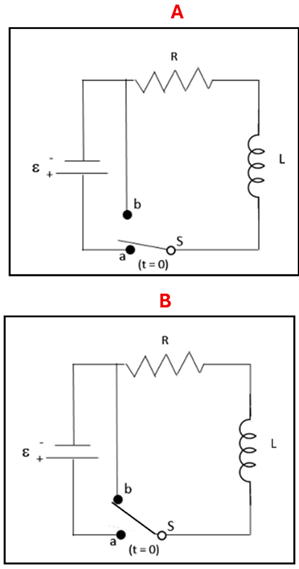
The top circuit shows a battery (with emf ε), a switch (S), an inductor (L), and a resistor (R). When the switch is moved to position ‘a’, a current will be present in the circuit. However, the inductor and the resistor work together to control how quickly the current will rise to its ‘steady state’ current. We saw in the last section of this lesson that inductors resist a change in current. An LR circuit, then, is a device that controls how quickly the current in a circuit goes from zero to its maximum (steady state) value.
Now that we have a steady current in the circuit, let’s move the switch to position ‘b’. When this occurs, the current will fall to zero. Although we can expect the current to fall to zero instantaneously in a circuit with just a resistor, by adding an inductor to the circuit we have created a situation where the current will continue for some time even though the battery is no longer connected. Like the RC circuit discussed previously, a resistor or an inductor with a larger value means the current will continue for a longer time before eventually dropping to zero. Whereas the RC circuit stores energy in the capacitor’s electric field that allows charge to continue to flow in the discharge process even without a battery, the LR circuit stores energy in the inductor’s magnetic field allowing current to continue even after the battery has been removed.
LR circuits have many practical applications as well. In electric motors, inductance from the motor’s windings resist sudden changes in current. This is important as motors in ceiling fans, washing machines, and electric drills self-regulate so they start up slowly. Home theater systems and car audio speakers also use LR circuits as the inductor-resistor combination blocks high-frequency signals and directs low frequencies to woofers.
Inductor-Capacitor (LC) Circuits
The third combination is a circuit where an inductor and capacitor are connected in series. This circuit offers even more unique properties making current oscillate even without an AC power supply.
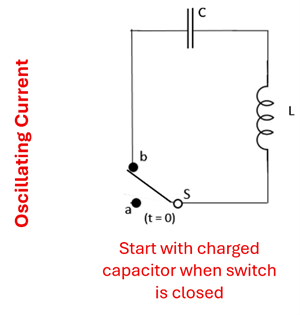
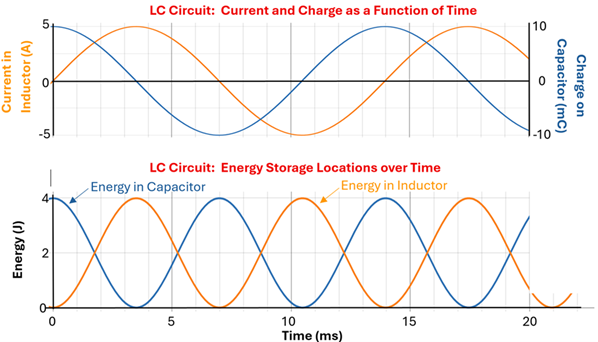
As we analyze the circuit here, let’s start with a fully charged capacitor connected to an inductor. When the switch is closed to complete the circuit (position ‘b’), charge from one plate of the capacitor moves around the circuit toward the other plate. In this process, however, current passes through the inductor which opposes this sudden flow of charge. At first, the inductor acts like a battery in reverse trying to prevent this flow of charge. Once the current gets to a maximum value and starts to decrease, however, the inductor will act like a battery continuing to push charges in the forward direction as it seeks to maintain the current. In fact, the inductor will continue to do so and even ‘overshoot’ until the capacitor becomes charged with the reverse polarity. In an ideal circuit with no resistance (so that no energy is dissipated through a resistor), this process will continue indefinitely as the current oscillates from one direction to the other, and then keep repeating this process.
The frequency at which this oscillation occurs is called the resonance frequency—similar to what we’ll explore with sound in an upcoming chapter. Here, we’ve created alternating current even without an AC power supply. Amazing!
Like their RC and LR counterparts, LC circuits have a host of practical applications. When you ‘tune’ a radio to a specific frequency, you’re using an LC circuit to adjust the circuit’s resonate frequency to that of the desired station. LC circuits enhance the efficiency of wireless charging as energy is transferred between loops at this resonant frequency. And if you’ve ever had an MRI, you can appreciate that an LC circuit was tuned to resonate at the Larmor frequency of the hydrogen nuclei. That’s just the beginning of uses for LC circuits!
Check Your Understanding
Use the following questions to assess your understanding. Tap the Check Answer buttons when ready.
1. Match the circuit component with its function in a circuit.
| (A) hinders the flow of charge in a circuit |
(1) capacitor |
| (B) seeks to maintain 'status quo' current |
(2) resistor |
| (C) stores charge |
(3) inductor |
Check Part A Answer
Answer: resistor
Check Part B Answer
Answer: inductor
Check Part C Answer
Answer: capacitor
2. Match the circuit component with its relationship to energy in a circuit.
| (A) stores energy in its electric field |
(1) capacitor |
| (B) stores energy in its magnetic field |
(2) resistor |
| (C) radiates energy through heat |
(3) inductor |
Check Part A Answer
Answer: capacitor
Check Part B Answer
Answer: inductor
Check Part C Answer
Answer: resistor
3. Match the circuit component with its schematic symbol.
(A) 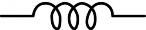 |
(1) capacitor |
(B)  |
(2) resistor |
(C)  |
(3) inductor |
Check Part A Answer
Answer: inductor
Check Part B Answer
Answer: resistor
Check Part C Answer
Answer: capacitor
4. Two lab groups each build an RC circuit with identical capacitors. Group 1 connects Resistor 1 in series with the capacitor. Group 2 does the same thing, but they use Resistor 2. Both groups use a voltmeter to measure the potential difference across the capacitor as a function of time. The graph below shows each group’s data.
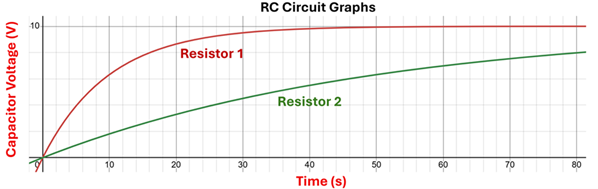
If Group 1 used a 125 Ω resistor, what is the most likely value of Group 2’s resistor?
(A) 25 Ω
(B) 125 Ω
(C) 625 Ω
Check Answer
Answer: c
The voltage across the capacitor for Group 2 takes longer to reach the voltage of the 10 V power supply. This occurs when the resistance of their resistor is greater than that of Group 1.
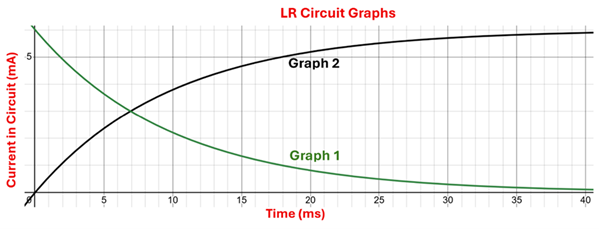
5. Another lab group built the two circuits shown (A and B). They collected current vs. time data for each but forgot which graph corresponds with which circuit. Help them out by identifying which graph goes with each circuit.
Check Part A Answer
Answer: Graph 2
This is the “rising current” situation since the switch connects the battery to the LR circuit.
Check Part B Answer
Answer: Graph 1
This is the “falling current” situation since the switch no longer connects the battery to the RL circuit.
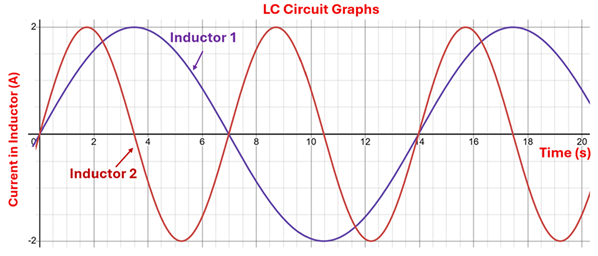
6. Electrical engineers build an LC circuit and measure the current through Inductor 1 as a function of time. The graph below shows their data. They then replace the inductor with Inductor 2 and collect additional data (labeled Inductor 2).
Does Inductor 2 have a larger self-inductance or a smaller self-inductance when compared to Inductor 1? How do you know?
Check Answer
Answer: smaller, current changes more frequently
The greater the inductance the more time it will take to change the current. Since the current in Inductor 2 oscillates more frequently, it must have a smaller self-inductance.
Figure 1 Picture borrowed from Wikimedia Commons https://commons.wikimedia.org/wiki/File:Electronic_Axial_Lead_Resistors_47kOhm.jpg
Figure 2 Picture borrowed from Wikimedia Commons https://commons.wikimedia.org/wiki/File:S.I.-capacitor-20150807-003.jpg
Figure 3 Picture borrowed from Wikimedia Commons (From MetaNest) https://commons.wikimedia.org/wiki/File:Small_solenoid.jpg under license Creative Commons