Mutual Inductance
Our study of electromagnetic induction in this chapter has revolved around Faraday’s Law and applications of this fundamental concept. We’ve learned that a changing magnetic flux through a loop of wire induces a current in that wire. We’ve seen that one way to produce a changing flux through a loop of wire is to have a changing current in a nearby wire that is not even electrically connected to this loop. The transformer that we explored in the previous lesson is an example of how a changing current in a primary loop can create a changing current in a nearby but separate secondary loop. How ‘effective’ the changing current in one loop is at creating an emf in another loop is measured with a concept called mutual inductance. Before we tackle the concept of mutual inductance, however, let’s do a brief review of the conditions necessary to induce current in the secondary loop.
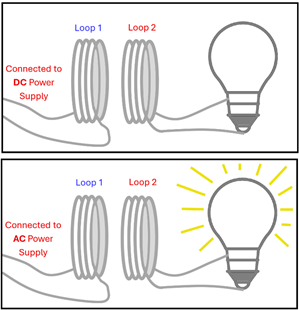
Imagine two coils—loop 1 and loop 2—that are parallel to each other as shown in the top picture. We’ll connect loop 2 to a light bulb and loop 1 to a DC power supply (such as a battery). Loop 1 has current in this wire which in turn creates a magnetic field around this loop. In fact, if loop 1 and loop 2 are adjacent, some of the magnetic field line from loop 1 will even pass through loop 2 creating a magnetic flux. Despite all this, the light bulb doesn’t light. No current is induced in loop 2 since the flux through it is not changing.
Now imagine the same scenario with one difference—loop 1 is connected to an AC power supply. This is illustrated in the bottom picture. Because the current in loop 1 is changing, the changing magnetic field it produces will give rise to a changing magnetic flux through loop 2. This changing flux gives rise to an induced emf in loop 2. This time current is induced in loop 2 which is responsible for lighting the bulb.
Since Faraday’s Law states that the bigger the rate of change of flux the greater the induced emf, it seems reasonable to say that the induced emf in loop 2, ε2, is proportional to the rate of change of current (∆I1 / ∆t) in loop 1. We’ll define the constant of proportionality, M, as the mutual inductance.
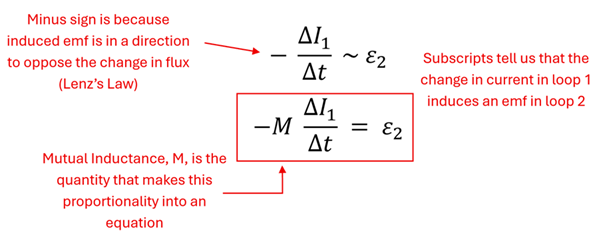
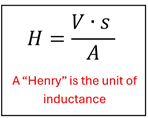
Since the rate of change of current is typically measured in Amps/sec and the induced emf is in Volts, mutual inductance is measured in units of Volts · sec / Amp. This is called a Henry, named after Joseph Henry, a contemporary of Faraday who is also credited with the discovery of electromagnetic induction.
What does M depend on? As we might suspect, the mutual inductance between the two loops depends on their geometric properties (windings in each loop, cross-sectional areas, distance between them, their relative orientation) and the medium surrounding them. It is the mutual inductance that helps us quantify how effective the changing current in loop 1 is at creating an emf in loop 2. Let’s consider a couple examples to better understand just how these factors contribute to the mutual inductance for a pair of loops.
Example 1: Finding Mutual Inductance
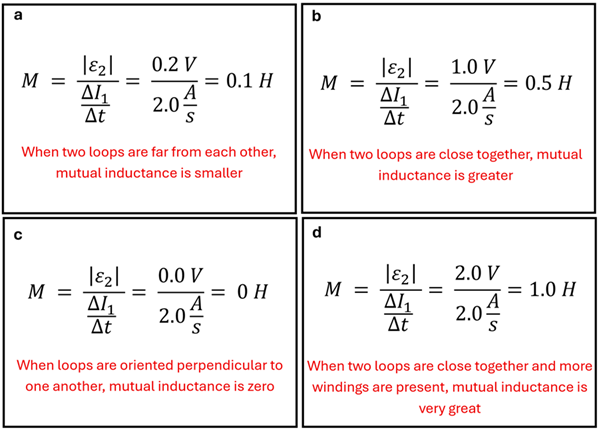
Problem: Two loops are positioned in four different orientations as shown below. In each case, the magnitude of the rate of change of current in loop 1 is 2.0 A/sec. The magnitude of the induced emf in loop 2 is given for each situation. Rank these loop orientations in terms of their mutual inductance (from lowest to highest).
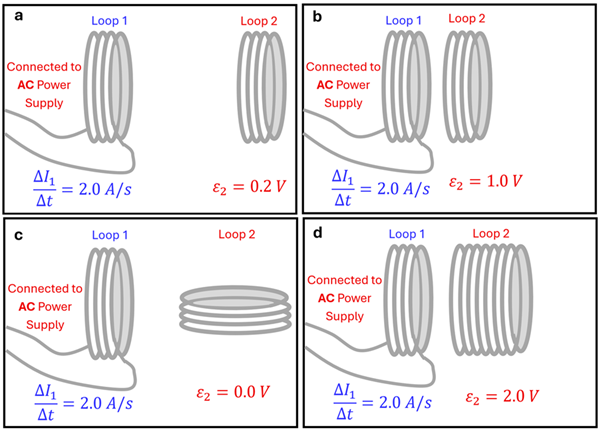
Solution: Ranking the mutual inductance from smallest to greatest we have c, a, b, d. We might conclude that aligning loops parallel, bringing them close together, and having more loops are all things that increase the mutual inductance of a pair of loops.
Example 2: Mutual Inductance at its Core
Problem: Consider three cases in which two loops are next to each other. Cases ‘a’ and ‘c’ have an iron core around which the wire loops are wrapped (with c having a larger core). The loops are not connected to a power supply in any of these cases. Rank these from lowest to highest mutual inductance.
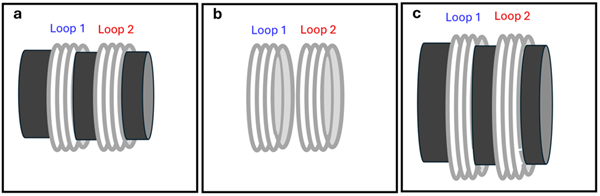
Solution: Ranking their mutual inductance from lowest to highest we have b, a, c. Adding an iron core in ‘a’ greatly increases the mutual inductance compared to ‘b’ where there is only air between the loops. In case ‘c’, since an iron core is present and the cross-sectional area of loops is greater than in both case ‘a’ and case ‘b’, the mutual inductance will be greater still.
It’s important to note that mutual inductance depends on geometric properties and what material surrounds the loops not that they are connected (or are not connected) to a power supply. In other words, the mutual inductance for a pair of loops is the same whether or not there is current in the loops.
What is also important about mutual inductance is that each loop affects the other. An alternating current in loop 1 induces an alternating current in loop 2; but this alternating current in loop 2 in turn affects the current in loop 1 that created it in the first place. According to Lenz’s Law, this feedback mechanism always tends toward status quo. Said another way, the induced current in loop 2 will in turn create an induced emf back in loop 1 that works to prevent it from changing its current anymore.
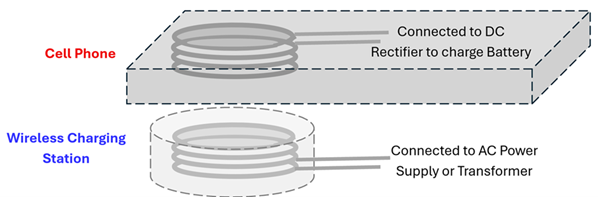
While all this theory might be interesting, does such a concept have any practical significance? If you’ve ever used wireless charging you’ve encountered this phenomenon. Consider loop 1, for example, as our wireless charging station which has alternating current cycling through this loop. Inside a cell phone (or whatever device is being charged wirelessly) is loop 2. The two loops are not electrically connected yet loop 1 induces a current in loop 2. (Since alternating current will be induced in loop 2, electrical engineers install a DC rectifier so it can charge the phone’s DC battery.) Ever notice how the two coils must be close to each other and aligned parallel in order for the charging to take place? You’ve done so to maximum the mutual inductance—perhaps without even knowing it!
Self-Inductance
In our study of mutual inductance above, we’ve seen how certain geometric factors impact the effectiveness of a changing current in loop 1 to induce a current in loop 2. We measured this effectiveness with M, the mutual inductance. But not only does a changing current in loop 1 affect loop 2, it affects itself! In other words, a changing current through a single coil of wire creates its own emf that seeks to oppose its own change in current. The ‘effectiveness’ of a single loop of wire to induce an emf to oppose this change is called self-inductance.
Let’s consider a single loop of wire with several windings—a solenoid. Imagine that we connect the two ends of this loop to a power supply that produces a constant current. In this case, the solenoid acts simply like a wire (because that is what it is!) Now suppose, however, we continuously turn up the voltage on the power supply so that the current through the solenoid is constantly increasing. The solenoid’s self-inductance will create a ‘back emf’ to try to cancel the increase in current. The solenoid acts like a battery in reserve as it tries to maintain the ‘status quo’ current. That is, the solenoid creates an emf that opposes the increasing current as it works to cancel this increasing flux created through the solenoid. Likewise, if we continuously turn down the voltage on the power supply so that the current is constantly decreasing, the solenoid’s self-inductance will create a ‘forward emf’ so that it acts like a battery in the same direction as the current. This emf opposes the decrease as it works to add to the decreasing flux through the solenoid in an effort to again maintain status quo.
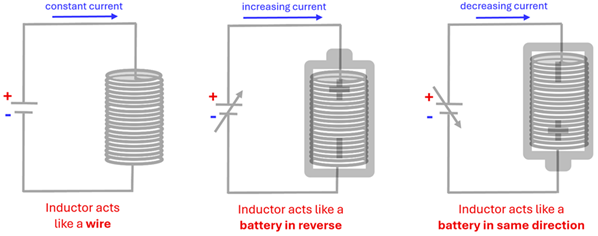
What self-inductance measures is how good that solenoid is at maintaining the existing current by creating a ‘back emf’ or ‘forward emf’ across the solenoid. Since a greater rate of change of current will induce a larger emf, we can mathematically describe self-inductance, L, in a similar manner to how we described mutual inductance:

Like mutual inductance, self-inductance is measured in units of Henry (H). It is also similar in that it depends on only geometric properties of the loop itself and what material is in its core. Any shaped loop of wire will have self-inductive properties and thus such loop is called an inductor. And while inductors can come in different shapes and sizes, the most common inductors are solenoids. In fact, the schematic symbol for an inductor is drawn as a solenoid.
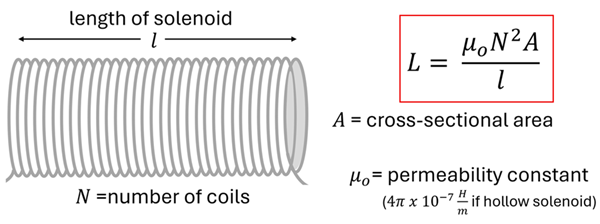
Since the solenoid is the most common shaped inductor, let’s focus our attention on how we would find the self-inductance of this particular inductor. The inductance of a solenoid can be calculated from these geometric properties:
Example 3: Direction of Induced EMF
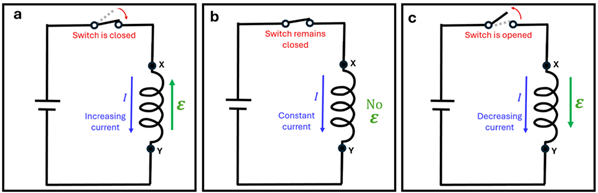
Problem: A battery and inductor form a circuit with a switch. The three situations shown below represent three moments in time: (a) the moment the switch is closed, (b) some time after the switch has been closed, and (c) the moment the switch is opened.
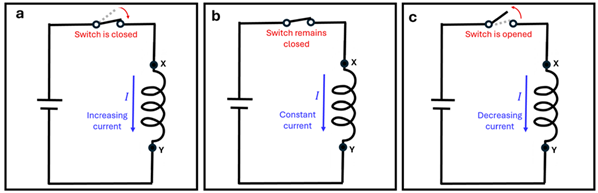
For each situation, describe the direction of the induced emf across the inductor. That is, does the induced emf point X to Y, Y to X, or is there no induced emf?
Solution: (a) Since the current is increasing, the induced emf across the inductor points to oppose the increase in current. The inductor will set-up a ‘back emf’ such that its emf points from Y to X. (b) Here there is no change in current, so the inductor acts just like a wire with no induced emf across it. (c) When the current is decreasing, the induced emf across the inductor will point in the direction of the current to try to maintain a status quo current. That is, the inductor will set up a ‘forward emf’ that points from X to Y.
Example 4: Self-Inductance of a Solenoid
Problem: A hollow solenoid with a radius of 1.0 cm and length 12.0 cm is made of 20 windings.
(A) What is the self-inductance of this solenoid?
(B) If an iron rod were inserted down the core of this solenoid, how would this affect the self-inductance of this inductor?
Solution: (a) Using the self-inductance equation for a solenoid, we find the inductance to be 1.3 µH (0.000013 H). Since this solenoid is only made of 20 windings, it has a relatively small inductance.

(b) Inserting an iron rod into a solenoid significantly increases its inductance. This is because iron has high magnetic permeability (we would replace μo in the above equation with μ for iron). This allows the magnetic field to be greatly increased when current passes through it. We’ve already seen that this effect is crucial for devices like transformers and electromagnets.
Because motors are made with many windings that freely spin in a magnetic field, you may have experienced the effects of self-inductance while using a device that has an electric motor in it. When coasting or braking on an electric scooter or e-bike, the wheels continue to spin the motor, generating a back emf. This same principle is used in the regenerative braking system of hybrid and electric cars to recharge the battery. When switching on a vacuum cleaner or blender, you may have noticed that lights on that same circuit dim momentarily. This is because a back emf is created in the circuit dropping the voltage throughout the circuit. When you start a car, the starter motor initially draws a very large current. As the motor speeds up, it generates more back emf which reduces the voltage across the motor and limits the current. This is part of how the motor self-regulates as it speeds up.
Self-inductance and mutual inductance are ways of measuring how effective a loop or pair of loops is in generating an emf that works to oppose a changing current. From explaining wireless charging to understanding how regenerative braking works, this concept of inductance shows up all over the place as we work to make sense of the world around us.
Check Your Understanding
Use the following questions to assess your understanding. Tap the Check Answer buttons when ready.
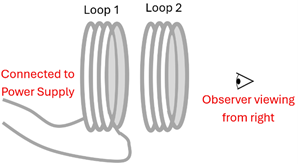
1. Two coils have a mutual inductance of 55 mH. When a power supply is turned on, the current Coil 1 grows from 0 to 3.0 A in 0.025 sec and points in the clockwise direction when viewed from the right.
(A) During this interval, what is the magnitude of the emf induced in the second coil?
(B) What is the direction of the induced emf (and thus the current) in the second coil?
Check Part A Answer
Answer: 6.6 V

Check Part B Answer
Answer: counterclockwise
By
Lenz's Law, the induced emf in loop 2 will be in a direction such that the magnetic field it creates will oppose the change in flux.
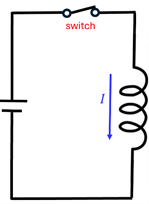
2. A 2.2 mH inductor carries a current of 0.48 A. When the switch in the circuit is opened, the current essentially drops to zero in 10.0 ms. During this interval, what is the average induced emf?
Check Answer
Answer: 0.11 V

3. A solenoid of radius 2.5 cm has 31 windings and a length of 25.0 cm.
(A) Find the self-inductance of the solenoid.
(B) At what rate (magnitude only) must the current change in order to product an emf of 70.0 µV (micro-volts)?

Check Part A Answer
Answer: 9.5 µH

Check Part B Answer
Answer: 7.4 A/s

4. A current is carried by a uniformly wound hollow solenoid with 490 windings, a 5.2 cm diameter, and a length of 12.8 cm.
(A) Compute the self-inductance of the solenoid.
(B) Which quantities depend on the current/change in current? (Select all that apply)
a. the magnetic field inside the solenoid
b. the magnetic flux through the solenoid.
c. the inductane of the solenoid.
Check Part A Answer
Answer: 5.0 mH

Check Part B Answer
Answer: a, b
It is important to note that self-inductance depends only on geometric properties of the solenoid. In other words, this solenoid has an inductance of 5.0 mH whether or not there is current passing through it.
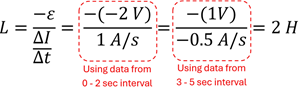
5. An inductor is connected to a variable power supply. In the image below, the top graph shows how the current in the inductor changes with time. The bottom graph shows the emf created by inductor as a function of time. (A negative emf represents a ‘back emf’ that opposes an increasing current; a positive emf represents a ‘forward emf’ that seeks to add to a decreasing current.) What is the self-inductance of this inductor?

Check Answer
Answer: 2 H
Looking for additional practice? Check out the CalcPad for additional practice problems.
Figure 1 borrowed from Wikimedia Commons (From 1840365varshithN) https://commons.wikimedia.org/wiki/File:Inductor_Symbols.jpg under license Creative Commons
Figure 2 borrowed from Wikimedia Commons https://commons.wikimedia.org/wiki/File:Solenoid,_air_core,_insulated,_20_turns,_rotated.svg