Fluid Dynamics in Action
Our study of the equation of continuity and Bernoulli's principle earlier in this lesson has allowed us to explore two fundamental concepts that predict how fluids move. The reality that fluid speed increases as a pipe narrow (equation of continuity) and the fact that pressure decreases as the speed of a fluid increases (Bernoulli’s principle) are not just theorical ideas, they are everyday experiences.
Throughout this chapter, we’ve seen the importance of understanding pressure. Since force is pressure acting over an area (force = pressure • area), whenever we encounter a situation where the pressure on one side of a system is different from that on the other side, we observe a net force acting on the system. Fluid dynamics is the study of such pressure differences resulting in a net force on a system.
In this final section of this chapter, we are going to explore several seemingly unrelated applications of fluid dynamics. As you do, however, you’ll find some common threads. And while all of these relate to the equation of continuity and Bernoulli’s principle, none of them can really be fully grasped without an understanding of all we’ve learned over the course of this chapter. Let’s apply so much of what we’ve learned to uncover the physics behind five common applications of fluid dynamics:
- Severe Weather and High Winds
- Perfume Bottles and Paint Sprayers
- Airplane Lift and Indy Cars
- Throwing a Curveball
- Passing Trucks on the Highway
1. Severe Weather and High Winds
Our investigations in this lesson have allowed us to understand the equation of continuity. It was here that we learned that as a fluid flows from a wider pipe to a narrower one the speed of the fluid must increase in order to maintain a constant flow rate. We used streamlines to illustrate this flow and saw that densely packed lines do not mean that the density of the fluid has changed, but rather that the speed of the fluid has increased. Bernoulli's principle added to our understanding that a faster moving fluid means a lower fluid pressure.
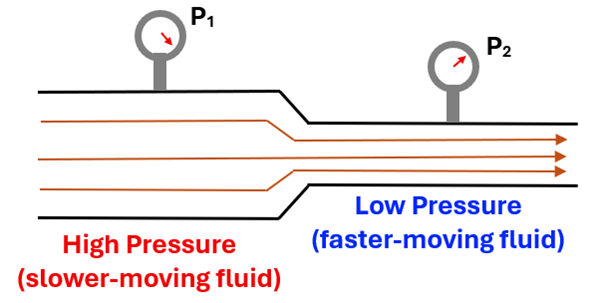
With these ideas fresh in our minds, let’s consider high winds (air is a fluid, right?) passing over the peaked roof of a home. We already know that fast moving winds must have densely packed streamlines. Notice, however, that the constricting of the lines is accentuated as the shape of the roof narrows the area in which the wind can travel. The result of these packed streamlines is still faster-moving air. From Bernoulli’s principle, the result of faster-moving air is reduced pressure.
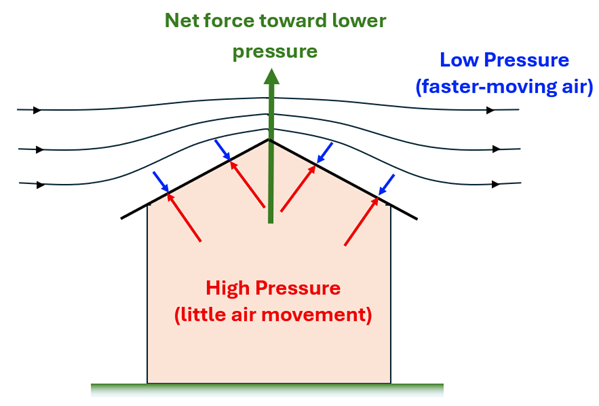
We learned back in Lesson 2 that normal atmospheric pressure is the result of air pushing on all sides of objects. At sea level, this is approximately 14.7 pounds of force on every square inch. While this translates to a huge force when applied over a sizeable area, we don’t feel its effects because, since air typically pushes from all sides, the net force is zero (or very close to it). Imagine, however, that while this is the air pressure inside a house, the air pressure above the roof is significantly reduced due to the fast-moving wind and the shape of the roof. Can you see why the roof of a home can actually be blown off in severe weather? When something horribly catastrophic like this occurs, it’s the air inside the home that pushes the roof upward!
2. Perfume Bottles and Paint Sprayers
Next, let’s consider a perfume bottle or paint sprayer. A liquid (perfume or paint) is held in a container with a vertical tube extending out of the liquid. When fast-moving air is squirted over the top of the vertical tube, the pressure above and inside the tube is reduced. Since the air inside the container is still at normal atmospheric pressure (which is higher than that of the fast-moving air at the top of the tube), the liquid is pushed up the tube and sprayed as a fine mist. Here again, we see Bernoulli’s principle in action!
3. Airplane Lift and Indy Cars
An investigation of Bernoulli’s principle will often lead to exploring the lift force experienced by airplanes. In our study of physics in previous chapters, we encountered forces such as the force of gravity on a plane, the applied force of thrust due to Newton’s third law as the propeller blades push against the air, and the force of air drag that points opposite the direction of motion. But where does this force of lift come from that allows a plane to fly?
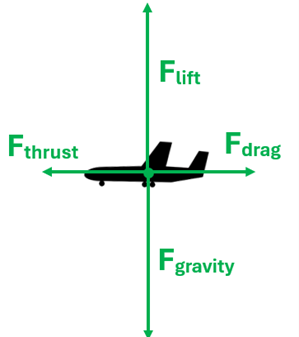
The key the understanding this force comes in understanding why wings have the shape and angle of attack that they do. Let’s consider an airplane flying toward the left side of this page. In the reference frame of the plane, the air would be zipping past it in the rightward direction. As the air approaches the airplane wing, some of the air travels above the wing and some below. Because of the tilt and curvature of the wing, however, the streamlines are constricted and more densely packed above the wing than below it. This is what we saw happening to the roof of the house above during a windstorm. The result is that the air moves faster over the wing compared to under the wing resulting in a lower pressure above and a higher pressure below. The outcome is a lift force. It’s the relatively higher air pressure below the wing that pushes the wing upward. This is what allows an airplane to fly!
The opposite effect is true for Indy cars. As Indy cars take turns at very high speeds, maximizing the static friction force between the road and the tires is essential. You may recall that the maximum frictional force is equal to the coefficient of friction times the normal force (Ffrict = μ • Fnorm). Typically, the normal force is equal to the weight of the car. If an additional down force could push the car into the road, however, the normal force would get bigger. This would allow the maximum frictional force to increase so that the car can take the corner even faster.
Indy cars take advantage of this by using air flow around the body of the car to create a down force. The body of the car is designed somewhat like an upside-down airplane wing. Adjustable wings at the front and rear also help provide additional down force.
4. Throwing a Curveball
Baseball pitchers take advantage of fluid dynamics as well. Let’s imagine a ball thrown to the left of this page without any spin. In the reference frame of the ball, the air would be moving rightward around the ball. Now let’s imagine the pitcher throwing the ball to the left but putting a spin on it so that it rotates clockwise as shown below. Friction between the ball (and particularly the threads of the ball) and the air help drag a thin layer of air around the spinning ball. The result is that the streamlines are compressed near the top of the ball where the spinning ball causes the air to move even faster than the linear speed of the ball itself. On the bottom side of the ball, friction slows the air as it passes along the ball’s underside. The result of the faster moving air above and the slower-moving air below creates a pressure difference. Like the airplane wing we encounter above, this pressure difference creates a lift force which causes the ball to rise. While this is one type of pitch that pitchers throw, they often spin the ball around a vertical axis (rather than the horizontal axis illustrated here), which causes the ball to curve left or right.
5. Passing Trucks
If you’ve ever decided to pass a large truck on the highway, you may have felt your car pulled toward the truck. This, too, is the result of constricted air moving faster and thus lowering the pressure. Consider, for example, the top view of a car passing a truck:
Notice that as air passes between the vehicles it is constricted. From the equation of continuity, we know that a constricted fluid must increase in speed in order to maintain flow rate. We know from Bernoulli's principle that an increased fluid speed means a decrease in pressure. Since the pressure between the vehicles (Pi) is less than the pressure on the far side of each vehicle (Po), the truck and car are pushed toward each other. Once again, we see the power of understanding how fluids behave to explain everyday phenomena!
There you have it. We’ve investigated five seemingly unrelated applications of fluid dynamics. We see the same concepts—the equation of continuity and Bernoulli’s principle—used to explain each of these.
Throughout this chapter on fluids, we’ve encountered the concepts of fluid density and pressure. We understood where a buoyant force comes from and how that relates to Archimedes’ Principle and Pascal’s Principle. In this lesson, we’ve explored the equation of continuity and Bernoulli’s principle. As you have grown in your understanding of how fluids behave, you’ve expanded your ability to explain how the world around you works. That’s the fun of understanding physics. That’s the joy of uncovering how a few fundamental laws can help us explain so much. Now, go out and find things in your everyday life that you can explain with all you’ve learned. Who knows, maybe you’ll even discover new applications of these principles. No ‘pressure,’ though!
Check Your Understanding
Use the following questions to assess your understanding. Tap the Check Answer buttons when ready.
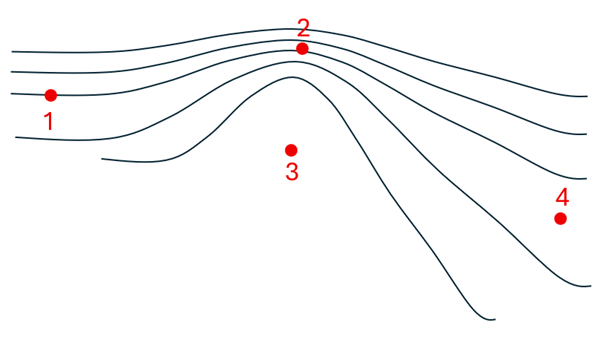
1. Below is an image of streamlines showing fluid flow. At what point in the image is the fluid moving the fastest?
Check Answer
Answer: 2
Where the streamlines are closest together, the speed of the fluid is the fastest.
2. As a fluid is forced to move from a wider area to a more narrow one, its speed ______(A)______ (increases, decreases) according to _____(B)______ (the equation of continuity, Bernoulli’s principle). This result is that the pressure in this region ____(C)_____ (increasing, decreasing) as a because of ______(D)_______ (the equation of continuity, Bernoulli’s principle).
Check Part A Answer
Answer: increases
Check Part B Answer
Answer: equation of continuity
Check Part C Answer
Answer: decreases
Check Part D Answer
Answer: Bernoulli’s principle
3. A windy day makes waves on the surface of a lake. As the wind continues to blow, the wave get higher and higher. How does Bernoulli’s principle help us explain why this is so?
See Answer
Answer:
As the wind travels across the crests (tops of wave), the air is constricted and the pressure above the wave tops decreases. Since the troughs (bottoms of wave) are somewhat protected from the wind, the air pressure above them is more or less maintained. Thus, the water is pulled up higher into the crests.
4. You may have experienced a large semi-truck passing you on the highway and you noticed that your car feels pulled toward the truck.
(A) How does the speed of the air between your car and the truck compare to the speed of the air on the other side of your car?
(B) Why does this make your car feel pulled toward the truck?
Check Part A Answer
Answer: It is greater
As the air is constricted between the two vehicles, the air between the truck and your car is traveling faster (relative to your car) than the air on the far side of your car.
Check Part B Answer
Answer: Lower air pressure between truck and car
The result of this fast-moving air between the truck and your car is a lower air pressure. Since the air pressure on the far side of your car is greater, your car is pushed by the air on the far side of your car, and you feel ‘pushed’ toward the truck.
5. On very warm days at high elevations, weather conditions at the airport can give rise to unusually low air density. What effect does such a condition have on a plane’s ability to take off?
Check Answer
Answer:
Unusually low air density at high elevations on hot days significantly degrades a plane's takeoff ability because as the density of air decreases, the pressure decreases as well. It’s possible that the lift force will not be large enough to safely allow planes to take off. Planes will be grounded until the weather conditions change.
Figure 1 Modified from Wikimedia Commons (From Mcapdevila) https://commons.wikimedia.org/wiki/File:Atomizer_schema-w2.jpg under license GNU
Figure 2 Modified from Wikimedia Commons https://commons.wikimedia.org/wiki/File:ISO_7001_PI_TF_016.svg
Figure 3 Image generated using some MS Word Iconography (Car).
Figure 4 Modified from Wikimedia Commons https://commons.wikimedia.org/wiki/File:Baseball.svg
Figure 5 Modified from Flowpedia (From Joceil.infante) http://flowpedia.com/index.php?title=File:Bernoulli%27s_Equation_Fig1.jpeg under license Creative Commons
Figure 6 Borrowed from Wikimedia Commons https://commons.wikimedia.org/wiki/File:8766South_Luzon_Expressway_Metro_Manila_Skyway_36.jpg
Figure 7 Borrowed from Wikimedia Commons (From Downtowngal) https://commons.wikimedia.org/wiki/File:Plane_on_runway_at_Denver_International_Airport.jpg under license Creative Commons