Another Thing Conserved
A figure skater pulls her arms inward and spins faster. An Olympic gymnast tucks in order to rotate quickly to stick his landing. A comet travels fastest in its orbit when it is closest to the sun. But why? We can explain these phenomena in terms of another important conservation law—the conservation of angular momentum.
In the previous section, we learned about the rotational counterpart to momentum—angular momentum. The reason we are so interested in an object’s angular momentum is that...
In the absence of an external torque,
the angular momentum of a system stays constant.
This is the law of conservation of angular momentum.
In Lesson 3, we introduced open and closed systems in the context of energy. A closed system is one in which the energy within a system stays constant. That is, it is conserved. An open system is one in which the energy within the system changes as work from an external force is done on the system. The same is true for angular momentum. In a closed system, the angular momentum stays constant. In an open system, the angular momentum can change. We saw in the previous section that the way we change the angular momentum of an object is by delivering an angular impulse to the system from a torque outside of the system. There may be torques exerted on one object inside the system by another object inside the system, but since these are internal impulses, they cannot change the angular momentum of the system.
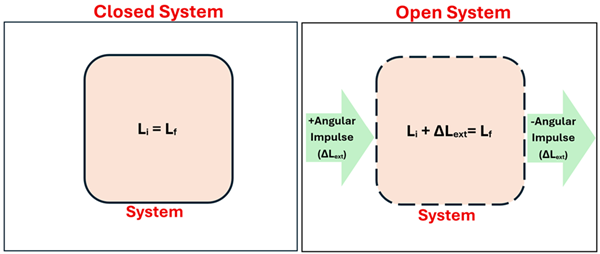
It is the closed system that we are most interested in here as we study the conservation of angular momentum.
We saw in the previous section that the angular momentum of a rotating object is equal to its moment of inertia times its angular velocity. In other words, L = I ω. In a closed system, since the angular momentum must be conserved, if the moment of inertia of the object changes, the angular velocity will adjust accordingly in order to conserve angular momentum. Mathematically, we can write:

If you’re thinking, "What does this mean in real life?" then you’ll probably find the next three examples helpful in understanding how this conservation of angular momentum equation can be applied to real situations.
Example 1: Spinning Chair
Problem: Whether or not you are a figure skater or a gymnast, you have probably sat in a chair that spins. Imagine you’re sitting in this slowly spinning chair with weights in your outstretched hands. You now bring your arms inward toward your body. Like the figure skater or gymnast, your angular velocity increases significantly. How come?
Solution: Let’s consider you, the chair, and the weights as our system. Provided there is no external torque acting on the system, angular momentum must be conserved. When the weights are in your outstretched arms, you have a very large moment of inertia. As you bring the weights in close to your body, however, your moment of inertia decreases significantly. Since L = I ω, the only way to conserve angular momentum when the moment of inertia decreases is to have the angular velocity, ω, increase!
Example 2: Conserved or Not Conserved
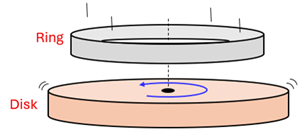
Problem: A disk (ICM = 2 kg·m2) is rotating with an angular velocity of 6 rad/s about an axis through its center. A ring (ICM = 1 kg·m2) is dropped on the disk so that their centers are aligned.
(A) Is angular momentum conserved in this situation?
(B) What is the final angular velocity of the disk-ring system?
Solution:
(A) If we define the system as both the disk and the ring, then the impulse that the ring exerts on the disk (which will slow it down) and the impulse that the disk exerts on the ring (which will speed it up) are both internal impulses. Provided there are no external impulses, the angular momentum of this system must be conserved.
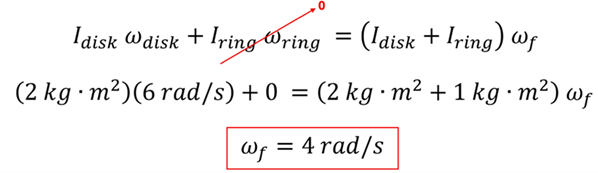
(B) As a result, we can apply the conservation of angular momentum relationship to find that the final angular velocity of the disk-ring system together is 4 rad/s.
Example 3: The Spinning Wheel
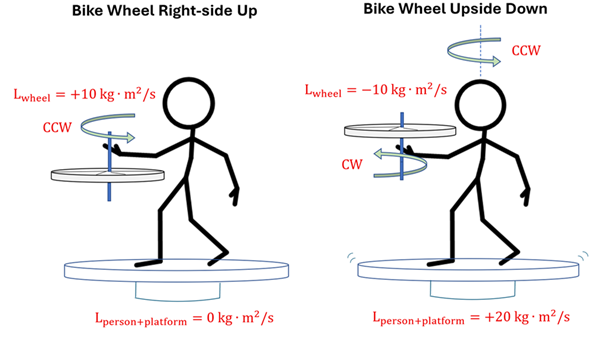
Problem: A person stands on a rotatable platform holding a bicycle wheel that is spinning counterclockwise with an angular momentum of Lwheel = +10 kg·m2/s. He quickly inverts the spinning wheel so that it is now spinning clockwise. Upon doing so, the person and platform start rotating. Explain why this is the case?
Solution: Let’s consider the bicycle wheel, the person, and the platform as our system. We’ll say that CCW is the positive direction of rotation. While an angular impulse was exerted on the wheel to invert it (thus changing its angular momentum from +10 kg·m2/s to -10 kg·m2/s), this impulse was provided by another part of the system. Thus, the angular momentum of the system must remain unchanged. As a result, the wheel exerts a counter-torque on the person (thus changing his angular momentum from 0 kg·m2/s to +20 kg·m2/s), which causes the person and platform to rotate counterclockwise.
In the previous section, we introduced two equations for finding the angular momentum of an object with respect to an axis of rotation. So far, our examples in this section have used L = I · ω rather than L = r p sin θ. How might we demonstrate conservation with this second equation? Satellite motion and a child jumping on a merry-go-round to get it rotating are two great examples to illustrate how our second equation is used in conservation of momentum scenarios. Let’s go there next.
Satellite Motion
All satellites that orbit the Earth (or any central mass) follow an elliptical orbit. As the satellite orbits, not only does its distance from the Earth vary, but its speed varies as well. What is fascinating is that we can exactly predict the satellite’s speed at any point using conservation of angular momentum. It is here, however, that we’ll use our second equation for angular momentum, L = r p sin θ. Let’s consider two points in the satellite’s orbit (below).
Point A is the location where the satellite is closest to the Earth in its orbit. Point B is where the satellite is furthest from Earth. If we assume no external torque acts on the satellite, we can write...
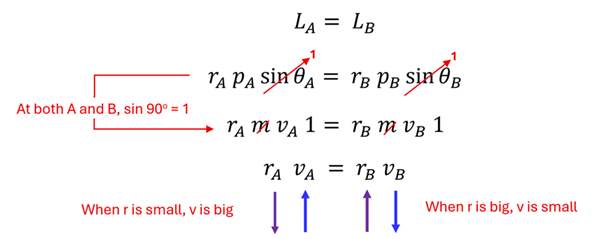
If there is no external torque acting on the satellite, the angular momentum is constant throughout its orbit. As a result, the speed decreases as the satellite moves from A to B and increases from B to A.
Example 4: An Orbiting Comet
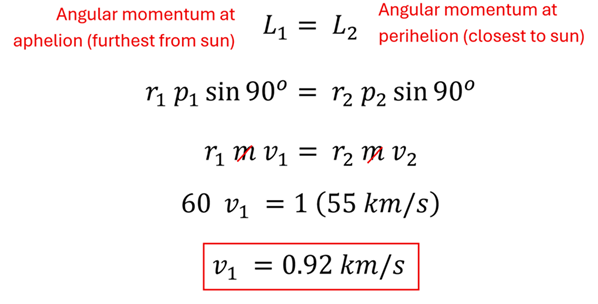
Problem: Halley’s comet orbits the sun in a very elliptical orbit. It takes 76 years to complete one trip around the sun. At aphelion (furthest from the sun), the comet is nearly 60 times further from the sun than at perihelion (closest to sun). At perihelion, it travels about 55 km/s relative to the sun. How fast is Halley’s comet traveling at aphelion?
Solution: Our first step is to recognize that the comet’s angular momentum is conserved throughout its orbit. Setting the angular momentum at aphelion (position 1) equal to its angular momentum at perihelion (position 2), we are able to find that Halley’s comet is travelling at a leisurely 920 m/s when it is furthest from the sun.
Another Application of Conservation of Angular Momentum
Let’s consider another situation where we can use conservation of angular momentum to make sense of the motion of rotating objects. In the previous section, we discussed that an object traveling in a straight line can have angular momentum with respect to an axis of rotation. While finding its angular momentum might have made sense mathematically, it may have seemed like merely a plug-and-chug exercise to find the angular momentum of an object traveling in a straight line. There is a very practical application, however.
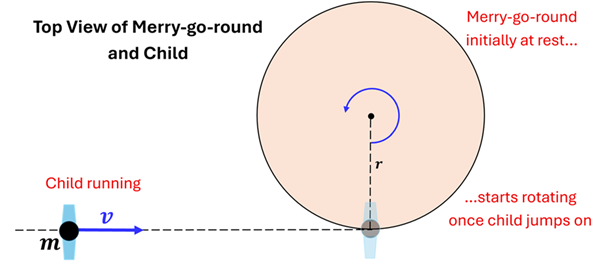
Consider a merry-go-round that is initially at rest, and a child comes running to jump on it. If we consider the merry-go-round and the child as our system, is angular momentum conserved in this "collision"? The answer is "yes." Here is a case where we have an object (the child) moving in a straight line with angular momentum with respect to an axis of rotation (the center of the merry-go-round). When the child jumps on the merry-go-round, the merry-go-round and the child rotate about the merry-go-round’s axis with the same angular momentum that the child had initially. It is true that the child imparted an angular impulse to the merry-go-round when she grabbed hold; it is equally true that the merry-go-round imparted this same angular impulse to the child in the opposite direction. Since these are internal impulses, they do not change the angular momentum of the system. Thus, angular momentum is conserved, and we can use this to help us analyze the situation. Let’s take a deeper look at this situation in the example below.
Example 5: Merry Go Round
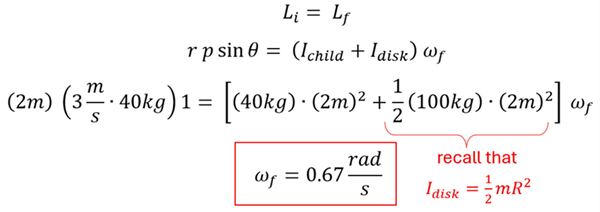
Problem: A 40 kg child running at 3 m/s jumps on a 100 kg merry-go-round that has a radius of 2 m. The merry-go-round can be approximated as a uniform disk. What is the magnitude of the angular velocity of the child and the merry-go-round once the child has jumped on?
Solution: Let’s consider our system as both the child and the merry-go-round. The child has angular momentum with respect to the axis of the merry-go-round. By conservation of momentum, this value must equal the angular momentum of the child and disk as they rotate together after the child jumps on the merry-go-round. We will find it convenient to use our second equation for angular momentum (L = r p sin θ) to represent the initial value. In the end, since both rotate about a common axis, we’ll find it most convenient to use the first equation for angular momentum (L = I ω). The child will act like as ring in its Center of Momentum calculation. Setting these equal, we find the magnitude of the angular velocity to be 0.67 rad/s.
We’ve seen that conservation of angular momentum is a powerful tool in explaining so many situations that involve rotation. Now it’s your turn to see if you can apply these ideas to the questions below.
Check Your Understanding
Use the following questions to assess your understanding. Tap the Check Answer buttons when ready.
1: A high diver is rotating once per second when he tucks (pulls his arms and legs inward) to increase his rotation to three times per second.
(A) Did his moment of inertia increase or decrease in this process?
(B) By how much did his moment of inertia change?
Check Part A Answer
Answer: decrease
By conservation of momentum, as the diver decreases his moment of inertia, his angular velocity increases according to Ii ωi = If ωf.
Check Part B Answer
Answer: 1/3 of its original value
If angular velocity triples, then the moment of inertia must be 1/3 its original value in order to conserve angular momentum.
2: A figure skater spins with an angular velocity of 4.0 rad/s and has a moment of inertia of 2.0 kg·m² when her arms and legs are extended. When she brings her arms and legs inward, she can reduce her momentum of inertia to 0.4 kg·m². What angular velocity does she spin with now?
Check Answer
Answer: 20 rad/s
Since Ii ωi = If ωf, (2.0 kg·m²)·(4.0 rad/s) = (0.4 kg·m²)· ωf. Solving for ωf, we find ωf = 20 rad/s.
3: As Halley’s comet orbits the sun, its speed relative to the sun changes. Where in its orbit is it slowing down?
a. when it is closest to the sun
b. when it is furthest from the sun
c. when it is approaching the sun
d. when it is moving away from the sun
Check Answer
Answer: d
As the comet gets further from the sun, r increases so v must decrease in order to conserve angular momentum.
4: When studying Kepler's Laws, we learned how he discovered that satellites sweep out equal areas in equal amounts of time. Two students offer an explanation as to how the conservation of momentum explains this observation. With which student do you agree?
Student 1: The speed of a satellite increases as its distance from the sun increases since the moment of inertia varies directly with angular velocity.
Student 2: When a satellite is closer to the sun, it has a smaller moment of inertia and thus it must have a larger angular velocity, so it is traveling faster.
Check Answer
Answer: Student 2
In order to conserve angular momentum, a satellite's moment of inertia varies inversely with its angular velocity. As such, it is possible for the satellites to sweep out equal areas in equal amounts of time.
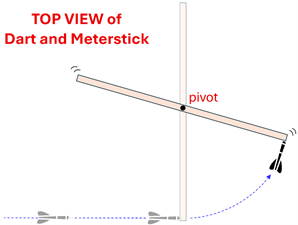
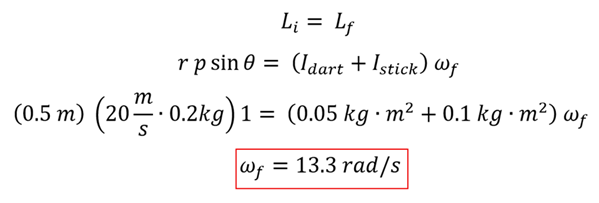
5: A toy dart (mass = 0.2 kg) is shot at 20 m/s perpendicular to the very end of a meterstick that has been allowed to pivot in a horizontal plane about its center without friction. The meterstick has a moment of inertia is 0.1 kg·m2. If the dart sticks to the end of the meterstick, with what angular velocity does the meterstick-dart system rotate? (Hint: Once it sticks, the moment of inertia of the dart itself will be 0.05 kg·m2 with respect to the pivot).
Check Answer
Answer: 13.3 rad/s
Looking for additional practice? Check out the CalcPad (RD8) for additional practice problems on both this section and the previous section.
Figure 1 Borrowed from Wikimedia Commons (From MikeRun) https://commons.wikimedia.org/wiki/File:Change-in-angluar-speed-due-to-change-in-moment-of-inertia.svg under license Creative Commons
Figure 2 Image generated using some MS Word Iconography.
Figure 3 Borrowed from Wikimedia Commons (From nagualdesign) https://commons.wikimedia.org/wiki/File:Halley%27s_Comet_animation.gif under license Creative Commons