Chapter 18: Electrochemistry - Lesson 1: Redox Reactions
Balancing Redox Reactions
Hold down the T key for 3 seconds to activate the audio accessibility mode, at which point you can click the K key to pause and resume audio. Useful for the Check Your Understanding and See Answers.
The Big Idea
The use of the half-reaction method to balance redox reactions is explained and demonstrated through numerous examples. A Check Your Understanding section provides students with independent practice and a chance to check their work and correct mistakes.
Balancing Redox Reactions
We learned to write balanced chemical equations in Chapter 8 of this Chemistry Tutorial. The method used is sometimes referred to as balancing by inspection. Oxidation-reduction reactions, especially those occurring in aqueous solutions, can be quite complicated. Balancing by inspection is often very difficult. Fortunately, there is a better way.
Redox reactions are usually balanced using the half-reaction method. The approach is to write equations for the two half-reactions - one for the oxidation and one for the reduction. These half-equations are balanced independent of one another by adding coefficients, electrons, and (where needed) H+ or OH- ions and H2O. It is important that the atoms of each element and the charge are balanced for each half-equation. Performing an atom count and a charge count will help to ensure that atoms and charge are balanced.
As an example, the two half-equations below have been balanced using coefficients, electrons, H+ ions, and H2O. An atom count and charge count is shown below each half-equation.
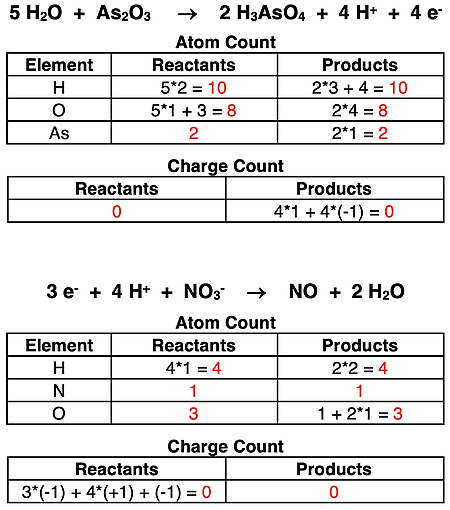
(If necessary, review How to Count Atoms.)
Once the half-equations are balanced, they are added together to form the whole equation for the redox reaction. We describe the details with numerous examples below.
How to Use the Half-Reaction Method
The step-by-step procedure for using the half-reaction method to balance a redox equation is:
Step 1: 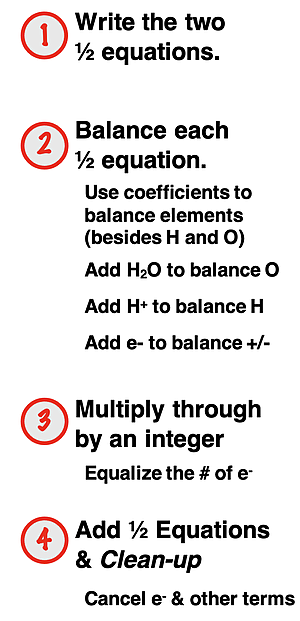 Conduct an oxidation state analysis to determine which reactant is oxidized and which is reduced. Then write separate half-equations for the two half-reactions.
Step 2:
Balance both half-equations independently.
- Use coefficients to balance all elements other than H and O.
- Add enough H2O to balance O.
- Add H+ ions (for acidic solutions) to balance the H.
- Add e- to balance charge.
- Conduct an atom count and a charge count to ensure balance.
Step 3:
Multiply each half-equation by an integer so the number of electrons in each equation is equal. Make sure you multiply every term in the equation by this integer.
Step 4:
Add the two half equations together. Cancel and simplify terms that appear on each side of the reaction symbol. For instance, the electrons should cancel. Some H+ ions and H2O molecules may cancel as well.
The above procedure assumes an acidic solution. There are some additional steps to take for redox reactions occurring in basic solutions. See Example 5.
The examples below illustrate the use of the half-reaction method. The examples become increasingly more complex. Additional practice opportunities can be found in the Check Your Understanding section.
Example 1 - Balancing Redox Reactions using the Half-Reaction Method
Use the half-reaction method to balance the following equation:Solution
Step 1:The two half-equations are:
Reduction: Sn4+ → Sn
Step 2:
Atoms, including H and O are already balanced. Electrons are added to each equation to balance the charge. As we would expect, electrons are on the product side of the oxidation half-reaction and on the reactant side of the reduction half- reaction.
Reduction: 4 e- + Sn4+ → Sn
Step 3:
To equalize the number of electrons on each half-reaction, the oxidation half-equation will be multiplied by 4. Observe how every term in the half-equation is multiplied by 4.
Reduction: 4 e- → Sn
Step 4:
The two half-equations are added together.
Then the redox equation is simplified by canceling like terms (e.g., electrons). The final balanced equation is:
Example 2 - Balancing Redox Reactions using the Half-Reaction Method
Use the half-reaction method to balance the following equation:Solution
Step 1:The two half-equations are:Reduction: H+ → H2
Step 2:
Zn is already balanced in the oxidation half-equation; electrons are added to the product side to balance charge. For the reduction half-equation, adding one more H+ (via a coefficient) balances the H atoms.
Reduction: 2 e- + 2 H+ → H2
Step 3:
There are two electrons in each half-equation. There is no need to multiply through by an integer.
Step 4:
The two half-equations are added together.
Then the redox equation is simplified by canceling like terms (e.g., electrons). The final balanced equation is:
Example 3 - Balancing Redox Reactions using the Half-Reaction Method
Use the half-reaction method to balance the following equation:Solution
Step 1:The I is oxidized from an oxidation state of -1 to 0. The N is reduced from an oxidation state of +5 to +2. The two half-equations are below. Observe that H2O has been omitted. It will be added in during step 2 as needed.Reduction: HNO3 → NO
Step 2:
For the oxidation half-equation, a coefficient is added to HI to balance I; 2 H+ is added to balance H; and 2 e- are added to balance charge.
For the reduction half-equation, 2 H2O are added to balance O; 3 H+ are added to balance H; and 3 e- are added to balance charge.
Reduction: 3 e- + 3 H+ + HNO3 → NO + 2 H2O
Step 3:
To equalize the number of electrons in each half-equation, the oxidation half-equation is multiplied by 3 and the reduction half-equation is multiplied by 2. Notice that every term is multiplied by these integers
Reduction: 6 e- + 6 H+ + 2 HNO3 → 2 NO + 4 H2O
Step 4:
The two half-equations are added together.
Then the redox equation is simplified by canceling like terms (e.g., electrons and H+ ions). The final balanced equation is:
Example 4 - Balancing Redox Reactions using the Half-Reaction Method
Use the half-reaction method to balance the following equation:Solution
Step 1:The C is oxidized from an oxidation state of -4 to +4. The Cr is reduced from an oxidation state of +6 to +3. The two half-equations are below. Observe that H+ and H2O have been omitted. They will be added in during step 2 as needed.
Reduction: Cr2O72- → Cr3+
Step 2:
For the oxidation half-equation, a coefficient is added to CO2 to balance C; 3 H2O is added to balance O; and 12 H+ is added to balance H; and 12 e- are added to balance charge.
For the reduction half-equation, a coefficient of 2 is added in front of Cr3+ to balance Cr; 7 H2O is added to the product side to balance O; 14 H+ is added to the reactant side to balance H; and 6 e- are added to the reactant side so that both sides have a charge of +6.
Reduction: 6 e- + 14 H+ + Cr2O72- → 2 Cr3+ + 7 H2O
Step 3:
To equalize the number of electrons in each half-equation, the reduction half-equation will be multiplied by 2. This will give 12 e- in each half-equation.
Reduction: 12 e- + 28 H+ + 2 Cr2O72- → 4 Cr3+ + 14 H2O
Step 4:
The two half-equations are added together.
Then the redox equation is simplified by canceling like terms (e.g., electrons) and removing 3 H2O from each side and 12 H+ from each side. The final balanced equation is:
Example 5 - Balancing Redox Reactions using the Half-Reaction Method
Suppose you're told that the reaction below occurs in basic solution:It is the same reaction as Example 4, except that Example 4 involved an acidic solution.
Solution
When you're told a reaction occurs in basic solution, begin by balancing it in the usual way. The usual way assumes an acidic solution. From our Example 4 work, we know this results in:The H+ is characteristic of acidic solutions. To transform the equation to a basic solution, add 16 OH- ions to each side. We do this to change the 16 H+ on the reactant side to water while leaving 16 OH- on the product side. (NOTE: It is important to add the 16 OH- to both sides of the equation. Failure to do so will disrupt the atom and charge balance.)
The 16 H+ + 16 OH- on the reactant side is equivalent to 16 H2O. Perform the substitution:
Now subtract 11 H2O from each side to simplify the equation. The final result is:
The OH- on the product side is characteristic of basic solutions.
Example 6 - Balancing Redox Reactions using the Half-Reaction Method
Use the half-reaction method to balance the following equation:Solution
Step 1:As we mentioned, the examples get progressively more difficult. Here the Ag is oxidized from an oxidation state of 0 to +2. There appears to be no reduction occurring. But we can reason that the oxygen of O2 will need to be balanced by adding H2O. That means that the O is reduced from an oxidation state of 0 to -2. The two half-equations are below. We will add the H2O to the reduction half-equation in step 2.
Reduction: O2 → ???
Step 2:
For the oxidation half-equation, a coefficient is added to CN- to balance C and N; and an e- is added to the product side to balance charge.
For the reduction half-equation, 2 H2O is added to the product side to balance O; 4 H+ is added to the reactant side to balance H; and 4 e- are added to the reactant side to balance charge.
Reduction: 4 e- + 4 H+ + O2 → 2 H2O
Step 3:
To equalize the number of electrons in each half-equation, the oxidation half-equation is multiplied by 4. This will give 4 e- in each half-equation.
Reduction: 4 e- + 4 H+ + O2 → 2 H2O
Step 4:
The two half-equations are added together.
Then the redox equation is simplified by canceling like terms (i.e., electrons). The final balanced equation is:
Practice Makes Perfect
We said it before. It probably cannot be said enough. Chemistry skills cannot be learned by watching. You must practice using the half-reaction method. And you should practice until you can balance a redox reaction without any help or reference aids. Using the half-reaction method will quickly grow on you ... if you practice using it to balance equations.Before You Leave - Practice and Reinforcement
Now that you've done the reading, take some time to strengthen your understanding and to put the ideas into practice. Here's some suggestions.- The Check Your Understanding section below includes questions with answers and explanations. It provides a great chance to self-assess your understanding.
- Download our Study Card on Balancing Redox Reactions. Save it to a safe location and use it as a review tool.
Check Your Understanding of Balancing Redox Equations
Use the following questions to practice the skill of using the half-reaction method to balance redox equations. Tap the Check Answer buttons when ready.
1. Balance the following equation:
Zn + NO3- → NH4+ + Zn2+
2. Balance the following equation:
H2O2 + SO2 → H+ + SO42-
3. Balance the following equation:
S2O62- + BiO3- → Bi3+ + SO42-
4. Balance the following equation:
Al + H2SO4 → Al2(SO4)3 + H2
TIP: Treat the SO42- ion as a spectator ion. Add it to the redox reaction in Step 4.
5. Balance the following equation (assuming a basic solution):
Cu + Br2 + OH- → Cu2O + Br- + H2O