Chapter 18: Electrochemistry - Lesson 3: Electrolytic Cells
The Stoichiometry of Electrolysis
Hold down the T key for 3 seconds to activate the audio accessibility mode, at which point you can click the K key to pause and resume audio. Useful for the Check Your Understanding and See Answers.
The Big Idea
Electrolysis uses electrical energy to drive non-spontaneous chemical changes, and the amount of product formed is directly tied to the charge that flows. Stoichiometry allows us to connect electrons, moles, and mass in electrolytic cells.
Stoichiometry Revisited
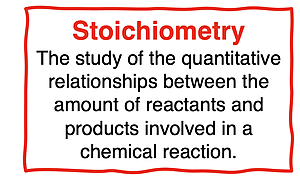 Stoichiometry is the study of the quantitative relationships between the amount of reactants and products involved in a chemical reaction. We introduced the topic in Chapter 9 of this Chemistry Tutorial. We learned how to use conversion factors and the factor label method to answer a variety of How much? questions. The goal was to relate the amount of reactants used (in grams or moles) to the amount of products formed (in grams or moles).
We subsequently used stoichiometry as a tool to answer How much? questions pertaining to gas stoichiometry (volumes), thermal stoichiometry (kJ of heat), solution stoichiometry (volumes and molarities), and acid-base stoichiometry (volumes and molarities). On this page, we will use stoichiometry as a tool to answer How much? questions related to current, time, and the amount of product (in grams or moles) formed in an electrolysis reaction.
Those who are rusty on their stoichiometry skills may wish to review:
Relationships
The two big questions that a student must be able to comfortably answer for success in any area of stoichiometry are what is related to what? and how are they related? An understanding of how two quantities - like grams and moles - are related allows a student to create conversion factors that can be used along the conversion pathway between the given information and the final answer. For instance, knowing that grams and moles of Cu are related by the molar mass of Cu, allows one to perform conversions between moles and grams of Cu using the molar mass as a conversion factor. The conversion factor is arranged so that the denominator unit matches the unit of the given quantity.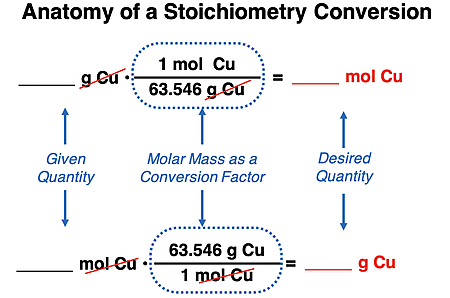
Relationships Between Electrolysis Quantities
The stoichiometry of electrolysis involves the following How much? quantities. The standard unit is indicated in parenthesis.- Mass of product formed (gram)
- Number of product atoms formed (mole)
- Number of electrons used in the electrolysis (mole)
- Quantity of charge associated with the number of electrons transferred through wire (Coulomb)
- Amount of current in the electrolysis circuit (ampere, amp, or A)
- Time that current was used (seconds)
There are three quantities in the above listing that are related to each other by an equation. They are the current (symbol: I), the time (symbol: t) and the quantity of charge (symbol: Q). The equation is Q = I•t. This equation can be algebraically manipulated to create new equations, tailored for determining I and t.
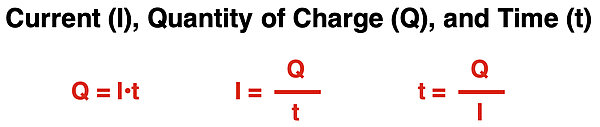
Note that attention must be given to units for these quantities - coulomb for Q, amperes (or amps or A) for I, and seconds for t. An ampere is equivalent to a coulomb/second.
The other quantities in the listing can be related to one another using conversion factors made from molar mass values, coefficients in the half-equation, and Faraday's constant (96485 C/1 mole of electrons). To illustrate the relationships, consider an electrolytic cell in which zinc ions are reduced at the cathode. The reduction half-equation is:
A typical electrolysis stoichiometry problem would involve relating values of current (I) and time (t) to the quantity of charge (Q, in coulombs) using the Q = I•t equation. Other quantities are related to Q by using conversion factors. For instance, the number of moles of electrons is related to Q using Faraday's constant.
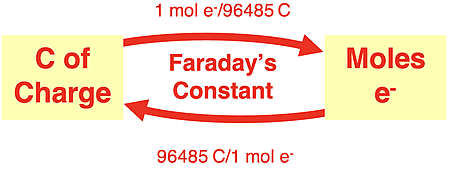
The number of moles of electrons is related to the moles of Zn atoms using the coefficients of the balanced half-equation. Note the equation shows that 2 mol of electrons are required to reduce Zn2+ to 1 mol of Zn atoms.
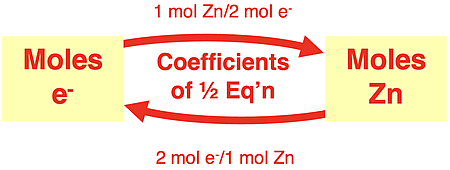
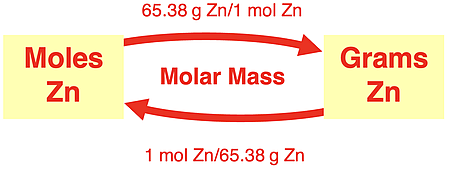
Finally, the moles of Zn is related to the mass of Zn (in grams) by the molar mass of zinc. The molar mass of Zn, found on the periodic table, is 65.38 grams per 1 mole.
There are a variety of types of stoichiometry problems that can arise for an electrolysis reaction. Regardless of the type of problem that is encountered, an understanding of the above relationships and the skill of using the factor label method will serve a student well. The schematic below shows the various quantities and the manner in which they are related. The schematic will prove useful for planning a solution to a electrolysis stoichiometry problem.
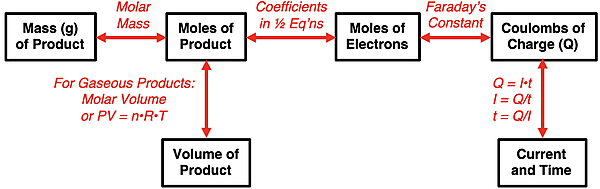
Developing the skill of using the factor label method and internalizing the relationship between quantities requires practice. We have provided three worked-out examples below. The Check Your Understanding section contains additional practice problems with thorough solutions. Finally, there are additional reinforcement ideas given in the Before You Leave section.
Example 1 - Determining the Mass of Product
A 3.50-A current is used to produce nickel metal from a solution containing Ni2+ ions. What mass of nickel is produced in 15.0 minutes?Solution
As with any Chemistry problem, a successful approach involves planning out the solution. Central to the planning is to identify the given information and the final destination. For this problem, we are given current (I) and time (t). We wish to determine the mass of nickel. We can identify the given info and the desired answer on our schematic in order to plot out the conversion pathway from the given information to the final answer.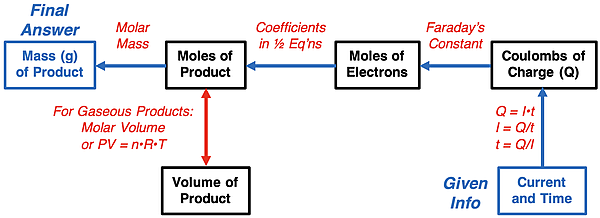
The solution will involve using the I and t value to determine the Coulombs of charge. The time in minutes will have to be converted to seconds by multiplying by (60 s/1 min). Three conversion factors will be used to convert …
- … from Coulombs to moles of electrons (Faraday's constant: 96485 C/mol e-)
- … from moles of electrons to moles of Ni (coefficients in half-equation)
- … from moles of Ni to mass of Ni (molar mass of Ni)
The molar mass of nickel is 58.69 g/mol (from the Periodic Table). The reduction half-equation is:
There are two moles of electrons involved for every one mole of nickel.
Step 1: Use Equation to Determine Coulombs of Charge (Q)
Q = (3.50 A)•(900. s)
Q = 3150 C
Step 2: Use Factor Label Method to Determine Mass of Ni
This step will begin by setting up the conversion factors in order to effectively cancel units. This is shown below.

Once the conversions factors are set up, numerical information is placed in the numerators and denominators. This is shown below.

The answer of 0.958 g Ni is determined by multiplying 3150 by all the numerator values and dividing by all the denominator values.
Example 2 - Determining the Current
A U.S. penny consists of a slug of zinc upon which a thin plate of copper is applied through an electroplating process. Consider a company that has a government contract to electroplate the pennies. The government specifications require a minimum mass of 62.5 mg of copper on each penny. The company immerses the pennies in a solution of Cu(CN)2 for 3.25 minutes. What current would be required to meet the government's minimum mass requirement?Solution
Once again, our approach begins with planning out the solution. For this problem, we are given the mass of product (Cu) and the time (t) the current is applied. We wish to determine the current (I). The given info and the desired answer are identified in our schematic.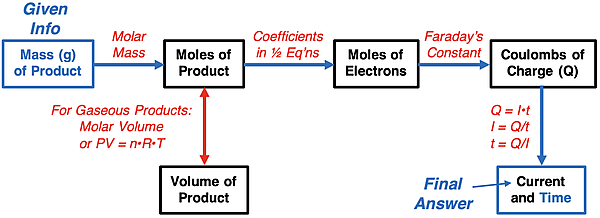
The current equation is I = Q/t. We will need to know Q in order to calculate the I value. This means that we will need to follow the conversion pathway indicated by the blue arrows from the mass of product to the coulombs of charge. Then, the equation can be used to calculate the current.
The molar mass of copper is 63.546 g/mol (from the Periodic Table). The reduction half-equation is:
There are two moles of electrons involved for every one mole of copper.
Step 1: Use Factor Label Method to Determine the Coulombs of Charge (Q)
This step will begin by setting up the conversion factors in order to effectively cancel units. The original quantity is 0.0625 g. This is equivalent to the given amount of 62.5 mg. The conversion factor set up is shown below.

Once the conversions factors are set up, numerical information is placed in the numerators and denominators. This is shown below.

The quantity of charge is determined to be 189.793 ... C. Since our solution is not complete, we will use the unrounded number in the next step.
Step 2: Use Equation to Determine Coulombs of Charge (Q)
We determined Q is Step 1 of the solution. The time was given as 3.25 minutes. This will need to be multiplied by (60 s/1 min) to determine its equivalent in seconds. The time in seconds is used in the equation:
I = (189.793 ... C)/(195 s)
I = 0.973 C/s
I = 0.973 A
The unit C/s is equivalent to 1 ampere (abbreviated A or Amp)
Example 3 - Determining the Time
A copper reclamation company applies a current of 2.50 amperes to a solution containing Cu2+ ions. How much time (in hours) would be required to electrodeposit 1.00 kg at the cathode location?Solution
The conversion pathway will look similar to the Example 2 solution. We are given the mass of product (Cu) and the current (I). We wish to determine the time (t). The given info and the desired answer are identified in our schematic.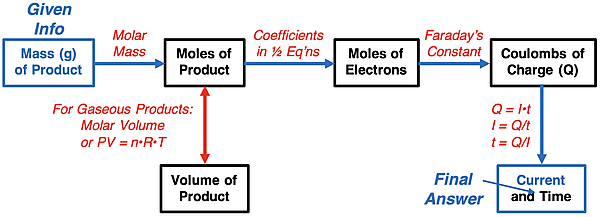
The time equation is t = Q/I. We will need to know Q in order to calculate the time. This means that we will need to follow the conversion pathway indicated by the blue arrows from the mass of product to the coulombs of charge. Then, the equation can be used to calculate the time.
The molar mass of copper is 63.546 g/mol (from the Periodic Table). The reduction half-equation is:
There are two moles of electrons involved for every one mole of copper.
Step 1: Use Factor Label Method to Determine the Coulombs of Charge (Q)
This step will begin by setting up the conversion factors in order to effectively cancel units. The starting quantity in the set-up is 1.00 x 10³ g. This is equivalent to the given amount of 1.000 kg. The conversion factor set-up is shown below.

Once the conversions factors are set up, numerical information is placed in the numerators and denominators. This is shown below.

The quantity of charge is determined to be 47787.39 ... C. Since our solution is not complete, we will use the unrounded number in the next step.
Step 2: Use Equation to Determine Coulombs of Charge (Q)
We determined Q is Step 1 of the solution. The time was given as 3.25 minutes. This will need to be multiplied by (60 s/1 min) to determine its equivalent in seconds. The time in seconds is used in the equation:
t = (47787.39 ... C)/(2.50 A)
t = 1.91 x 10⁴ s
t = 5.31 hr
The time in hours can be determined from the seconds by multiplying by (1 hr/3600 s).
Before You Leave - Practice and Reinforcement
Now that you've done the reading, take some time to strengthen your understanding and to put the ideas into practice. Here's some suggestions.- Our Calculator Pad section is the go-to location to practice solving problems. You'll find plenty of practice problems on our Thermal Chemistry and Thermodynamics page. Check out the following problem sets:
- The Check Your Understanding section below includes questions with answers and explanations. It provides a great chance to self-assess your understanding.
- Download our Study Card on Stoichiometry of Electrolysis. Save it to a safe location and use it as a review tool.
Check Your Understanding of the Stoichiometry of Electrolysis
Use the following questions to practice the skill of solving an electrolysis stoichiometry problem.. Tap the Check Answer buttons when ready.
1. A 1.25-A current is used to produce chromium metal from a solution containing Cr3+ ions. What mass of chromium is produced in 30.0 minutes?


2. Aluminum metal is produced from molten aluminum oxide (Al2O3) using a 1.34-A current for 1.25 hours. Determine the mass of aluminum produced.


3. A 1.50-A current is used for 19.6 minutes in an experiment involving the electrolysis of water.
2 H2O(l) → 2 H2(g) + O2(g)
Assuming STP conditions, calculate …
a. … the volume (in mL) of hydrogen gas produced.
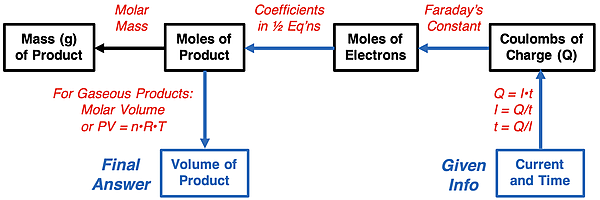


b. … the volume (in mL) of oxygen gas produced.

