Chapter 18: Electrochemistry - Lesson 3: Electrolytic Cells
Electrolysis and Its Applications
Hold down the T key for 3 seconds to activate the audio accessibility mode, at which point you can click the K key to pause and resume audio. Useful for the Check Your Understanding and See Answers.
The Big Idea
By studying electrolysis and electrolytic cells, students learn how electrical energy can force chemical change and how these redox processes power technologies from metal refining to hydrogen production.
 What is Electrolysis?
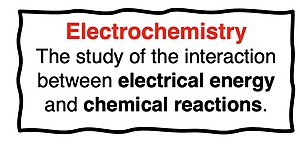
Electrochemistry is the study of the interaction between electrical energy and chemical reactions. In Lesson 2, we learned about chemical reactions that can cause the flow of electrons and a sustained electric current. These are the spontaneous reactions of a galvanic cell. In Lesson 3, we will learn about another type of electrochemical reaction - electrolysis reactions.
Electrolysis reactions are reactions that occur because of the flow of electrons in the form of a sustained electric current. An electrolysis reaction is a non-spontaneous reaction; it does not occur naturally on its own. A sustained intervention in the form of an electric energy supply is required. Electrolysis reactions can be thought of as the opposite of the reactions that occur in galvanic cells. Instead of the reaction producing electric current, an electrolysis reaction occurs because of an external source of electric current.
Products of Electrolysis
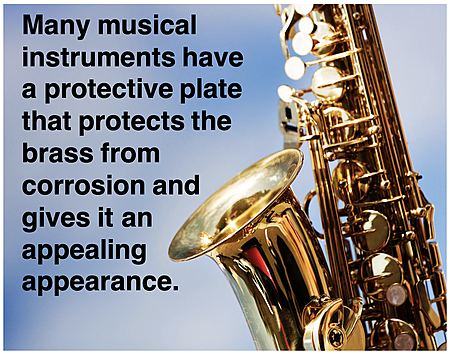 You are likely familiar with many consumer products made using electrolysis reactions.
- door knobs and drawer knobs with a shiny decorative coat
- gold-plated and silver-plated jewelry
- kitchen cutlery (spoons, forks, etc.)
- chrome-plated automobile parts, like bumpers and hood ornaments
- aluminum beverage cans
- many coins consist of a copper-nickel coating placed on a less expensive metal base
Many other common consumer products, like soap and paper, were made using chemicals that were produced from electrolysis reactions. Chlorine gas, hydrogen gas, and sodium hydroxide are commonly used by the chemical industry to make a host of other consumer products.
 Galvanic vs. Electrolytic Cells
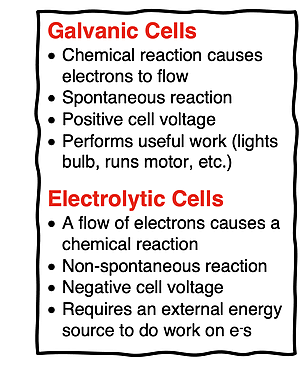
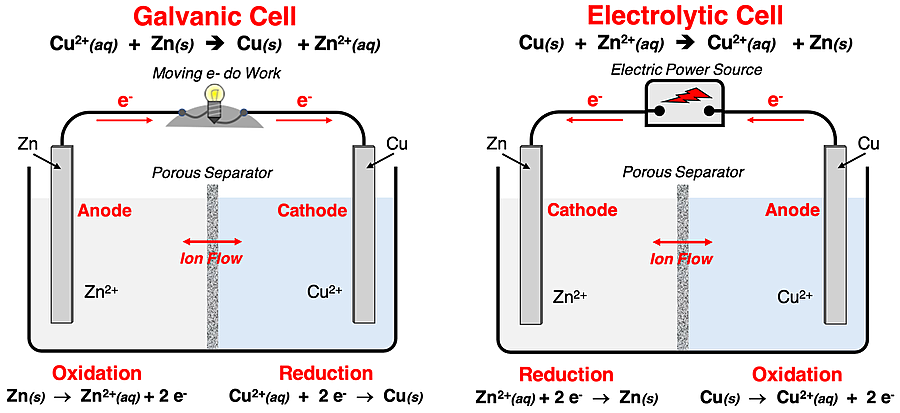
A spontaneous redox reaction occurs in a galvanic cell. The reaction produces a positive cell voltage that causes the flow of electrons from the anode to the cathode. This electron flow does useful work - lighting a light bulb, running a motor, etc. An electrolytic cell utilizes a non-spontaneous redox reaction - an electrolysis reaction. The reaction is characterized by a negative cell voltage, an indicator of its lack of spontaneity. Because the reaction is non-spontaneous, an external source of energy must continuously do work to move electrons from the anode to the cathode. The external source must provide enough volts to overcome the negative cell voltage and force electrons to move in the direction that they don't naturally move.The diagram below contrasts the two types of cells. The galvanic cell on the left has a cell voltage of +1.10 V (assumes standard conditions - 1.00 M solutions). Electrons flow naturally from the anode to the cathode. An electrolytic cell is shown on the right. The half-reactions and full reaction are the opposite of what occurs in the galvanic cell. Because of this, the cell voltage is -1.10 V. The electric power source must provide a voltage greater than 1.10 V to force the electrons to move from the anode to the cathode.
The Electrolysis of Water
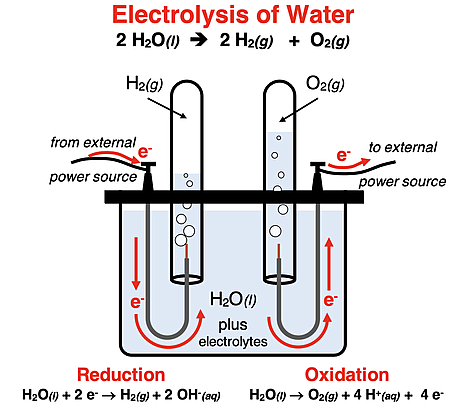 The electrolysis of water to produce hydrogen and oxygen gas may be the most widely known electrolysis reaction, in part, because it is easily performed in a school laboratory setting. Wires from the positive and negative terminals of an external power source are inserted into water (having a diluted concentration of an electrolyte such as H2SO4 or KNO3). The power source forces electrons to flow from the anode through the wires to the cathode. Water is oxidized at the anode to produce O2(g) and reduced at the cathode to produce H2(g). The half-reactions are:
Oxidation: H2O(l) → O2(g) + 4 H+(aq) + 4 e-
Reduction: H2O(l) + 2 e- → H2(g) + 2 OH-(aq)
The overall reaction can be determined in the usual manner (multiplying the reduction half-equation by two to equalize electrons, adding the half-equations, and then simplifying) to produce:
(Review as needed: Balancing Redox Reactions)
As predicted by the coefficients of the balanced equation, one observes that the volume of H2 produced is twice the volume of O2.
Electrolysis of Brine
Brine is an aqueous solution of concentrated NaCl. The NaCl is dissociated into Na+ and Cl- ions. When a current is run through a brine solution, chloride ions are oxidized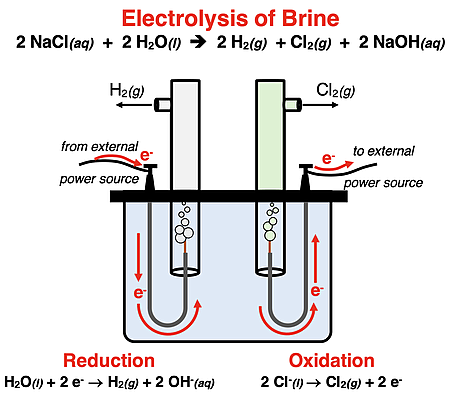 to produce chlorine gas at the anode and water is reduced to produce hydrogen gas at the cathode. The half-reactions are:
Oxidation: 2 Cl-(aq) → Cl2(g) + 2 e-
Reduction: H2O(l) + 2 e- → H2(g) + 2 OH-(aq)
The overall reaction can be determined in the usual manner (adding the reactions, and simplifying) to produce:
2 Cl-(aq) + H2O(l) → Cl2(g) + H2(g) + 2 OH-(aq)
The spectator ion - Na+ - can be added to each side as 2 Na+(aq) to produce the following overall equation:
2 NaCl(aq) + H2O(l) → Cl2(g) + H2(g) + 2 NaOH(aq)
(Review as needed: Balancing Redox Reactions)
The chloride ion is oxidized in this electrolytic cell. This may be surprising when inspecting a Table of Standard Reduction Potentials. Water's oxidation potential is slightly lower than that of the chloride ion.
Oxidation: H2O(l) → O2(g) + 4 H+(aq) + 4 e- Eox° = -1.23 V
Oxidation: 2 Cl-(aq) → Cl2(g) + 2 e- Eox° = -1.36 V
We might expect H2O(l) to be oxidized instead since it would require a slightly lower voltage from the electric power source. This is not the case due to a rare phenomenon known as overvoltage. It ends up that certain substances like water have difficulty transferring electrons to the metal wire. An applied voltage higher than 1.23 V is needed to force the transfer. The Cl-(aq) ion is thus the species that is oxidized.
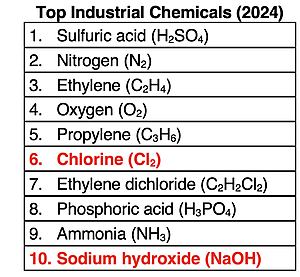 The electrolysis of brine is an important industrial process. All three products of the reaction are common starting materials in the chemical industry for producing consumer products. Year after year, chlorine and sodium hydroxide are listed somewhere on the Top 10 list of most industrially important chemicals. Chlorine gas is used in the production of plastics like polyvinyl chloride (PVC), solvents, pesticides, and paper products, and in water purification processes. Sodium hydroxide is used in the manufacture of soaps, detergents, cotton and rayon-based textiles, and paper products. Hydrogen gas is used in the manufacture of ammonia (for fertilizers, cleaning supplies, and refrigerants), in steel production, and in petroleum refining.
(Data source: ReAgent)
Electrolytic Refining of Impure Metals
 Electrolysis is used in many metal processing plants. One use is electrorefining. Electrorefining is the process of purifying an impure sample of metal. Copper refining is one example. Copper is found in the earth as copper-containing ores - large rock deposits concentrated with copper compounds. The ores are mined and processed to extract the copper, with the end goal of producing relatively pure copper metal. The final step of the process involves the electrorefining of an impure sample of copper.
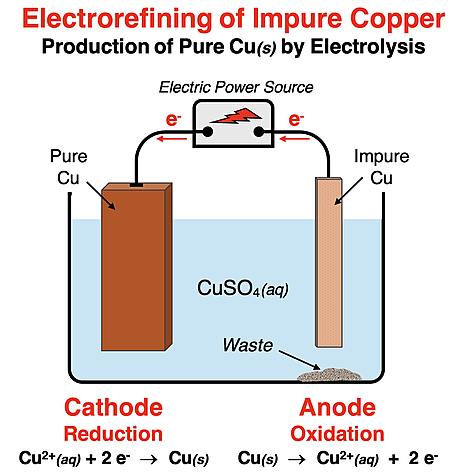 A slab of the impure copper is used as the anode. A sheet of pure copper is used as the cathode. Electricity is used to force the oxidation of copper at the anode location.
Copper ions enter the solution and migrate towards the cathode location. Electrons are forced through the wires from the anode to the cathode. At the cathode, copper ions gain electrons and deposit on the cathode as pure copper.
Over the course of time, the impurities in the anode drop to the bottom of the tank as a sludge. The overall process involves moving copper from the anode where it is contaminated by a variety of other substances to the cathode where it is very pure copper. That's Chemistry for Better Living!
Electroplating
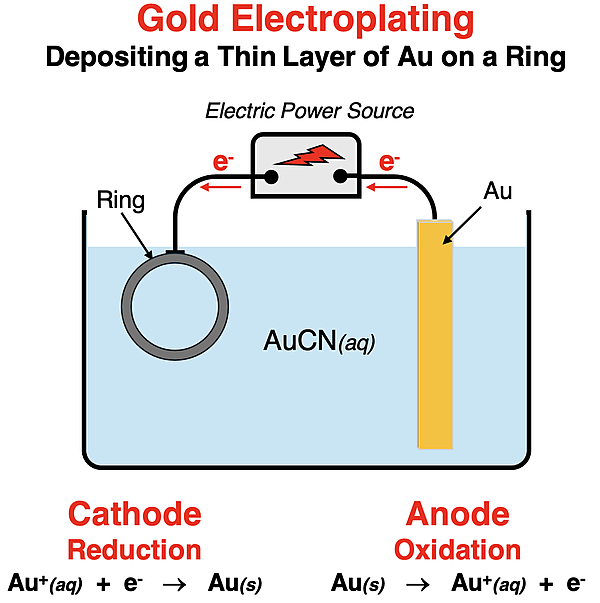
Electroplating is the process of depositing a thin layer of metal onto an object using electrolysis. The thin layer is usually added to give the object an attractive appearance or to improve its corrosion resistance. Electroplating is commonly used in the jewelry, automotive, electronics, and food canning industries. The metal that is selected to be the coating is used as the anode. The object that is to be plated by this metal is used as the anode.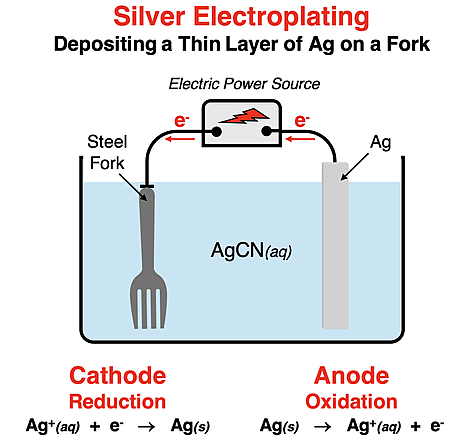 Suppose we wish to electroplate a steel fork with a thin layer of silver to give it some decorative appeal and to protect the steel from corrosion. Silver is used as the anode and the fork is placed at the cathode location. An aqueous solution of silver cyanide (AgCN) is commonly used as an electrolyte due to its stability and high conductivity. Solid silver is oxidized to silver ions at the anode.
Silver ions migrate through the solution towards the cathode. Electrons are forced to move through the wire from the anode to the cathode by the external power source. At the cathode, the silver ions gain electrons and are reduced to solid silver.
The process, when suitably controlled, results in a smooth (not flaky), uniform coating of silver on the fork.
Before You Leave - Practice and Reinforcement
Now that you've done the reading, take some time to strengthen your understanding and to put the ideas into practice. Here's some suggestions.- The Check Your Understanding section below includes questions with answers and explanations. It provides a great chance to self-assess your understanding.
- Download our Study Card on Electrolytic Cells. Save it to a safe location and use it as a review tool.
Check Your Understanding of Electrolytic Cells
Use the following questions to assess your understanding of electrolysis and electrolytic cells. Tap the Check Answer buttons when ready.1. Consider the following statements. Identify each as being true of only galvanic cells (GC), only electrolytic cells (EC), both types of cells (BC), or neither type of cell (NC).
- Oxidation occurs at the anode. Check Answer
- The cell produces an electric current that can do useful work. Check Answer
- The cell voltage is a positive value. Check Answer
- Electrons move through solution from the anode to the cathode. Check Answer
- The anode and cathode must be placed in an electrolyte solution. Check Answer
- The ∆G value for the reaction is a positive value. Check Answer
- The reaction is spontaneous. Check Answer
- Reduction occurs at the cathode. Check Answer
- The use of an external electric power source is required for this type of cell. Check Answer
- A rechargeable battery uses this type of cell. Check Answer
- Electrons move through the wire from the cathode to the anode. Check Answer
- The cell voltage for the reaction is a negative value. Check Answer
- The ∆G value for the reaction is a negative value. Check Answer
- The reaction is non-spontaneous. Check Answer
- The cells have very few industrial or commercial applications. Check Answer
2. Describe how you would electroplate gold onto a piece of jewelry. Accompany your description with a schematic diagram.