Hold down the T key for 3 seconds to activate the audio accessibility mode, at which point you can click the K key to pause and resume audio. Useful for the Check Your Understanding and See Answers.
A Bit of History
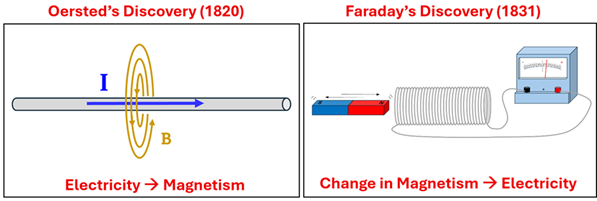
We learned in a previous lesson that physics teacher Hans Christian Oersted was credited with the discovery that electricity causes magnetism. In 1820, his simple observation that a compass needle deflected when current passed through a nearby wire has revolutionized our world. This connection between electricity and magnetism has led to the invention of motors, speakers, and hundreds of other devices that work because a current carrying wire produces a magnetic field around it.
Oersted’s discovery soon led scientists to ask the reverse question: Can magnetism cause electricity? The answer to this question came in 1831 through the work of Michael Faraday. Faraday found that it’s not the presence of a magnetic field that produces a current, but rather that a changing magnetic field can create a current in a nearby loop of wire. In other words, a change in magnetism causes electricity. This phenomenon is known as electromagnetic induction.
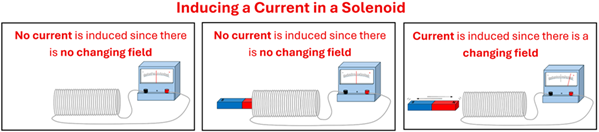
So how did Faraday discover this? Or perhaps more importantly, how might we observe this idea that a changing magnetic field causes a current? Consider a solenoid connected to a galvanometer (a device that measures small currents). Since there is no battery in our circuit, we see that the galvanometer reads zero current—just as we would expect. If we place a magnet inside the solenoid, we still have no reading on the galvanometer. This suggests that it is not the presence of a magnetic field that causes current in our circuit either. However, if we move the magnet into or out of the solenoid, we see something quite interesting—the galvanometer needle moves indicating that a current has been created in the wires. It was an experiment like this that allowed Faraday to discover that a moving magnet changes the strength of the magnetic field inside the solenoid. It is this change in the field that is responsible for the production of this current. Physicists call this an induced current since it was caused by a change in the magnetic field inside the solenoid.
While it is helpful to understand the questions that physicists were asking back in the early 1800’s, there is so much more to this concept of electromagnetic induction yet to be uncovered. We’ll see in the next section of this lesson that Faraday found there are other ways to induce a current in a nearby coil of wire other than just moving a magnet. To make sense of this, we’ll need to explore the concept of magnetic flux. That is where we’ll go next.
Check Your Understanding
Use the following questions to assess your understanding. Tap the Check Answer buttons when ready.
1. True or False. Oersted discovered that magnetism caused electricity.
2. True or False. Faraday concluded that if a magnetic field is present, current will be induced in a nearby coil.
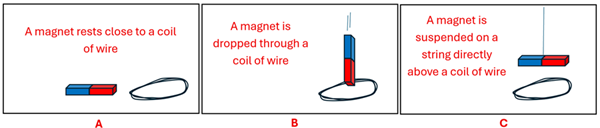
3. In which situation would current be induced in the coil of wire?