Electricity Generation and Power Transmission
Now that we have made sense of how electricity is generated and how transformers are used to step-up or step-down voltage, we have the building blocks to understand how electricity gets from a power plant to your home. Let’s consider the entire process of electricity generation and power transmission illustrated in the picture below.
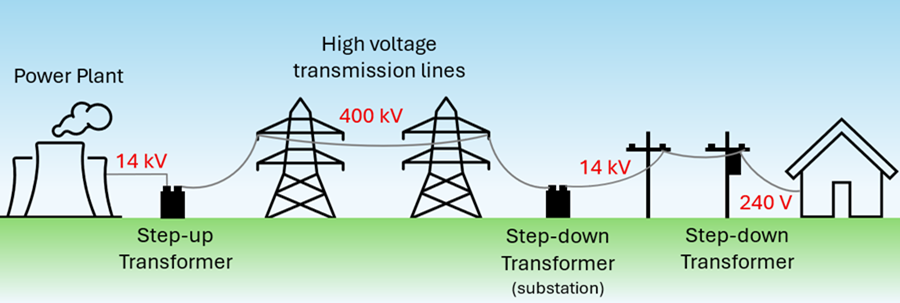
Whether it be a hydroelectric plant, a wind farm, a coal burning plant, or a nuclear reactor, all power plants work on the same principle. Mechanical energy is used to spin a magnet near a coil of wires (or to spin a coil of wires near a magnet) to create a changing flux through these coils. As we explored earlier in this lesson, this change in flux induces an emf in the wire. This emf is responsible for a potential difference across the two ends of this wire. This is, in fact, how all electricity is generated. Since the power plant’s generators produced alternating current, we can take advantage of a step-up transformer to raise the voltage as power is brought to a community.
You will notice that a step-up transformer raises the voltage produced by the power plant and then a step-down transformer reduces the voltage back to a value that can be more safely transmit through a neighborhood. In the middle of this process, however, we see that this power was transmitted at a very high voltage across the high voltage transmission lines. Why step up the voltage only to step it back down again? The answer to this question comes as we understand power loss in wires.
Power Loss In Wires
For most of us, the nearest power plant is tens to hundreds of kilometers away. That means that the electric energy generated at the power plant must be transmitted through many, many kilometers of wire to make it to your neighborhood. The problem comes as we recognize that wires have resistance. Back in our chapter on electric circuits, we explored the concept of resistance and discovered what determines the resistance of a wire.
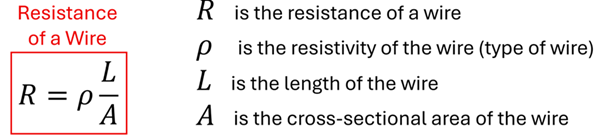
One aspect engineers wrestle with as they develop an electrical power distribution plan is what wire to use to minimum the wire’s resistance in a cost-efficient way. First, they recognize the importance of using a wire that offers low resistivity. While there are many types of metal that offer low resistivity values, high voltage power lines are typically made of aluminum, often reinforced with a steel core. While copper has lower resistivity, aluminum is generally preferred for its lighter weight and lower cost. Another factor these engineers can control is the diameter of wire used. Most high voltage transmission lines are relatively thick—typically 2 to 5 cm. They minimize resistance by increasing the wire’s cross-sectional area. The factor that dominates the resistance calculation, however, is the length of the transmission line. That is something they can’t always control. If the nearest power plant is 100 km away, the length term in the resistance equation puts the transmission wire’s resistance in the 5 Ω to 20 Ω range. While that might not seem like a very large resistance, a wire’s resistance is one of two critical factors in determining the power loss in these transmission lines.
So, if the electrical resistance is only one of the factors, what else contributes to power loss in these wires? By combining the power equation (P = I V) from our last section with Ohm’s Law (V = I R), we can derive an expression that illustrates how the power loss depends on both the wire’s resistance and the current in the wire.
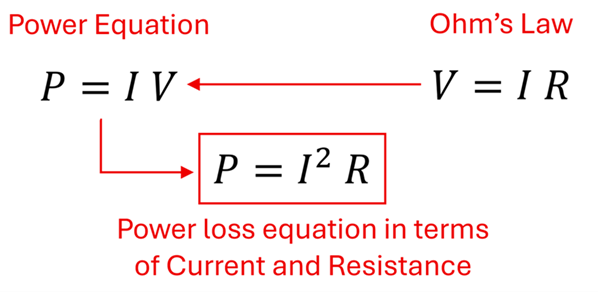
This equation suggests that a greater power loss will occur as more current passes through the wires. The more current in the wires the hotter they become. Energy is then ‘lost’ as heat is transferred to the environment. To minimize the power loss through the transmission wires we want to not only minimize the resistance but also the current. In fact, we especially want to minimize the current since this term is squared in our power equation.
We just discussed how we might minimize the resistance, but how can we transfer a large amount of power while minimizing the current? Wouldn’t it be nice if there was a way to still transfer a significant amount of power but use a smaller current? There is! That’s why the transformer is such an important device. It allows us to transmit large amounts of power while working to minimize this power loss due to heat. Let’s consider an example to illustrate just how significant it is to use a step-up transformer.
Example: Calculating Power Loss in Wires
Problem: An average-sized power plant might generate 500 MW (5 x 10⁸ W) of power. Let’s assume that the output voltage from the power plant generators is 14 kV and that all this power needs to be transmitted to communities through wires that have a combined resistance of 5 Ω.
(A) What is the current supplied from the power plant?
(B) Assuming that no transformer is used, what is the power loss over the power lines whose combined resistance is 5 Ω?
(C) Now suppose that a step-up transformer is installed just outside the power plant that is used to step up the voltage to 400 kV before transmission through these power lines. What would the power loss over the lines be now?
Solution:
(A) Using the power equation we can calculate the total current in the wires from the power plant to be approximately 36,000 A.
(B) If no transformer is used, the power loss through the transmission lines would be 6.4 x 10⁸ W. It is interesting to note that this number is actually greater than the power generated by the entire power plant. This suggests that all the electrical energy would be dissipated by heat and never make it to the communities themselves!
(C) If a step-up transformers is used, the power loss through the transmission lines is about 7.9 x 10⁶ W (7.8 x 10⁶ W not using rounded numbers). This is about 2% of the total power produced by the power plant. Obviously, installing a step-up transformer before power is transmitted long distances through wires is essential.
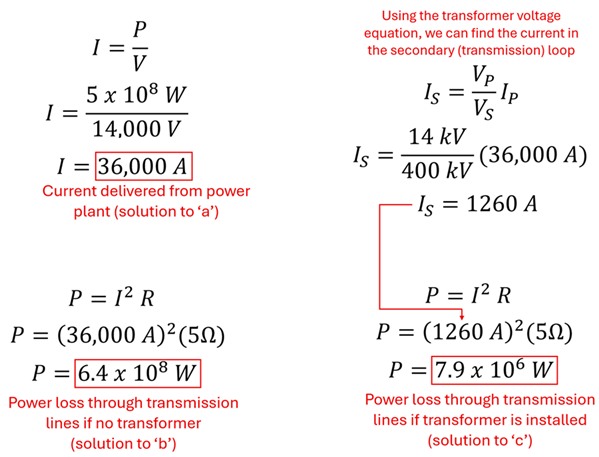
This example illustrates why transformers are essential in the transmission of electrical power through transmission lines. While each transformer introduces power losses of up to 1-2%, and while there are other losses throughout the transmission process, electrical companies are satisfied with total losses in the 10% range. That’s way better than what it would be without a transformer. Had they not used a step-up transformer, we may not get any electricity delivered to our community!
Power Transmission to Your Home
Transmitting electrical power with a high voltage and low current is the way to go when sending power across long distances. However, we surely don’t want to have a potential differenceof 400 kV across the appliances and electronics that we use every day. This would be quite dangerous. Electric company know this, too. They install step-down transformers at substations like the one shown in the picture. The purpose of these substations is to step down the voltage so that electrical power can be delivered to local communities in a safer manner.
While these substations step down the voltage significantly, there may still be several kilometers between them and your home. As a result, another step-down transformer is typically installed that brings the voltage down to the value delivered to your home. You’ve likely seen these gray cylinder-shaped transformers on power poles in your own neighborhood.
While many of the appliances in your home operate off 120 V (or 240 V if you live in Europe)—the potential differences delivered to the wall outlets in your home, you may regularly use cell phone, laptops, and other electronics that operate on 5 V. As we saw in our last section, this is why your electronic devices often come with their own step-down transformer to operate these devices.
We’ve covered the entire process from how electricity is generated to how it is transmitted to the electrical devices that you use every day. The fact that you can make sense of this entire process is pretty neat. While Faraday may not have had any idea how significant his discovery of electromagnetic induction was, we’ve had the chance to unpack how it works at a fundamental physics level as well as appreciate the many applications of this important principle. We’ve seen that the linkage between electricity and magnetism is significant. We’ve appreciated the fact that we can explain so much about the world around us by understanding this linkage. And while we’ve uncovered a great deal of how magnetic induction helps us understand how things work, there is still more to learn that other physicists understand…and a much more that they don’t. Like Orsted and Faraday of years ago, scientists today continue to ask questions about the world around them. We get to join them as we ask our own questions and discover how the world around us works too.
Check your Understanding
Use the following questions to assess your understanding. Tap the Check Answer buttons when ready.
1. The resistance of a wire depends on several factors. Identify whether increasing each of these factors increases or decreases the wire’s resistance.
(A) resistivity of the wire
(B) length of wire
(C) cross-sectional area of wire
Check Part A Answer
Answer: increases
Since R=ρL/A, a wire’s resistivity is directly proportional to its resistance
Check Part B Answer
Answer: increases
Since R=ρL/A, a wire’s length is directly proportional to its resistance.
Check Part C Answer
Answer: decreases
Since R=ρL/A, a wire’s cross-sectional area is inversely proportional to its resistance.
2. High voltage power lines are used to transmit electrical power over long distances. Select the statement that best explains why this is the case.
(A) With high voltage comes lower current which leads to less power loss to heat
(B) With high voltage comes high current which leads to greater power loss to heat
(C) Resistance in wires decreases with high voltage but increases with current
(D) Resistance in wires increases with high voltage but decreases with current
Check Answer
Answer: A
Since P = I V, a step-up transformer is able to transmit the same amount of power using a smaller current across a higher potential difference. Lower currents are desired as this leads to less power loss since lower currents do not heat up wires as much as higher currents do.
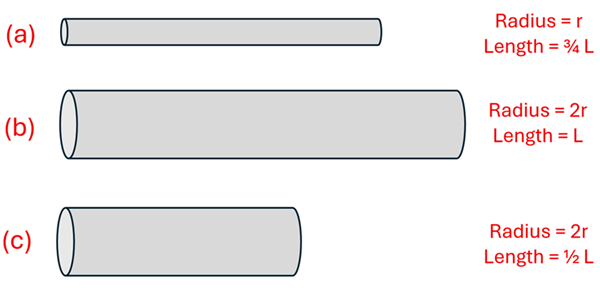
3. Three wires of identical material (that is, with the same resistivity) are shown. Rank these from smallest resistance to greatest resistance.
Check Answer
Answer: c, b, a
Using R=ρL/A, we see that 'c' has half the resistance of 'b' which has one-third the resistance of 'a'.
4. The thin wire shown has a radius of 5.0 x 10⁻⁴ m, a length of 150 m, and a resistivity of 2.7 x 10⁻⁸ Ωm. The wire carries 2.0 A of current.
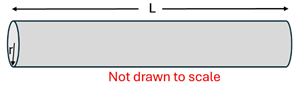
(A) Calculate the resistance of this wire
(B) Determine power loss across the length of this wire
Check Part A Answer
Answer: 5.2 Ω
Using the resistance of a wire equation, R=ρL/A, R=(2.7 x 10⁻⁸Ωm) (150 m) / (7.9 x 10⁻⁷ m2) = 5.2 Ω. (The cross-sectional area was found using π r2.)
Check Part B Answer
Answer: 21 W
The power loss equation with current and resistance can be used to find P=I2 R =(2.0 A)2 (5.2Ω) = 21 Watts. Thin, long wires that carry large currents have greater power losses than thick, short wires that carry small currents.
5. Select the statement on the left with the correct explanation on the right.
| (A) Power plants are an essential part of our society because… |
(1) they adjust the voltage to safer values that can be delivered to the community |
| (B) Step-up transformers are important in long-distance power transmission because… |
(2) they generated electrical energy through electromagnetic induction |
| (C) Substations in your community are important because… |
(3) they help minimize power losses due to heat |
Check Part A Answer
Answer: 2
Power plants use electromagnetic induction to generate electricity.
Check Part B Answer
Answer: 3
Power loss is greater with higher currents, so step up transformers reduce the current to minimize power loss.
Check Part C Answer
Answer: 1
Substations lower voltages to safer values that can be delivered throughout the local community
Some author-generated image contain icons sourced from Microsoft Word Clipart.
Figure 1 borrowed from Wikimedia Commons (From Saiphani02) https://commons.wikimedia.org/wiki/File:Electrical_substation_of_railways_in_Vizianagaram.jpg under license Creative Commons
Figure 2 borrowed from Wikimedia Commons https://commons.wikimedia.org/wiki/File:Power_Distribution_Line_Pole_with_Distribution_Transformers.png