Root Mean Square Voltage
When you plug a cord into a wall outlet the outlet provides a potential difference of 120V alternating current (AC). If it is alternating current, however, doesn’t the voltage fluctuate? Is 120 V the average value? Is it the maximum value? Truth is, it is neither. The 120 V value that we report is actually the root mean square (RMS) value. The RMS voltage is commonly referred to in AC circuits because it represents the equivalent direct current (DC) voltage that would produce the same amount of power in a resistive load. In other words, the RMS value provides a more practical measure for calculating power when comparing it with DC circuits.
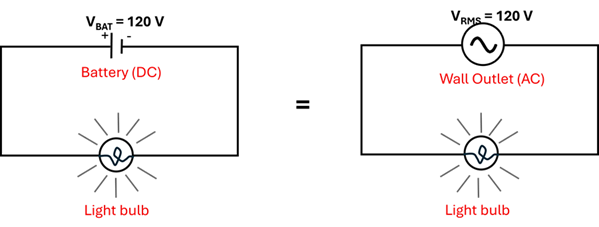
In reality, a wall outlet actually oscillates between ±170 V. The way physicists get 120 V from this is they perform what is called the root mean square (RMS) calculation. How do you perform such a calculation? First, you square the value of the voltage at every moment in time along this sinusoidal voltage function. Next, you take the mean (average) value of all the squared voltage values throughout the cycle. Finally, you take the square root of that mean. That’s why it’s called the root mean square value.
To illustrate this, let's analyze the below graph.
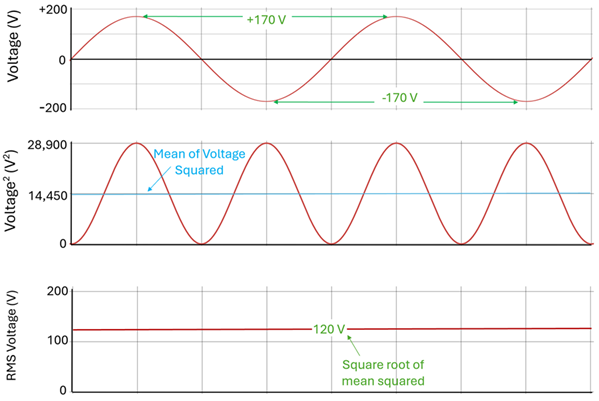
Consider an AC voltage function that oscillates in a sine wave between + 170 V and -170 V (top graph). If we now square the voltage shown on this top graph at every moment in time, we get the voltage squared graph (middle graph). It is interesting to note why it is important to square the function before we take the average. Had we just taken the average voltage from the first graph, we’d get zero since the AC voltage value is negative for just as much of a cycle as it is positive. Squaring the voltage only gives us positive values. With the voltage squared, now we take the mean value. This is shown as the blue line on the middle graph. Finally, we undo the square that we performed by taking the square root of the mean value. This leads us to the RMS voltage (bottom graph).
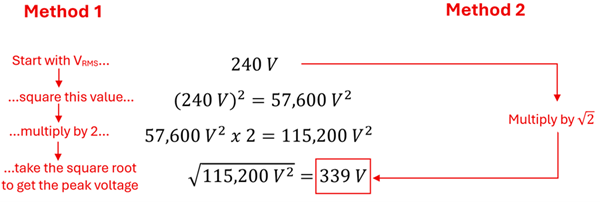
Practically speaking, this is essentially taking the peak value from the top graph and dividing it by √2. Or said another way, the RMS voltage is the peak voltage divided by √2. While the RMS voltage has no real meaning in the analysis of direct current (DC) circuits, it is commonly used in alternating current electronics. From now on, when we refer to the voltage in an alternating current circuit, you can assume that we are referring to the RMS voltage.
Example 1: Finding Peak Voltage for AC Circuit
Problem: The circuit breaker box in your home is connected to wires from the electric company that supply VRMS = 240 V. What is the peak voltage for this line?
Solution: To find the peak voltage, we must reverse the process illustrated above. Here are two methods to arrive at the peak voltage of ±339 V.
Step Up, Step Down
One of the advantages of using alternating current is that it is easier to step-up or step-down the voltage. For example, a wall outlet’s 120 V potential difference is too large for your cell phone’s 5 V charger. This brings us to understand the operation of a valuable device used in AC circuits—the transformer. A transformer earns this name because it is a device that ‘transforms’ an AC voltage by scaling it up or down by a desired amount. And with our understanding of electromagnetic induction, we can make sense of how it works.
Imagine a rectangular ‘donut’ of iron as shown below. Now imagine we wrap several windings of wire around the left side of the donut (shown in red). The two ends of this loop are then attached to an AC voltage source. We will call this left side the primary loop since it is directly connected to our voltage source. We learned back in the previous chapter that when several coils of wires (a solenoid) are wrapped around an iron core, the magnetic field produced by the solenoid can becomes over a thousand times stronger. We saw that this was because the wire’s B-field aligns the domain within the iron core. This makes a much stronger magnet. What is more, the iron core can be bent into different shapes to direct the magnetic field. If, at a given instance in time, the current in the primary loop is directed as shown, we can use our Field-finding Right Hand Rule to show that the magnetic field inside the windings points upward through these coils. Since magnetic fields have no beginning or end, the rectangular shape directs this B-field around the donut as shown.
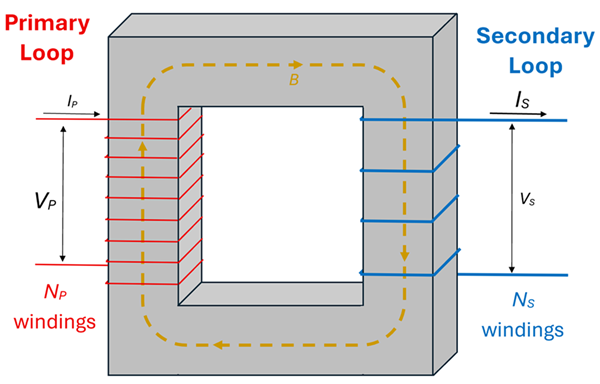
Now imagine that we add another loop of wire that is wrapped around the right side of the iron donut (shown in blue). This loop goes to the device that we want to operate (such as a cell phone charger, refrigerator, or computer). We’ll call this loop the secondary loop. What is important to note is that the primary and secondary loops are not electrically connected to each other. However, the magnetic field created by the primary loop will provide a magnetic flux through the windings of the secondary loop. Because the primary loop is connected to an alternating current source, the direction of the B-field in the iron core will oscillate back and forth. In turn, this creates a change in flux through the secondary loop. We know what a change in flux produces, don’t we?! It induces a current in the secondary loop! Here we see two separate circuits that are not electrically connected but both have alternating current in them. The alternating current in the primary loop has induced current in the secondary loop.
You might be wondering, “If we want alternating current in the secondary loop, why not just connect it directly to the primary loop? Wouldn’t this be easier?” While that would be much simpler, there is something very powerful that we gain by having two separate loops that share our iron donut but are not electrically connected. By having a different number of windings wrapped around the iron in the secondary loop compared to the primary loop, we are able to step up or step down the voltage across the secondary circuit compared to that of the primary circuit. The voltage in the secondary circuit can be determined according to this relationship Vs = (NS / NP) * VP:
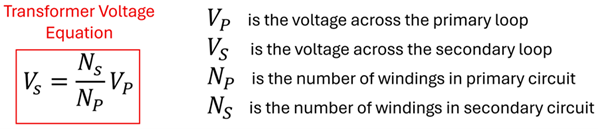
This simple device ‘transforms’ the RMS voltage up or down merely based on the ratio of windings in the secondary circuit compared to the primary circuit. Let’s try an example to see how this works.
Example 2: A Step-Up Transformer
Problem: The electric company wishes to build a substation transformer that steps up the voltage from the primary loop which is at 12.5 kV. The primary loop has 100 windings and the secondary loop 3,200 windings. To what value is the transformer stepping up the voltage?
Solution: To find secondary loop voltage, we use the transformer voltage equation and substitute the values provided. Doing so shows us that this transformer steps up the voltage to 400 kV or 400,000 V.
Example 3: A Step-Down Transformer
Problem: The wall outlet in your home provided a potential difference of 120 V. Your cell phone charger operates on 5 V. If the primary loop has 144 windings around the iron donut, how many coils should the secondary loop have?
Solution: To find number of secondary loops in the transformer, we’ll use the transformer voltage equation and rearrange it to solve for the number of windings in the secondary coil. Substituting values and solving leads to 6 windings in the secondary loop.
You might be thinking, “Wait a minute! Aren’t we getting something for nothing? How can we just step up or step down the voltage simply by changing the ratio of primary to secondary windings?” Well, there is a catch. Energy must be conserved. Power, the rate at which energy is transferred from the primary loop to the secondary loop, must be conserved as well. But how is this possible when we are transforming the voltage to just about anything we want?
Back in our lesson on power in the chapter on electric circuits, we learned that power equals current times voltage. P = I V for short. The catch is that what we ‘gain’ by increasing the voltage in a step-up transformer, we ‘lose’ through decreasing the current in the secondary loop. Similarly, what we ‘lose’ by decreasing the voltage in a step-down transformer, we ‘gain’ through increasing the secondary loop’s current. Thus, if our transformers are 100% efficient (and most transformers are 98-99% efficient), PP = PS (power of primary equals power of secondary), so IP*VP = ISVS, or a Step up in Volts means a smaller current, or a step down in volts equals a larger current.
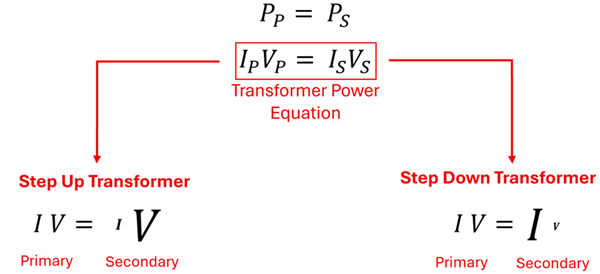
While this is a net zero change in power from the primary loop to the secondary loop, the transformer is a device that allows us to ‘exchange’ current for voltage.
In the next section we’ll see why, in certain instances, it is important to step up the voltage and at other times step down the voltage. For now, however, we can understand that the transformer is a simple yet valuable device that allows us to produce just about any AC voltage desired.
Example 4: Up with Voltage, Down with Current
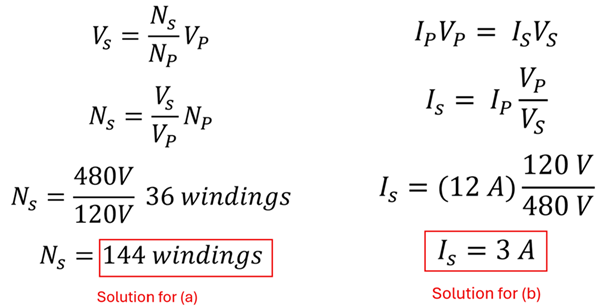
Problem: A primary circuit carries an RMS current of 12 A across an RMS potential difference of 120 V. There are 36 windings in the primary loop. Assuming our transformer is 100% efficient (that is, there is no loss of power) and we wish to step up the voltage to 480 V across the secondary loop. Determine the (a) number of secondary winding necessary, and (b) output current in the secondary loop.
Solution: (a) Using the transformer voltage equation we determine the number of windings in the secondary loop to be 144 winding. (b) Using the transformer power equation, we find that since the voltage was multiplied by a factor of four, the current must be reduced by this same factor. Thus, the current in the secondary loop is 3 A.
Transformers for your Electronics
You probably use transformers on a regular basis. The ‘brick’ that a cell phone charger or computer connects to before it gets plugged into the wall is a transformer. Inside this brick is a primary loop and a secondary loop with windings around an iron donut. They work just like we’ve discussed above. These bricks are typically printed with a power rating (in Watts) on them, which represents the maximum rate at which energy can be transferred from the primary to the secondary loop. Thus, a higher wattage transformer will be able to charge a cell phone or laptop battery faster.
The power provided to the secondary loop in a transformer similar to the one in the photo is typically used to charge a cell phone or laptop battery. However, we discussed above that batteries are direct current devices—not alternating current. So, what happens inside this brick is a little more involved than just stepping down the voltage. There is also a rectifier circuit, often containing diodes. While transformers step down the voltage from the primary loop’s AC voltage to the secondary voltage, the rectifier circuit is responsible for converting that stepped-down AC voltage to the DC voltage required by the phone or laptop.
In the final section of this lesson, we’ll explore the entire process from generating electricity at the power plant to transmitting this electricity through power lines to the running of the actual electronics like the one you are using right now. What’s really neat is that, as we develop our understanding of electromagnetic induction in this chapter, we are becoming equipped to understand this entire process.
Check Your Understanding
Use the following questions to assess your understanding. Tap the Check Answer buttons when ready.
1. Read the four statements below. What two statements best describe the functions of the iron ‘donut’ in a transformer?
(A) Causes the magnetic field lines to have a beginning and end
(B) Increases the strength of the magnetic field strength
(C) Electrically connects the primary and secondary loops
(D) Channels the magnetic field from primary to secondary windings
Check Answer
Answer: b, d
In the lesson on the
electromagnetic, we learn that the permeability for iron is over a thousand times greater than that of air. Thus, wrapping windings around an iron core greatly increases the magnetic field strength (answer ‘b’). In addition, the magnetic domains will align in a way so that they follow the donut shape and cause the field to pass through the windings of the secondary loop as well (answer ‘d’).
2. A transformer works for AC but not DC. Which statement below best explains why?
(A) DC voltages are always lower than AC voltages
(B) DC voltages oscillate at a higher frequency than AC voltages
(C) Power = I V applies to AC circuits but not to DC circuits
(D) Current in the windings must be changing to produce a changing B-field
Check Answer
Answer: d
Since transformers work on the principle of electromagnetic induction, Faraday’s Law states that in order to induce an emf in a secondary loop we must have a changing flux through its windings. A primary coil with direct current may produce a B-field in the iron donut, but unless the current is changing there will be no change in magnetic flux and thus no induced emf in the secondary loop.
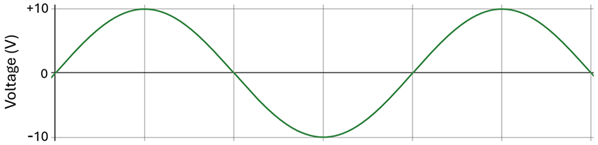
3. An AC circuit oscillates between a peak voltage of ±10.0 V. What VRMS?
Check Answer
Answer: 7.07 V
The RMS voltage can be found by dividing the peak voltage by √2.
4. A transformer is used to change the AC voltage from 1500 V to 120 V. There are 80 windings in the secondary loop. Assuming the transformer is 100% efficient, how many windings are there in the primary loop?
Check Answer
Answer: 1000 windings
Using the transformer voltage equation, we find NP = (VP/VS) NS = (1500 V/120 V) 80 windings = 1000 windings
5. A transformer has 260 windings in the primary loop and 105 windings in the secondary loop. What kind of transformer is this and, assuming 100% efficiency, by what factor does it change the voltage?
Check Answer
Answer: step down, 40% of the primary loop voltage
Using the transformer voltage equation, we find NS / NP = VS / VP = 105 windings / 260 windings = 0.40. This is a step-down transformers where the secondary voltage has decreased to 40% the primary loop voltage.
6. Neon signs require 12 kV for their operation. To operate from a 120 V line,
(A) What must be the ratio of secondary to primary windings in a transformer?
(B) What would the voltage output be if the transformer were connected backwards?
Check A Answer
Answer: 100
Using the transformer voltage equation, we find NS / NP = VS / VP = 12,000 V / 120 V = 100. This is a step up transformers.
Check B Answer
Answer: 1.2 V
If connected backwards, it would become a step-down transformer which would decrease the primary voltage by a factor of 100 to 1.2 V.
7. A 100% efficient 45 W transformer has an output of 15 A and an input of 25 V.
(A) Is this a step-up or step-down transformer?
(B) By what factor does the voltage change?
Check A Answer
Answer: Step-down transformer
For the secondary loop, V = P / I = 45 W / 15 A = 3.0 V. Since the primary voltage was 25 V and the secondary voltage is 3.0 V, this is a step-down transformer.
Check B Answer
Answer: Decreases by a factor of 8.3 times
Since the voltage stepped down from 25 V to 3.0 V, it decreased by a factor of 8.3.
Figure 1 borrowed from Wikimedia Commons (From Yoshieslunchbox) https://commons.wikimedia.org/wiki/File:Distribution_Transformer_1.jpg under license Creative Commons
Figure 2 borrowed from Wikimedia Commons (From Georg Fuchs, MikeRun) https://commons.wikimedia.org/wiki/File:High-current-transformer-experiment.jpg under license Creative Commons
Figure 3 taken by Author