What is an Ideal Fluid?
In past chapters, we studied the motion of objects like a box sliding down a frictionless ramp or a rollercoaster car moving up and down hills without a loss of mechanical energy. In reality, boxes sliding down ramps always experience some friction. Similarly, rollercoaster cars will lose some mechanical energy no matter how smooth the track. We made these assumptions, however, because they help us see the big picture of some fundamental laws that govern the how and why of motion. Such assumptions helped us uncover Newton’s Law, for example. They helped us make sense of the Law of Conservation of Energy.
As we move through this chapter, we’ll be making some assumptions about the fluids we’ll study as we work to understand how they exert pressure and how they move. We’ll assume that these fluids are ideal fluids. And while no real fluid is truly ideal, many real fluids (like water or air under certain conditions) can be approximated as ideal. This is just what we did when we envisioned a frictionless ramp or considered a rollercoaster car that loses no mechanical energy. These assumptions will help us make sense of how fluids exert pressure. They will help us understand how fluids move.
In this section, we’ll take a look at four characteristics of ideal fluids:
- Incompressibility
- No Viscosity
- Steady Fluid Motion
- Non-Turbulent
As we understand and then apply these assumptions to the fluids that we’ll study, we’ll be able to discover several important principles that govern how fluids behave.
Characteristic 1: Incompressibility
The first characteristic of an ideal fluid is that it is incompressible. This means that if you squeeze the fluid by applying pressure on all sides, its volume will stay constant. As a result of an ideal fluid’s incompressibility, it follows that the density of an ideal fluid must remain constant as well, regardless of changes in pressure or temperature.
Consider, for example, two fluids of the same volume. For a compressible fluid, when pressure is applied to all sides, its volume decreases. Since its volume decreases (but it’s the same mass), its density will increase. In other words, we now have the same mass packed into a smaller volume. Now consider the incompressible fluid. When pressure is applied to all sides of this fluid, the volume remains the same. As a result, the density of the fluid also remains unchanged.
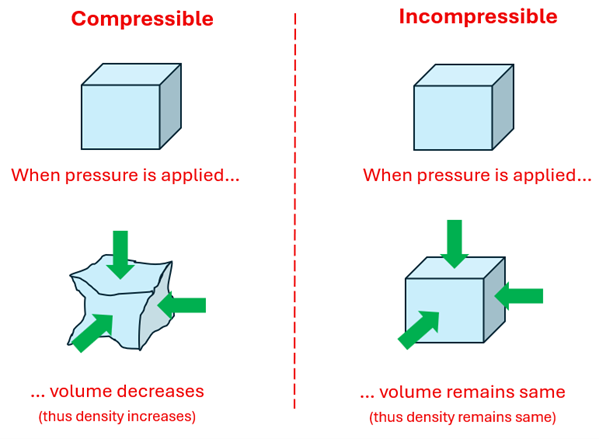
In order to develop the principles and laws that we’ll encounter in the lessons ahead, we’ll assume that our fluids possess this first characteristic of incompressibility.
Characteristics 2: No Viscosity
The second characteristic of an ideal fluid is that it has no viscosity. That is, there is no internal friction (or viscosity) between layers of the fluid that are next to each other. Viscosity describes the internal resistance to flow within a liquid. Consider the image below showing water (left) and honey (right). Water flows freely. There is no observable resistance to its flow and thus likely has little or no internal friction. This is quite different from honey, however. When honey is poured, it sticks to itself, and there is an observable resistance to its flow. This suggests that there is a significant amount of internal friction. In short, ideal fluids act like water rather than honey in that they have no viscosity.
If fluids have no viscosity, then it follows that as they move, there is no mechanical energy loss due to friction. This property will be important as we analyze the motion of fluids in Lesson 3.
Characteristic 3: Steady Fluid Motion
The third characteristic that we’ll assume for an ideal fluid is steady fluid motion. In physics, ‘steady motion’ means that the velocity of the fluid particles at any point is constant as time passes. Imagine, for example, a pipe that carries a fluid through it. Point A is a location inside the pipe through which a fluid passes. Let’s say that the velocity of the fluid that passes through Point A is 1 m/s to the right. If the motion of the fluid is steady, then the fluid that passes through Point A will always be traveling at 1 m/s to the right. Steady fluid motion does not mean that the velocity of the fluid has to be 1 m/s to the right everywhere, however. It could be that the velocity of the fluid that passes through Point B is 2 m/s to the right. That’ s okay. As long as the velocity at Point A is always 1 m/s to the right and the velocity at Point B is always 2 m/s to the right, we have steady fluid motion.
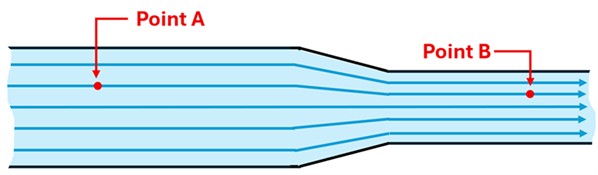
It follows then that for steady fluid motion, the flow paths (the blue arrows) are well-defined and do not cross.
Characteristic 4: Non-Turbulent
The final characteristic of an ideal fluid is that it is non-turbulent. This means that the individual fluid particles do not rotate around their own centers of mass. If a small wheel were placed in the fluid, it would translate (move in a line) in the direction that the water carries it, but it would not rotate. Maybe the best way to understand what non-turbulent fluid motion means is to contrast it with turbulent flow. The pictures below may be helpful to visualize this difference.
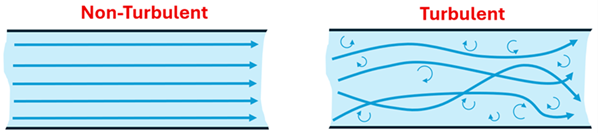
When honey or syrup is poured slowly, the molecules move in layers so that there is no swirling that occurs. This is an example of a fluid that is non-turbulent. Water flowing through a narrow pipe moves without swirling if its speed is slow. This is also non-turbulent motion. Contrast these with smoke from a fire, which becomes turbulent and swirls as the smoke rises. Whitewater rapids also swirl in a chaotic, turbulent motion.
Are ‘steady motion’ (characteristic 3) and ‘non-turbulence’ (characteristic 4) the same thing? Although steady motion is often non-turbulent, they do mean something different. Steady motion means the fluid’s velocity at a given point is unchanging in time. Non-turbulent means that the fluid moves in a smooth and layered motion in space, without swirling and chaotic mixing. Airflow in a wind tunnel at high speed might be steady (at any given point, the air always moves with the same velocity) but turbulent (at places within the wind tunnel, the air swirls).
No real fluid perfectly exhibits all these characteristics, just like no ramp is perfectly frictionless, and no rollercoaster perfectly conserves mechanical energy. However, these assumptions about ideal fluids will help us understand some important principles about pressure within fluids and about how fluids move. That is where we are headed next!
Check Your Understanding
Use the following questions to assess your understanding. Tap the Check Answer buttons when ready.
1. Incompressibility. The density of a fluid is determined by the equation ρ = m / V where m is the fluid’s mass, V is the fluid’s volume, and ρ is the fluid’s density. Now, assume significant pressure is applied to the fluid from all sides. Which graphic of this density equation best illustrates what occurs for a
(A) Compressible fluid
(B) Incompressible fluid
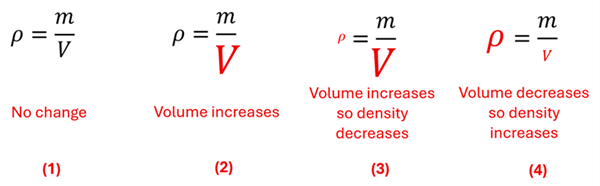
Check Part A Answer
Answer: 4
Check Part B Answer
Answer: 1
2. No Viscosity. Watch the below animation of two different fluids that fall into a clear container. Which fluid (left or right) illustrates a fluid with no viscosity?
Check Answer
Answer: left
A fluid with no viscosity has no internal friction between layers and therefore has no resistance to flow.
3. Steady fluid motion. For steady fluid motion, why can’t the flow path lines (lines that show the path of fluid particles' motion) cross?
Check Answer
Answer: The same point in space would have two velocities.
Recall that velocity describes speed in a given direction. Crossing flow path lines would mean that the direction (and thus the velocity) of the fluid at a given point changes with time.
4. Non-Turbulent. Identify the fluid motions below as turbulent or non-turbulent.
(A) Swirling smoke rising from a bonfire.
(B) Maple syrup poured slowly from a jar
(C) White-water rapids in a river.
(D) Water flowing through a narrow pipe at a slow speed
(E) Ocean waves breaking on the shore
Check Part A Answer
Answer: Turbulent
Check Part B Answer
Answer: Non-Turbulent
Check Part C Answer
Answer: Turbulent
Check Part E Answer
Answer: Non-Turbulent
Check Part E Answer
Answer: Turbulent
Figure 1 Modified from Wikimedia Commons (From Synapticrelay) https://commons.wikimedia.org/wiki/File:Viscosities.gif under license Creative Commons
Figure 2 Borrowed from Wikimedia Commons (From Synapticrelay) https://commons.wikimedia.org/wiki/File:Viscosities.gif under license Creative Commons
Figure 3 Borrowed from Wikimedia Commons (From Amethyst80) https://commons.wikimedia.org/wiki/File:Demonstration_of_viscosity_of_liquids.gif under license Creative Commons