Introduction to Fluids
Giant cruise ships are able to float in the ocean. Your ears pop when you swim to the bottom of the pool. A car mechanic is able to lift a massive car quite easily with a hydraulic jack. Airplanes experience a lift force that allows them to take off. What do these phenomena have in common? They all do what they do because of fluids.
This chapter is about fluids and why understanding the physics of fluids will help us make sense of everyday phenomena. In this first lesson, we’ll describe what fluids are and how we can distinguish one from another. In our second lesson, we’ll explore several fundamental principles that help us understand everything from why your ears pop when you swim to the bottom of a pool, to how a mechanic can almost effortlessly use hydraulics to lift a massive car with a hand pump, to why massive cruise ships float. And since a fluid is something that flows, in lesson three, we’ll consider fluids in motion. There, we’ll explore many more everyday examples, from why we have wind to why putting your thumb over the opening of a hose makes water squirt out faster to why a curveball curves and airplanes are able to fly. Since you encounter fluids in so many aspects of your life, this chapter will help you explain the world around you even more.
Not only does understanding fluids matter, fluids are matter. So, let’s begin to unpack what fluids are by understanding matter. Let’s look at the states in which we find matter in our lives every day.
States of Matter
Matter refers to the stuff that is all around us. It includes our school materials, the water that we drink, the air that we breathe, and your friends, families, and pets. This thing we call matter is defined as anything that is made of stuff and occupies space. In scientific terms, matter is anything that has mass and volume.
Mass: there has to be some stuff in the object
Volume: the stuff has to occupy some space
Physicists (like chemists) normally classify matter into three states: solid, liquid, or gas. While some classification systems also include a fourth state of matter called plasma, we’ll focus our attention on solids, liquids, and gases in this section.
While you may be familiar with these states of matter and may be able to give several examples of each, let’s look at what makes a solid different from a liquid, and a liquid different from a gas.
In the chapter on Matter in our Chemistry Tutorial, we use particle diagrams to assist in thinking about matter at the particle level. Particle diagrams represent the particles of a sample of matter using small circles. The particles can be thought of as atoms, molecules, or ions. The particle diagrams below are representations of the three states of matter.
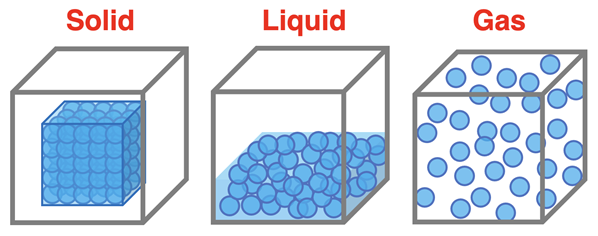
We see that the solid state diagram depicts an orderly arrangement of close-together particles occupying a fixed position. The sample does not expand to fill the container. There is a fixed volume and a fixed shape. Since it has a fixed volume and shape, it is very difficult to compress it or make it smaller. The gaseous state diagram depicts rather distant particles with no ordered arrangement. These particles fill the entire volume of the container, and the gas assumes the shape of the container. Unlike the solid, the gas can be compressed to take up less volume if we squeeze it on all sides. The liquid state depicts close-together molecules with no orderly arrangement, with a shape that is determined by the container and occupying a volume that is not determined by the container. We might summarize a few of the distinguishing characteristics of each state of matter in a table like this.
| Property |
Solid |
Liquid |
Gas |
| Shape |
Fixed |
Not fixed |
Not fixed |
Particle
Arrangement |
Ordered |
Not ordered |
Not ordered |
| Volume |
Fixed |
Fixed |
Not Fixed |
| Compressibility |
Not easily
compressed |
Not easily
compressed |
Compressible |
We’ve highlighted in red the properties that are fixed and don’t easily change. We’ve highlighted in green the things that are not fixed and do change. Of the properties listed, we see that solids tend to be very fixed, gases are not fixed, and liquids share some properties of both.
One important characteristic that makes gases unique is that their volume is not fixed. This leads to the fact that gases are generally compressible, whereas liquids and solids are not easily compressed. This will be an important quality as we explore the characteristics of ideal fluids in an upcoming section.
What are Fluids?
This chapter is about fluids. So, we come to an important question: What are fluids? Is a fluid just another name for a liquid? What does it mean for something to be a fluid?
A fluid is not always a liquid, but all liquids are fluids. In physics, the term fluid typically refers to substances that can flow. As such, these would be substances that do not have a fixed shape. We see from the table above that this includes both liquids and gases. Both liquids and gases are made of molecules, atoms, or ions that can move freely past one another and take the shape of their container. So, to answer our question, all liquids and gases are fluids. Solids are not fluids.
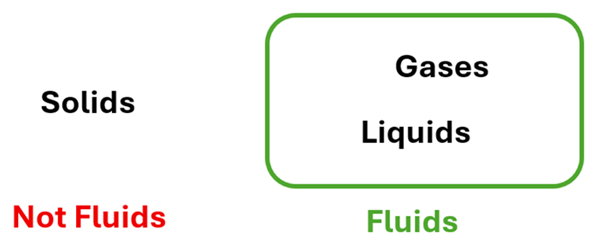
Now that we’ve described what a fluid is, we’re ready to look at one of the properties of a fluid that makes one fluid unique from another—the property of density. Let’s explore the property of density in the next section.
Check Your Understanding
Use the following questions to assess your understanding. Tap the Check Answer buttons when ready.
1. Consider a solid. Which of the following characteristics is true of a solid? Select all that apply
☐ Has a fixed shape
☐ Has an ordered arrangement of particles
☐ Has a fixed volume
☐ Is not easily compressed
Check Answer
Answer: All Apply.
⌧ Has a fixed shape
⌧ Has an ordered arrangement of particles
⌧ Has a fixed volume
⌧ Is not easily compressed
2. Consider a liquid. Which of the following characteristics is true of a liquid? Select all that apply
☐ Has a fixed shape
☐ Has an ordered arrangement of particles
☐ Has a fixed volume
☐ Is not easily compressed
Check Answer
Answer: Only fixed volume and not easily compressed are true.
☐ Has a fixed shape
☐ Has an ordered arrangement of particles
⌧ Has a fixed volume
⌧ Is not easily compressed
3. Consider a gas. Which of the following characteristics is true of a gas? Select all that apply
☐ Has a fixed shape
☐ Has an ordered arrangement of particles
☐ Has a fixed volume
☐ Is not easily compressed
Check Answer
Answer: None are true.
☐ Has a fixed shape
☐ Has an ordered arrangement of particles
☐ Has a fixed volume
☐ Is not easily compressed
4. Identify each statement as true or false.
(A) All liquids are fluids
(B) All fluids are liquids
(C) All gases are fluids
(D) Fluids are any gases and any liquids
Check Part A Answer
Answer: True
Check Part b Answer
Answer: False
Fluids can be gases or liquids.
Check Part C Answer
Answer: True
Check Part D Answer
Answer: True
Fluids can be gases or liquids because they can both flow.