The Big Idea
A nucleus changes its identity through a nuclear reaction. Those changes follow strict conservation rules. By ensuring mass number and atomic number remain balanced on both sides of the equation, we can track what particle is emitted and what new nucleus form.
Chemical Reactions Revisited
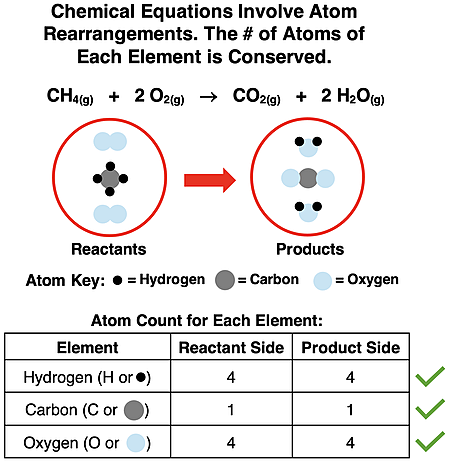
Chemical reactions, as introduced in Chapter 8 of this Chemistry Tutorial, are quite different than the nuclear transmutations discussed in this chapter. Chemical reactions involve the breaking of bonds in the reactants, the rearrangement of atoms, and the formation of new bonds in the products. Chemical equations describe the result of these atom rearrangements. Because atoms are not created nor destroyed but simply rearranged, we observe the same number of atoms of each element on the reactant side as on the product side. The task of balancing a chemical equation involved the addition of coefficients in front of the formulae in an effort to balance atoms. Atom counts were performed for each element to ensure that the number of atoms on the reactant side equals the number of atoms on the product side of the equation.
Nuclear Transmutation
In Lesson 1a, we learned that certain isotopes of elements have unstable nuclei. These radioisotopes naturally undergo a transmutation, often into the nucleus of a different element. That is, we might start with the nucleus of a carbon-14 atom and end with the nucleus of a nitrogen-14 atom. Clearly, the atom of carbon is not conserved. This transmutation is represented by a nuclear equation like the one below for beta decay.

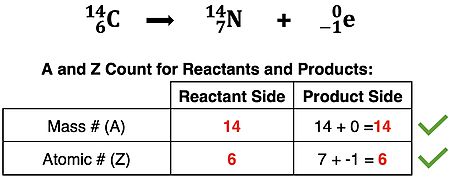
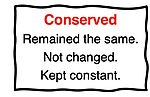
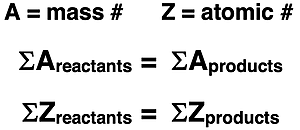 The isotope symbols in the equation consist of an element symbol, the corresponding atomic number, and the mass number of the isotope. One pattern that we ALWAYS observe is that the sum of the mass numbers (A) of all species on the reactant side equals the sum of the mass numbers for all species on the product side. We also ALWAYS observe that the sum of the atomic numbers (Z) are the same on the reactant side as on the product side. Just as we performed an atom count to ensure that a chemical equation is balanced, we could perform a mass number and atomic number count to ensure that a nuclear equation is balanced. This is shown below:
 Law of Conservation of Mass and Charge
There are two fundamental principles that underly both a chemical equation and a nuclear equation. As we mentioned above, the principle is not the conservation of atoms as it does not apply to a nuclear equation. The two fundamental principles are the law of conservation of mass and the law of conservation of charge. Mass and charge are conserved in both chemical and nuclear equations.
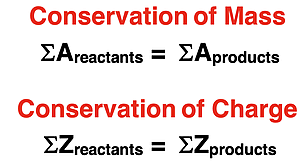 Let's look at nuclear equations through the lens of these two fundamental principles. Nuclear equations describe the changes in the nucleus. Protons and the neutrons give the nucleus its mass. The sum the protons and the neutrons is the mass number. We have observed that this sum is the same on the reactant and the product side, demonstrating the law of conservation of mass. Protons give the nucleus its charge (neutron have no overall charge). The atomic number describes the number of protons. Thus, the atomic number reflects the nuclear charge. We have observed that this sum of the atomic numbers is the same on the reactant and the product side, demonstrating the law of conservation of charge.
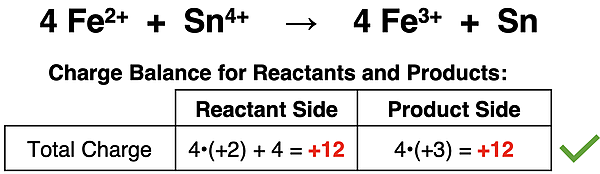
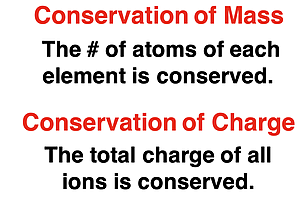 Now let's look at chemical equations through the lens of these two fundamental principles. The mass of the species in a chemical equation is related to the number of atoms of each element )and their molar mass). That fact that the number of atoms of each element is the same on the reactant and the product side demonstrates the law of conservation of mass. In many instances, the reactants and products of a chemical equation have no overall charge. But if they are ions, we would observe a charge. The law of conservation of charge would state that the sum of the ion charges on the reactant side is equal to the sum of the ion charges on the product side. This is demonstrated by the net ionic equation for the oxidation-reduction reaction shown below.
How to Write Balanced Nuclear Equations
The task of balancing a nuclear equation often involves determining the identity (and symbol) of an unknown particle or determining the identity (and symbol) of an unknown isotope. The process begins by writing down the symbols of ...
- All known isotopes on the reactant side (known as the parent nucleus)
- All known isotopes on the product side (known as the daughter nucleus)
- Any particles that are known to be present on either the reactant or product side
There is often an unknown particle or nucleus on the reactant or product side. Leave space for writing in its symbol once you have determined it. Conduct a mass balance and a charge balance to determine the A value (superscript) and the Z value (subscript) of any missing particle or nucleus. Once you known the A and Z values of the unknown, you can use
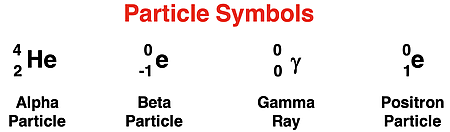
a periodic table (for isotopes) to determine the elemental symbol or your understanding of particles to determine the particle symbol (shown below).
The examples below demonstrate the use of this strategy. Additional practice is available in the
Check Your Understanding section and links to additional problems with feedback are listed in the
Before You Leave section.
Example 1 - Writing a Balanced Nuclear Equation
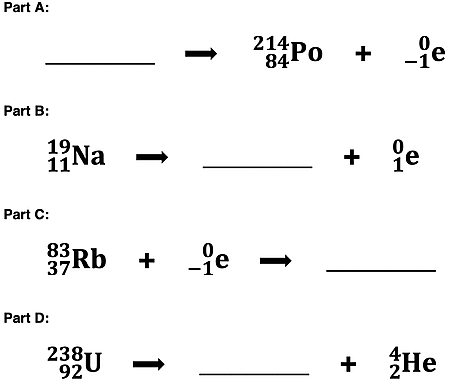
For the following nuclear equations, determine the symbol and the name of the unknown reactant or product. Tap a Check Answer button to view an answer and the solution.
Solution:
Check Part A
Part A Solution: The parent nucleus (reactant side) is unknown. We can use a mass and charge analysis to determine its atomic and mass numbers. A mass analysis or mass number (A) balance would lead to this simple mathematical statement:
Aparent nucleus = 214 + 0
The mass number of the parent nucleus is 214. A charge analysis or atomic number (Z) balance would lead to the statement:
Zparent nucleus = 84 + -1
The atomic number of the parent nucleus is 83. Using the periodic table, we can identify the parent nucleus as being bismuth (Bi). Its name is
bismuth-214. The nuclear equation can be written as ...
Check Part B
Part B Solution: The daughter nucleus (product side) is unknown. We can use a mass and charge analysis to determine its atomic and mass numbers. A mass analysis or mass number (A) balance would lead to this simple mathematical statement:
19 = Adaughter nucleus + 0
The mass number of the daughter nucleus is 19. A charge analysis or atomic number (Z) balance would lead to the statement:
11 = Zdaughter nucleus + 1
The atomic number of the daughter nucleus is 10. Using the periodic table, we can identify the daughter nucleus as being neon (Ne). Its name is
neon-19. The nuclear equation can be written as ...
Check Part C
Part C Solution: The daughter nucleus (product side) is unknown. We can use a mass and charge analysis to determine its atomic and mass numbers. A mass analysis or mass number (A) balance would lead to this simple mathematical statement:
83 + 0 = Adaughter nucleus
The mass number of the daughter nucleus is 83. A charge analysis or atomic number (Z) balance would lead to the statement:
37 + -1 = Zdaughter nucleus
The atomic number of the daughter nucleus is 36. Using the periodic table, we can identify the daughter nucleus as being krypton (Kr). Its name is
krypton-83. The nuclear equation can be written as ...
Check Part D
Part D Solution: The daughter nucleus (product side) is unknown. We can use a mass and charge analysis to determine its atomic and mass numbers. A mass analysis or mass number (A) balance would lead to this simple mathematical statement:
238 = Adaughter nucleus + 4
The mass number of the daughter nucleus is 234. A charge analysis or atomic number (Z) balance would lead to the statement:
92 = Zdaughter nucleus + 2
The atomic number of the daughter nucleus is 90. Using the periodic table, we can identify the daughter nucleus as being thorium (Th). Its name is
thorium-234. The nuclear equation can be written as ...
Example 2 - Writing a Balanced Nuclear Equation
Given the word equations, write the balanced nuclear equation and identify the name of the daughter nucleus. Tap a Check Answer button to view an answer and the solution.
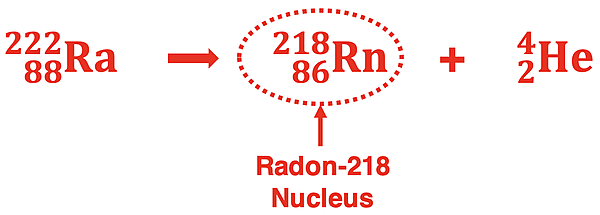
a. A radium-222 nucleus undergoes alpha decay.
Check Part A
Part a Solution:Radium-222 is the reactant (the parent nucleus). Using a periodic table, we learn that radium (Ra) has an atomic number of 88. One of the products is an alpha particle. The other product is the
daughter nucleus. We don't know what the daughter nucleus is; we can figure that out through a mass and charge analysis. We can set up the nuclear equation with a blank for the daughter nucleus:
A mass analysis or mass number (A) balance would lead to this simple mathematical statement:
222 = Adaughter nucleus + 4
The mass number of the daughter nucleus is 218. A charge analysis or atomic number (Z) balance would lead to the statement:
88 = Zdaughter nucleus + 2
The atomic number of the daughter nucleus is 86. Using the periodic table, we can identify the daughter nucleus as being radon (Rn). Its name is
radon-218. The nuclear equation can be written as ...
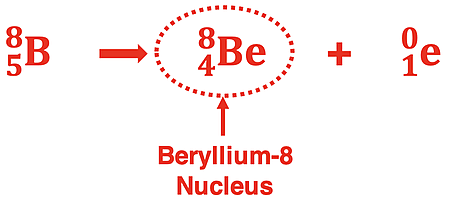
b. A boron-8 nucleus undergoes positron decay.
Check Part B
Part b Solution:
Boron-8 is the reactant (the parent nucleus). Using a periodic table, we learn that boron (B) has an atomic number of 5. One of the products is a positron. The other product is the
daughter nucleus. We don't know what the daughter nucleus is; we can figure that out through a mass and charge analysis. We can set up the nuclear equation with a blank for the daughter nucleus:
A mass analysis or mass number (A) balance would lead to this simple mathematical statement:
8 = Adaughter nucleus + 0
The mass number of the daughter nucleus is 8. A charge analysis or atomic number (Z) balance would lead to the statement:
5 = Zdaughter nucleus + 1
The atomic number of the daughter nucleus is 4. Using the periodic table, we can identify the daughter nucleus as being beryllium (Be). Its name is
beryllium-8. The nuclear equation can be written as ...
c. A silver-108 nucleus undergoes beta decay.
Check Part C
Part c Solution:
Silver-108 is the reactant (the parent nucleus). Using a periodic table, we learn that silver (Ag) has an atomic number of 47. One of the products is an electron. The other product is the
daughter nucleus. We don't know what the daughter nucleus is; we can figure that out through a mass and charge analysis. We can set up the nuclear equation with a blank for the daughter nucleus:
A mass analysis or mass number (A) balance would lead to this simple mathematical statement:
108 = Adaughter nucleus + 0
The mass number of the daughter nucleus is 108. A charge analysis or atomic number (Z) balance would lead to the statement:
47 = Zdaughter nucleus + -1
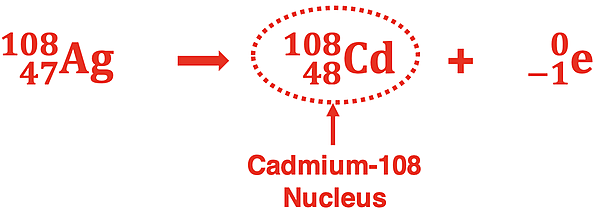
The atomic number of the daughter nucleus is 48. Using the periodic table, we can identify the daughter nucleus as being cadmium (Cd). Its name is
cadmium-108. The nuclear equation can be written as ...
Example 3 - Writing a Balanced Nuclear Equation
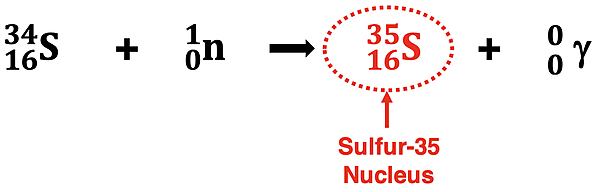
The nuclear equation below describes a neutron bombardment reaction (to be discussed in Lesson 3). Identify the unknown product.
View Answer and Solution
Solution:The daughter nucleus (product side) is unknown. We can use a mass and charge analysis to determine its atomic and mass numbers. A mass analysis or mass number (A) balance would lead to this simple mathematical statement:
34 + 1 = Adaughter nucleus + 0
The mass number of the daughter nucleus is 35. A charge analysis or atomic number (Z) balance would lead to the statement:
16 + 0 = Zdaughter nucleus + 0
The atomic number of the daughter nucleus is 16. Using the periodic table, we can identify the daughter nucleus as being sulfur (S). Its name is
sulfur-35. The nuclear equation can be written as ...
Before You Leave - Practice and Reinforcement
Practice definitely makes perfect ... and that's what the rest of the page is about. It's your turn to strengthen your understanding and put the ideas into practice. Here's some suggestions.
Check Your Understanding of Nuclear Equations
Use the following questions to develop your skill at writing balanced nuclear equations. Tap the Check Answer buttons when ready.
1. Use appropriate isotope symbols and particle symbols to write balanced nuclear equations from the following word equations.
a. An americium-243 (Am-243) nucleus undergoes alpha decay.
Check Part A
Part a Solution:Americium-243 (Am-243) is the reactant (the parent nucleus). Using
a periodic table, we learn that americium (Am) has an atomic number of 95. One of the products is an alpha particle. The other product is the
daughter nucleus. We don't know what the daughter nucleus is; we can figure that out through a mass and charge analysis. We can set up the nuclear equation with a blank for the daughter nucleus:
A mass analysis or mass number (A) balance would lead to this simple mathematical statement:
243 = Adaughter nucleus + 4
The mass number of the daughter nucleus is 239. A charge analysis or atomic number (Z) balance would lead to the statement:
95 = Zdaughter nucleus + 2
The atomic number of the daughter nucleus is 93. Using
a periodic table, we can identify the daughter nucleus as being neptunium (Np). Its name is
neptunium-239. The nuclear equation can be written as ...
b. A yttrium-85 (Y-85) nucleus undergoes positron emission.
Check Part B
Part b Solution:Yttrium-85 is the reactant (the parent nucleus). Using
a periodic table, we learn that yttrium (Y) has an atomic number of 39. One of the products is a positron particle. The other product is the
daughter nucleus. We don't know what the daughter nucleus is; we can figure that out through a mass and charge analysis. We can set up the nuclear equation with a blank for the daughter nucleus:
A mass analysis or mass number (A) balance would lead to this simple mathematical statement:
85 = Adaughter nucleus + 0
The mass number of the daughter nucleus is 85. A charge analysis or atomic number (Z) balance would lead to the statement:
39 = Zdaughter nucleus + 1
The atomic number of the daughter nucleus is 38. Using
a periodic table, we can identify the daughter nucleus as being strontium (Sr). Its name is
strontium-85. The nuclear equation can be written as ...
c. A cobalt-57 (Co-57) nucleus undergoes electron capture.
Check Part C
Part c Solution:
Cobalt-57 is the reactant (the parent nucleus). Using
a periodic table, we learn that cobalt (Co) has an atomic number of 27. Since this is an electron capture, there is a second reactant - an electron. The only product is the daughter nucleus. We don't know what the daughter nucleus is; we can figure that out through a mass and charge analysis. We can set up the nuclear equation with a blank for the daughter nucleus:
A mass analysis or mass number (A) balance would lead to this simple mathematical statement:
57 + 0 = Adaughter nucleus
The mass number of the daughter nucleus is 57. A charge analysis or atomic number (Z) balance would lead to the statement:
27 + -1 = Zdaughter nucleus
The atomic number of the daughter nucleus is 26. Using
a periodic table, we can identify the daughter nucleus as being iron (Fe). Its name is
iron-57. The nuclear equation can be written as ...
d. A hydrogen-3 nucleus undergoes beta decay.
Check Part D
Part d Solution:
Hydrogen-3 is the reactant (the parent nucleus). Using
a periodic table, we learn that hydrogen (H) has an atomic number of 1. One of the products is an electron. The other product is the
daughter nucleus. We don't know what the daughter nucleus is; we can figure that out through a mass and charge analysis. We can set up the nuclear equation with a blank for the daughter nucleus:
A mass analysis or mass number (A) balance would lead to this simple mathematical statement:
3 = Adaughter nucleus + 0
The mass number of the daughter nucleus is 3. A charge analysis or atomic number (Z) balance would lead to the statement:
1 = Zdaughter nucleus + -1
The atomic number of the daughter nucleus is 2. Using
a periodic table, we can identify the daughter nucleus as being helium (He). Its name is
helium-3. The nuclear equation can be written as ...
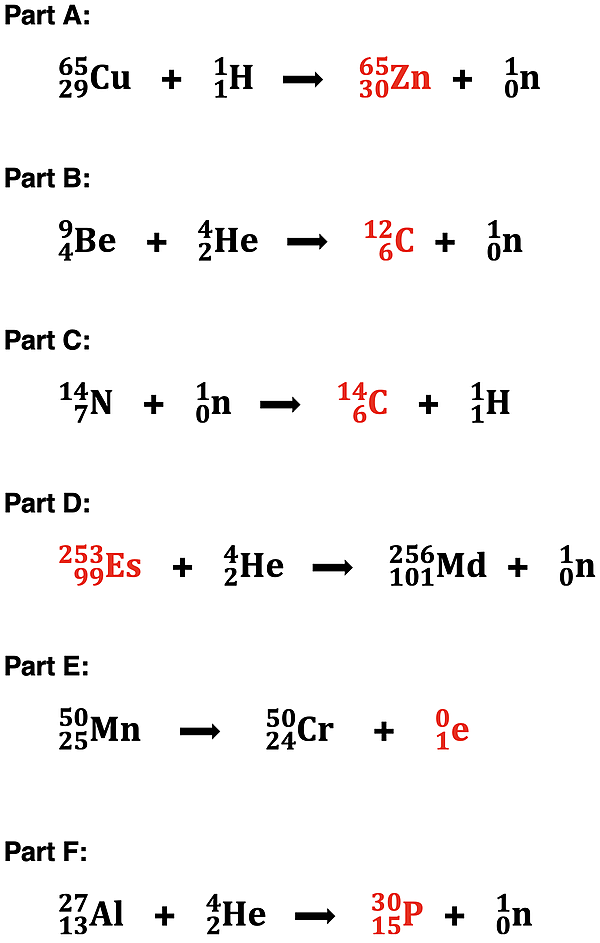
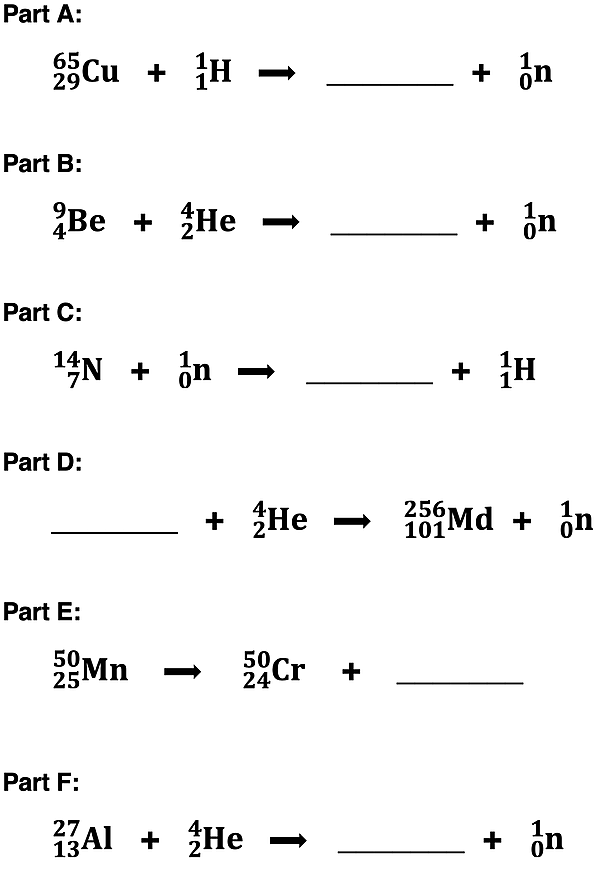
2. The following nuclear transmutations may be unfamiliar to you at the moment (but not by chapter's end). An understanding of mass balance (A values) and charge balance (Z values) will allow you to determine the symbol of the missing particle or nucleus. Determine answers to Parts A through F; then tap the
Check Answers button to see how you did.
Check Answers
Answers in Red: For each part, conduct a mass number balance to determine the superscript of the missing nucleus. The sum of the superscripts on the left side should equal the sum of the superscripts on the right side.
Conduct an atomic number balance to determine the subscript of the missing nucleus. The sum of the subscripts on the left side should equal the sum of the subscripts on the right side.
The subscript is the atomic number of the element. Once the subscript of the unknown nucleus is known, use
a periodic table to determine the elemental symbol. Put it all together - superscript, subscript, and symbol - and you're done.