Lesson 2: Rates of Decay
Part b: Radioactive Dating
Part a:
Half-Life
Part b: Radioactive Dating
The Big Idea
Because radioactive isotopes decay at constant, measurable rates, they serve as natural clocks inside ancient materials. Radioactive dating connects nuclear chemistry to geology, archaeology, and biology - revealing timelines that would otherwise remain hidden.
What is Radioactive Dating?
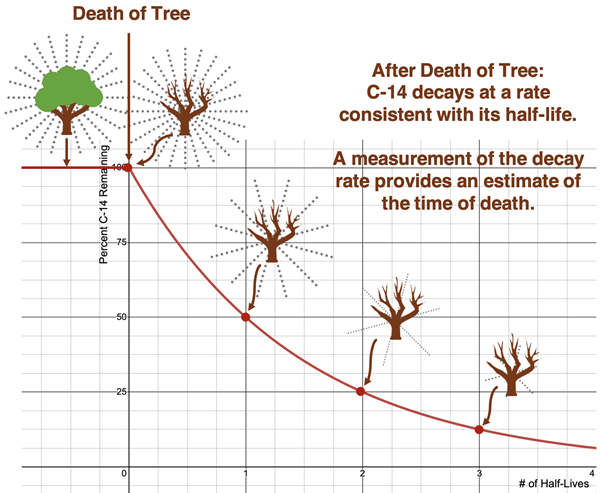
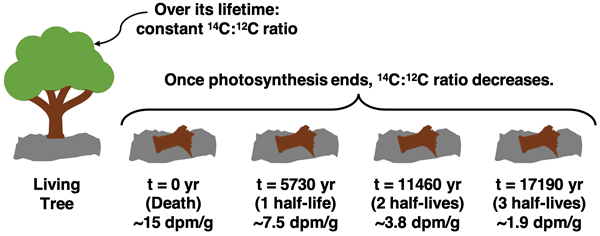
Radioactive dating is the process of using radiation emitted by radioisotopes to determine the age of an archaeological artifact or geologic formation. The most common type of radioactive dating is carbon-14 dating. The C-14 dating process is based on the premise that living species assimilate the C-14 isotopes into their structures through photosynthesis and food consumption. This intake of carbon-14 is balanced by its natural radioactive decay, giving the species a relatively constant amount of carbon-14 relative to the non-radioactive carbon-12. Once the species dies, photosynthesis and the intake of carbon-14 ceases. Yet the decay of carbon-14 continues and the ratio of carbon-14 to carbon-12 gradually declines.
Carbon-14
Carbon-14 is the only naturally occurring radioisotope of carbon. It is produced in the upper atmosphere as a product of a chain of nuclear events. A cosmic ray striking a helium nucleus will emit a neutron. The neutron bombards a nearby nitrogen atom to produce carbon-14.

The carbon-14 produced in the upper atmosphere reacts with oxygen molecules to form carbon dioxide. This CO2, with a radioactive C-14 atom, joins the non-radioactive CO2 molecules as part of the natural carbon cycle. Approximately 1 atom of every trillion carbon atoms is radioactive C-14.
Living plants gather CO2 through photosynthesis, thus contributing to the amount of carbon-14 in its structure. Animals consume plants, contributing to the amount of carbon-14 in their body. While this carbon-14 intake is occurring, the radioisotope undergoes a natural radioactive decay:

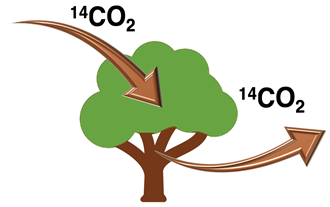 The beta decay of carbon-14 counteracts its accumulation through metabolism and food consumption. While an organism is alive, it continually takes in new carbon; plants absorb CO₂ from the air and animals obtain carbon by eating plants or other animals. This constant exchange keeps the C-14 to C-12 ratio in the organism the same as in the environment.
The death of the species - plant or animal - disrupts the carbon cycle and ends the balancing act. There is no more intake of carbon-14 from the environment through photosynthesis and food consumption. But because it is radioactive, carbon-14 continues to decay while carbon-12 levels remain steady. Over time, the C-14 to C-12 ratio decreases. The rate by which it decreases follows the natural decay curve of any radioisotope.
Carbon-14 Dating
A gram of pure carbon from a modern living organism is observed to undergo approximately 15 beta decays per minute (dpm). This value of 15 dpm per gram of carbon has historically been used as the reference activity in carbon-14 dating. It reflects the natural ratio of C-14 to C-12 in the atmosphere.
A dead organism will decay at a lesser rate due to the decrease of carbon-14 in its structure. The longer that it has been dead, the less carbon-14 that is present and the lower the decay rate. By measuring the decay rate per gram of carbon, the age of the organism can be determined. The half-life of carbon-14 is approximately 5730 years. Since the decay rate is proportional to the amount of carbon-14 present, the usual mathematics can be applied.
Review: Mathematics of Radioactive Decay.
Example 1 - Using Carbon-14 Activity to Determine the Age of a Sample
A scientist is using carbon-14 dating methods to determine the age of some skeletal remains at an ancient burial site. The skeletons have an activity of 10.8 decays per minute per gram of carbon. Assuming negligible changes in carbon-14 concentrations over time, we can assume that the activity was 15 decays/minute at the time of death. Use the half-life of carbon-14 (5730 years) to determine the age of the skeletal remains.
Solution:
The decay rate is proportional to the amount of C-14. At the time of death, it was 15.0 dpm per gram of carbon. At time t, it is 10.8 dpm. Our knowns and unknowns are:
No = 15.0 dpm
N = 10.8 dpm
t1/2 = 5730 yr
t = ???
We will use the equation t = - t1/2 • ln(f) / ln(2) to solve for the time. The f value represents the fraction of C-14 remaining in the skeleton; it is equal to N/No. Our first step is to determine f. Then we will calculate the time.
f = N/No = 10.8 dpm / 15.0 dpm = 0.720
t = - t1/2 • ln(f) / ln(2) = - 5730 yr • ln(0.720) / ln(2) = 2720 yr
(rounded from 2715.625 ... yr)
Example 2 - Relating Carbon-14 Activity to the Age of a Sample
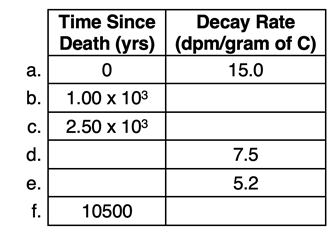 At the time of death, a living species will contain sufficient carbon-14 in their bodies to decay at a rate of 15.0 decays/minute per gram of carbon. The half-life of carbon-14 is 5730 years. Use this information to complete the rows of the table.
Solution:
There are two types of problems here. One involves determining the decay rate (rows b, c, and f). The other involves determining the time (rows d and e). For each problem type, we will assume the amount (N) of C-14 is proportional to the decay rate. As such, we will use the decay rate as the value of N (and No).
For Rows b, c, and f: we will use N = No / 2n where n = # of half-lives = t/t1/2. We will first calculate n and use the n value to determine the decay rate.
For Rows d and e: we will use t = - t1/2 • ln(f) / ln(2) to solve for the time. The f value represents the fraction of C-14 remaining in the skeleton; it is equal to N/No. We will first calculate f and use the f value to determine the time.
Row b:
No = 15.0 dpm, t = 1.00x10³ yr, t1/2 = 5730 yr
N = ???
n = t / t1/2= 1.00x10³ yr / 5730 yr = 0.17452 ...
N = No / 2n = 15.0 dpm / 20.17452... = 13.3 dpm
Row c:
No = 15.0 dpm, t = 2.50x10³ yr, t1/2 = 5730 yr
N = ???
n = t / t1/2= 2.50x10³ yr, / 5730 yr = 0.43630 ...
N = No / 2n = 15.0 dpm / 20.43630 ... = 11.1 dpm
Row d:
No = 15.0 dpm, N = 7.5 dpm, t1/2 = 5730 yr
N = ???
f = N / N0= 7.5 dpm / 15.0 dpm = 0.500 (NOTE: the activity is cut in half)
t = - t1/2 • ln(f) / ln(2) = - 5730 yr • ln(0.500) / ln(2) = 5730 yr
(That makes sense! It takes a half-life of time to cut the activity in half.)
Row e:
No = 15.0 dpm, N = 5.2 dpm, t1/2 = 5730 yr
N = ???
f = N / N0= 5.2 dpm / 15.0 dpm = 0.34666 ...
t = - t1/2 • ln(f) / ln(2) = - 5730 yr • ln(0.34666 ...) / ln(2) = 8760 yr
(rounded from 8757.6115... yr)
Row f:
No = 15.0 dpm, t = 10500 yr, t1/2 = 5730 yr
N = ???
n = t / t1/2= 10500 yr / 5730 yr = 1.83246 ...
N = No / 2n = 15.0 dpm / 21.83246... = 4.2 dpm
(rounded from 4.21177 ... dpm)
Limitations of Carbon-14 Dating
Carbon-14 dating methods were developed by chemist Willard Libby from the University of Chicago in the 1940s. It provides a reasonably accurate estimate of the age of once-living organisms up to approximately 50,000 years. Beyond 50,000 years, the carbon-14 content of the organism decreases to levels that are no longer measurable.
 The carbon-14 dating method assumes that the proportion of C-14 to C-12 is constant over the past 50,000 years of time. The fact is that the ratio is not quite as constant as pi (π). A few of the causes of non-constancy include the increased use of fossil fuel combustion and nuclear weapons testing. Fossil fuel combustion contributes to the carbon dioxide content in the atmosphere. But since the fuels that are burned are derived from died-a-long-time-ago fossils that are depleted of their carbon-14, there is a dilution effect. The contribution of this CO2 to the atmosphere causes a lowering of the modern ratio below what it would have been in less recent geologic history. The nuclear weapons testing during the two decades prior to their ban in 1963 caused an infamous bomb spike in the proportion of carbon-14. The detonation of nuclear weapons in the atmosphere produced neutrons that changed N-14 atoms into C-14 atoms by the same process that naturally occurs in the upper atmosphere.
Since the 1960s, there has been considerable research into atmospheric levels of carbon-14. Analysis of polar ice samples and annual tree rings have allowed scientists to confirm that fluctuations in carbon-14 levels are not drastic. These studies have also led to correction factors and calibration curves to account for fluctuations and provide more accurate dating results.
Before You Leave - Practice and Reinforcement
Now that you've done the reading, take some time to strengthen your understanding and to put the ideas into practice. Here's some suggestions.
- Our Calculator Pad section is the go-to location to practice solving problems. You’ll find plenty of practice problems on our Nuclear Chemistry page. Check out the following problem set: Set NC7: Radioactive Dating
- The Check Your Understanding section below includes questions with answers and explanations. It provides a great chance to self-assess your understanding.
- Download our Study Card on Carbon-14 Dating. Save it to a safe location and use it as a review tool.
Check Your Understandingof Carbon-14 Dating
Use the following questions to assess your understanding of how carbon-14 dating works. Tap the Check Answer buttons when ready.
1. Carbon-14 is present in our environment because _____.
- of the combustion of fossil fuels
- it is produced when a living organism dies
- it is produced by the decay of uranium-238 isotope
- cosmic rays interact with gases in our upper atmosphere, leading to C-14 production
Check Answer
Answer: D
Cosmic rays bombard a helium atom, releasing a neutron. The neutron bombards a nearby nitrogen atom, producing carbon-14.
2. Carbon-14 dating is used to determine the age of ______.
- any organism that has died since the solar system was formed
- rocks, dinosaurs, and just about any other ancient artifact
- organisms that have died in the past 50,000 years
- uranium deposits found beneath the earth
Check Answer
Answer: C
Carbon-14 dating methods are used to determine the time of death of organisms (once living things) that have died in the past 50,000 years. Carbon-14 levels of dead organisms much older than 50,000 years are too low to have detectable decay rates.
3. The accuracy of the carbon-14 dating method is dependent upon the following. Choose all that apply.
- Cosmic rays have bombarded the Earth’s atmosphere at essentially the same rate in the past 50,000 years.
- The half-life associated with the beta decay of carbon-14 is a constant value.
- The ratio of C-14 to C-12 in the atmosphere has not significantly changed in the past 50,000 years.
- The C-14 to C-12 ratio in a living organism is the same as the ratio in the atmosphere.
- The carbon-14 content of rocks is the same today as it was 50,000 years ago.
Check Answer
Answer: A, B, C, and D (NOT E)
Carbon-14 is not used to date rocks; so the carbon-14 levels in rocks is not important to the validity of carbon-14 dating.
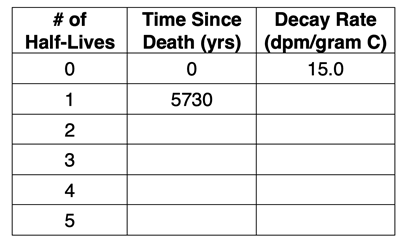
4. Complete the following table. (
Fancy equation not required.)
Check Answer
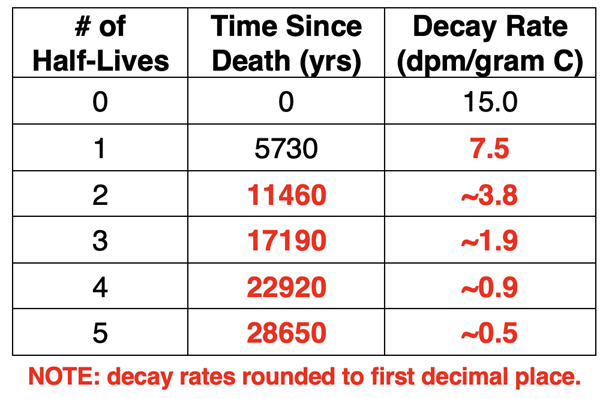
Answer: See Graph
The amount of C-14 in the sample is halved every 5730 years. The decay rate is proportional to the amount. So the decay rate will halve every 5730 years. (The unit on decay rate is decays per minute per gram of carbon.)
5. Fragments from an ancient tree have a decay rate of 12.5 dpm/g. How many years ago did the tree die?
Check Answer
Answer: 1510 yr
The decay rate is proportional to the amount of C-14. At the time of death, it was 15.0 dpm per gram of carbon. At time t, it is 12.5 dpm/g. Our knowns and unknowns are:
No = 15.0 dpm/g
N = 12.5 dpm/g
t1/2 = 5730 yr
t = ???
We will use the equation t = - t1/2 • ln(f) / ln(2) to solve for the time. The f value represents the fraction of C-14 remaining in the skeleton; it is equal to N/No. Our first step is to determine f. Then we will calculate the time.
f = N/No = 12.5 dpm / 15.0 dpm = 0.8333333 ...
t = - t1/2 • ln(f) / ln(2) = - 5730 yr • ln(0.8333333 ...) / ln(2) = 1510 yr
(rounded from 1507.187... yr)