Hold down the T key for 3 seconds to activate the audio accessibility mode, at which point you can click the K key to pause and resume audio. Useful for the Check Your Understanding and See Answers.
Lesson 1: A Model of Solutions
Part a: What is a Solution?
Part a: What is a Solution?
Part b:
Solubility and Structure
Part c:
The Dissolving Process
Part d:
Solubility, Temperature, and Pressure
Part e:
Dissociation of Ionic Compounds
The Big Idea
In chemistry, a solution is a stable, uniform mixture of solute(s) dissolved in a solvent. This lesson explores how that works.
Solutions Are Everywhere
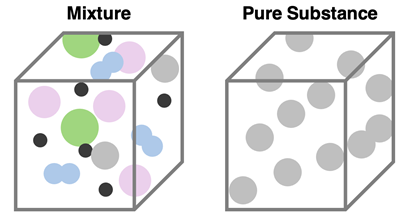 In Chapter 2 of our Chemistry Tutorial, we discussed the distinction between pure substances and mixtures. In nature, mixtures are considerably more common than pure substances. And even in our daily lives, the consumer products that we encounter are more likely to be mixtures of two or more substances than they are to be pure substances.
One type of mixture is a solution. It is mixture in which its parts or components are intermingled in such a matter that you cannot distinguish between them. Solutions are everywhere. The air you breathe is a solution of several gases, predominantly nitrogen and oxygen gas. The water you drink is a solution of numerous minerals and salts, and on occasion, dissolved gases. The likelihood is hight that the food you eat, the clothes you wear, the products in your refrigerator and kitchen cabinets, the surfaces you walk on and sit on and sleep on, and just about everything else is a solution. Given their prevalence, a Chemistry Tutorial that focuses on the study of matter would not be complete without a discussion of solutions.
What is a Solution?
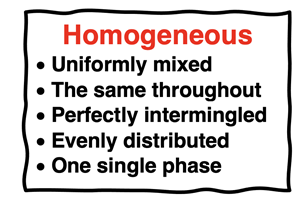 A solution is a homogeneous mixture of two or more substances. In referring to a solution as homogeneous, we mean uniformly distributed. The two (or more) parts are intermingled evenly. The air you breathe at head level is guaranteed to be identical to the air at the top and the bottom of the room since its parts are distributed uniformly.
A solution is a stable mixture. Provided temperature and pressure conditions are maintained, the parts of the solution will not separate and settle out. This makes a solution quite different than a heterogeneous mixture like oil and vinegar salad dressing. When the salad dressing is mixed, the oil and vinegar intermingle. But their intermingling is a temporary condition, and within time the oil and vinegar will once again settle out into their separate phases. A solution is not like that; the intermingling of its parts is not a temporary condition. It is a stable mixture; its parts will not settle out.
Solutions Consist of Solutes and a Solvent
 A solution consists of a solvent and at least one solute. These can be solids, liquids, or gases. While air is a mixture of several gases, tap water is a mixture of numerous solids and some gases dissolved in liquid water. A metal alloy, discussed in Lesson 3a of Chapter 11, is most often a mixture of two or more solids. Vinegar is a homogenous mixture of water and acetic acid. A soda is a mixture of water, flavorings, sweeteners, colorants, and dissolved carbon dioxide gas.
The solvent is generally regarded as the dissolving medium or the major component in the mixture. The solutes are the other components that are dispersed about the dissolving medium. Maintaining a stable solution requires that the solvent and the solute interact at the particle level through interparticle forces that hold them in place and ensure their stability. We will discuss the role of these interparticle forces in greater detail in Lesson 1b.
Aqueous Solutions
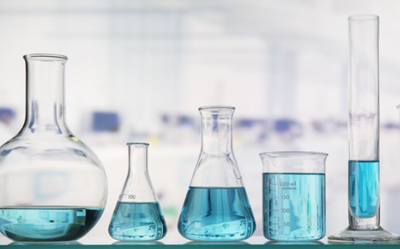 An aqueous solution is a solution in which water is the solvent. Partly because water is so abundantly available on Earth, and partly because it is such an effective solvent, aqueous solutions are the most common type of solution both inside and outside of the Chemistry classroom. Water is very effective at dissolving ionic compounds and polar covalent compounds. Even biological compounds like protein, enzymes, and B and C vitamins readily dissolve in water. Nonpolar substances like oils, fats, gasoline, and other hydrocarbons are unable to dissolve in water.
Most of our studies of solutions in Chapter 13 will be focused on aqueous solutions. The particles that are dissolved in an aqueous solution can be atoms, molecules, or ions. As we continue through these lessons, we will learn why and how solutes dissolve, why and when the dissolved particles are ions, the factors that affect the amount of dissolved solute, and how to mathematically describe the amount of solute that is dissolved in water.
Before You Leave - Practice and Reinforcement
Now that you've done the reading, take some time to strengthen your understanding and to put the ideas into practice. Here's some suggestions.
- The Check Your Understanding section below include questions with answers and explanations. It provides a great chance to self-assess your understanding.
Check Your Understanding of Solution Basics
Use the following questions to assess your understanding of what a solution involves. Tap the Check Answer buttons when ready.
1. Describe the difference between a pure substance, a homogeneous mixture, and a heterogeneous mixture.
Check Answer
Answer:
A pure substance consists of a single element or compound. A mixture is different in that it contains two or more substances. If the mixture appears the same throughout and does not settle out into layers over the course of time, then the mixture is a solution or homogeneous mixture. If the mixture does not appear the same throughout or if parts of the mixture settle out and separate into layers over the course of time, then the mixture is a heterogeneous mixture.
2. Consider the following descriptions of a sample of matter. Based on the description, is the sample (in
bold lettering) a solution or not?
- The bottle of high pulp orange juice has not been used for a while. Most of the pulp is located in a layer at the bottom of the bottle.
Check Answer
Answer: Not a Solution
Orange juice is a heterogeneous mixture. You likely shake it vigorously before use because parts of the mixture settle out and separate. Mixing temporarily disperses the ingredients more uniformly.
- A brass candlestick consists of 68% copper and 32% zinc.
Check Answer
Answer: Solution
Brass is a metal alloy of copper and zinc. The atoms are uniformly mixed throughout the brass. It appears the same throughout.
- When picking up the can of paint at the paint store, the employee put the can in a machine that shook it vigorously. She then gave you three paint sticks and said "be sure to stir the paint vigorously before using it."
Check Answer
Answer: Not a Solution
The fact that the paint can was being shook vigorously and that you were told to stir before use are indicators that there are numerous ingredients in the paint. Those ingredients settle out and separate with time and should be mixed by stirring or shaking for the best effect. The paint is a heterogeneous mixture.
- You purchased a new brand of contact lens cleaner in a clear bottle and it appears to be a single substance; yet the label lists a variety of ingredients.
Check Answer
Answer: Solution
It is a mixture since several ingredients are listed on its label. Yet it looks like a single pure substance so it must be homogeneous.
- The box of baking soda in the refrigerator boasts of consisting of pure sodium bicarbonate.
Check Answer
Answer: Not a Solution
The baking soda is a pure substance consisting of a compound known as sodium bicarbonate (NaHCO3).
3. Water is sometimes referred to as a universal solvent. Does that mean that water dissolves everything?
Check Answer
Answer: No
Water does not dissolve everything! Referring to water as a universal solvent is at best an exaggeration. Water is an abundantly available and effective solvent, especially for most ionic compounds and for many polar covalent compounds. But many substances do not dissolve in water. Water is unable to dissolve many nonpolar compounds and organic compounds.
P.S. Don't forget to wash your hands with soap.
4. Explain how you can tell the difference between the solute and the solvent for a solution.
Check Answer
Answer:
This is actually not as straightforward of a question as one would think.
For aqueous solutions in which a gas or a solid is dissolved in water, we consider water to be the solvent. Whatever has been dissolved in it is the solute.
For solutions of two or more solids or of two or more liquids or of two or more gases, we consider the component that is most abundantly present to be the solvent and the other substances to be the solute.