Lesson 2: Galvanic Cells
Part d: Batteries and Commercial Cells
Part a:
What is a Galvanic Cell?
Part b:
Reduction Potentials
Part c:
Cell Voltage
Part d: Batteries and Commercial Cells
The Big Idea
Different battery types rely on different materials and reaction pathways, but they all operate on the same principle: spontaneous redox reactions that create a flow of electrons and produce usable voltage. This page explains the details behind alkaline dry cells, lead-acid storage batteries, and lithium-ion batteries.
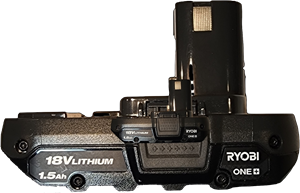 What are Commercial Cells and Batteries?
Take a moment to consider some of the devices in your daily life that require electrical power yet are not plugged into an electrical outlet. Calculator. Cell phone. Laptop computer. Electric razor. Electric toothbrush. Wrist watch. Car. Electric car. Flashlight. Portable work tools. Cordless electric lawn tools. This list probably scratches the surface of the variety of mobile or portable devices that utilize commercial cells or batteries. Our society has become quite dependent upon the use of battery-powered electrical devices. But did you know that the electricity used by these devices is provided by a galvanic cell?
Oxidation and reduction are at the core of operation of each of these devices. A galvanic cell is packaged into the 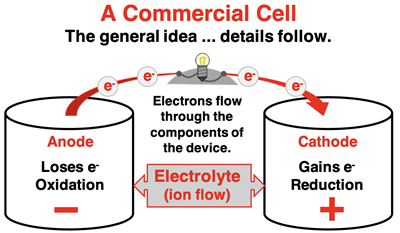 device to provide the electricity required to operate it. Oxidation occurs at the anode or negative terminal. A wire attached to the negative terminal carries those electrons through the device to the components that require power - light, motor, speaker, fan, etc. The wire eventually returns to the cathode or positive terminal of the galvanic cell where reduction occurs. An electrolyte (serving as the salt bridge or porous disk) of some kind allows for the movement of ions to maintain electrical neutrality and a sustained flow of current through the wire. These packages of chemicals are what we call commercial cells and batteries ... and are another example of Chemistry for Better Living!
 Technically, a single galvanic cell is a called a cell. You can find cells available in various sizes with labels like AAA, AA, A, C, and D. The types of chemicals inside these different-sized cells are identical, but the amount of chemicals present varies. The larger cells have a longer lifetime. A combination of two or more cells is called a battery. For instance, a 9-volt battery commonly available at stores is a collection of six 1.5-volt cells arranged in a series fashion to produce a total of 9 volts of electric potential. The six-fold increase in electric potential gives the battery the ability to produces six times as much current. There are also a variety of brands available - Energizer, AC Delco, Rayovac, Duracell, and many more. And finally, there are a variety of battery types that differ in terms of the chemicals that are used and thus the number of volts of electric potential that it provides.
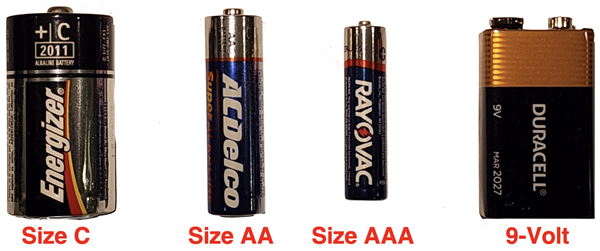
NOTE: For convenience and readability sake, we will use the term battery for the remainder of this page to refer to both commercial cells and batteries.
Attributes of an Effective Battery
Not all batteries are created equal. There are a number of considerations when evaluating the type of battery that is best for a particular device. These considerations include:
- Capacity
Capacity refers to how long the battery can be used before it must be discarded or recharged. Capacity is expressed in the unit Ampere•hours (abbreviated A•hr or A•h) where amperes refers to the amount of current the device uses.
- Energy Density
Energy density is the amount of energy sored in a battery relative to the amount of space it occupies.
- Safety
Some battery types have a tendency to overheat and can lead to a fire or explosion.
- Cost
Battery cost is affected by the chemicals that are used and their marketplace availability. The size and capacity also affect the cost.
- Durability
Some battery uses require that the battery sustain a lot of physical stress and vibration and extreme temperature ranges. Not all batteries perform equally in all conditions.
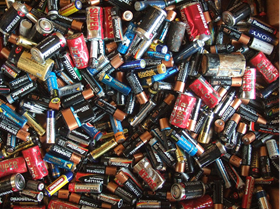 Lifespan
Rechargeable batteries have a longer lifespan. But not all batteries recharge equally. The downfall of NiCd batteries was that their capacity diminished if not fully discharged before recharging.- Environmental Impact
Some cells utilize chemicals such as lead, cadmium, and mercury; these can have a negative environmental impact.
Image Source:
Wikimedia Commons
Alkaline Dry Cells
Alkaline dry cells are a non-rechargeable battery type that relies on the following half-reactions:
Oxidation: Zn
(s) + 2 OH
-(aq) → ZnO
(s) + H
2O
(l) + 2 e
-
Reduction: 2 MnO
2(s) + H
2O
(l) + 2 e
- → Mn
2O
3(s) + 2 OH
-(aq)
The two half-reactions result in a cell voltage of 1.50 V to 1.65 V. With use, ion concentrations change and so does the cell voltage. Once it drops to approximately 1.0 V, the battery is considered spent and no longer useful.
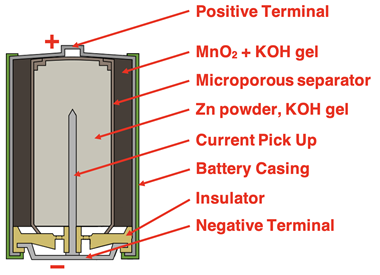
The anode compartment is filled with a paste of powdered zinc mixed into a KOH gel. The cathode compartment is filled with a paste of MnO
2 and graphite (to improve conduction) mixed into another KOH gel. The KOH serves as the electrolyte. The two compartments are separated by a cellophane-like, porous separator that prevents the mixing of the Zn and MnO
2 while allowing the OH
- ions to pass from the cathode side (where they are produced) to the anode side (where they are a reactant). All the chemicals are encased in a conducting steel cannister that is in contact with the cathode compartment and serves as the positive terminal. A brass pin is centered in the anode compartment to collect electrons. It is connected directly to the negative terminal and insulated from contact with the steel cannister.
Alkaline dry cells are commonly used in electronic toys, flashlights, smoke alarms, portable radios, wall clocks, calculators, digital cameras, remote controls. and more. They are relatively non-toxic, very portable, and have a high energy density. Yet, they are not rechargeable.
Image Source:
Wikimedia Commons
Lead-Acid Storage Battery
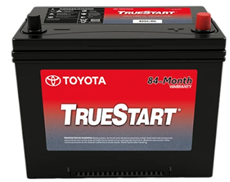
The first rechargeable battery was the lead-acid storage battery. Used primarily in automobiles to start the engine, this battery is long-lasting, durable enough to withstand the impact of bumps and potholes, and able to operate across a broad temperature range. They are costly and have a relatively low energy density.
Image Source:
Toyota
The battery relies on the following half-reactions:
Oxidation: Pb
(s) + HSO
4-(aq) → PbSO
4(s) + H
+(aq) + 2 e
-
Reduction: PbO
2(s) + 4 H
+(aq) + HSO
4-(aq) + 2 e
- → PbSO
4(s) + 2 H
2O
(l)
The two half-reactions result in a cell voltage of approximately 2 volts. Six cells are arranged in series to produce a 12-volt battery.
Each cell consists of two parallel plates consisting of a grid packed with reactants. The anode consists of a grid filled with spongy lead and the cathode consists of a grid filled with a paste of lead oxide. The two plates are immersed in a sulfuric acid electrolyte that helps separate the plates and allow for ion exchange. Modern innovations have utilized a fiberglass mesh to encase the electrolyte, resulting in a thick, gel-like consistency.

As the battery is used, lead sulfate is produced at each electrode and adheres to the plates. When not in use, the engine re-charges the battery by running the reaction in reverse and converting the products back into reactants. Because the conversion of PbSO
4 back into PbO
2 at the cathode is not 100% successful, the battery eventually
dies. Dead batteries are easily recycled by separating the chemicals and reprocessing them to create new batteries. This significantly reduces the negative environmental impact that the lead might have.
The Lithium Ion Battery
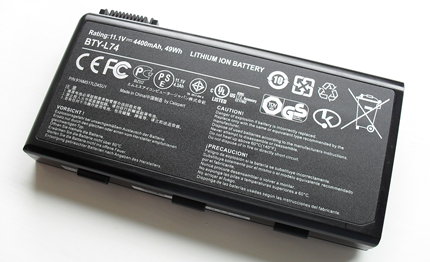
The promising newcomer to the battery world is the lithium-ion battery. Their uses range from toys, consumer products, laptops, cell phones, power tools, and electric vehicles. It is a rechargeable, light-weight battery with a relatively long lifespan and a high energy density. The mining and extraction of the raw materials used in a lithium-ion battery results in a negative impact upon the environment. And as of this date, the management and recycling of spent batteries is highly undeveloped.
Image Source:
Wikimedia Commons
There are a multitude of variations on the design of the lithium-ion battery. But every design shares three core ideas:
- Lithium atoms (Li) are a reactant at the anode location and a product at the cathode location. The atoms are stored in different ways at each location, utilizing a process known as intercalation.
- Lithium ions (Li+) are a product at the anode location and a reactant at the cathode location. These ions pass through an electrolyte that separates the anode and cathode.
- Electrons travel through the external circuitry to power the device the battery is used for.
The anode compartment of a lithium-ion battery is composed of layers of graphite (carbon). Lithium atoms fill the spaces between carbon atoms in adjacent layers. These lithium atoms undergo oxidation, producing a lithium ion and releasing an electron to the external circuit.
Oxidation: LiC
6(s) → C
6(s) + Li
+(aq) + e
-
The anode is separated from the cathode by a thin plastic separator soaked with an organic electrolyte. This separator serves the same function as the salt bridge or porous disk of any galvanic cell - it allows the passage of ions to maintain a balance of charge. There is a migration of lithium ions from the anode to the cathode through this porous separator.
Most lithium-ion batteries use a cathode that consists of a metal oxide (we will represent it by MO
2 where M is some metal, such as cobalt). The metal oxide forms a layered lattice structure that can absorb lithium ions into the spaces between its layers. It is in these spaces that the ions gain an electron to form a lithium atom. The atom becomes the new resident between the lattice’s layers. We can represent this event by the following half-equation:
Reduction: MO
2(s) + Li
+(aq) + e
- → LiMO
2(s)
(
NOTE: In real lithium-ion batteries, this process happens gradually and involves many lithium ions entering or leaving the crystal. The equation above simplifies the overall chemical change.)
As a lithium-ion battery is used, the number of lithium atoms wedged between graphite layers decreases and the number of lithium atoms wedged between the metal oxide increases. To recharge the battery, the reaction is run in reverse using a recharger. This replenishes the lithium atoms at the anode located while removing them from the cathode location.
The Future
We’ve discussed three battery types. There’s many more. A few notable types not discussed include nickel-cadmium (NiCd), nickel-metal hydride (NiMH), and fuel cells. As history unfolds, there will likely be more and better batteries. It is not likely that our dependence upon batteries will lessen. A reliable bet is that we will become even more dependent upon batteries. And as is often the case, societal needs motivate technological innovations. Expect the world of batteries to welcome many newcomers in the coming decades. It will be a pleasure to watch human innovation and chemistry combine for better living.
Before You Leave - Practice and Reinforcement
Now that you've done the reading, take some time to strengthen your understanding and to put the ideas into practice. Here's some suggestions.
- The Check Your Understanding section below includes questions with answers and explanations. It provides a great chance to self-assess your understanding.
Check Your Understanding of Batteries and Commercial Cells
Identify the following statements as being True or False. For the False statements, identify the error in the statement or correct the statement. Tap the Check Answer buttons when ready.
1. TRUE or FALSE: A battery is a galvanic cell, that has a positive electrode in place of a cathode and a negative electrode in place of the anode.
Check Answer
Answer: FALSE
Technically, a battery is a collection of two or more galvanic cells. Each cell has an anode and a cathode just like a galvanic cell. We refer to the anode as the negative terminal and the cathode as the positive terminal.
2.
TRUE or
FALSE: One difference between a galvanic cell and a battery is that a battery does not have a salt bridge.
Check Answer
Answer: TRUE
It is true that you won't find a battery with a salt bridge. It is also true that not all galvanic cells have salt bridges; some have porous disks that serve the same function as a salt bridge. But what all commerical cells and laboratory-style galvanic cells have in common is some form of anode-cathode separator that is filled with an electrolyte that allows ions to flow between compartments.
3.
TRUE or
FALSE: An AA-sized cell and an AAA-sized cell differ in terms of the number of volts of electric potential that they provide. The larger cell provides more volts.
Check Answer
Answer: FALSE
Both AA- and AAA-sized cells provide the same voltage. The larger cell has a longer lifespan since it contains more chemicals.
4.
TRUE or
FALSE: An alkaline dry cell is one of the most popular rechargeable batteries.
Check Answer
Answer: FALSE
The alkaline dry cell (as of this writing) is indeed one of the most popular commercial cells. However, it is not recyclable. Thus, the statement is false.
5.
TRUE or
FALSE: An automobile uses a lead-acid storage battery to start up the engine.
Check Answer
Answer: TRUE
Automobiles with an internal combustion engine rely upon a 12-volt lead acid storage battery to start up.
6.
TRUE or
FALSE: The electrons involved in the oxidation-reduction half-reactions pass through the electrolyte from the anode to the cathode.
Check Answer
Answer: FALSE
The electrons lost at the anode pass through a wire to the cathode. Ions pass through the electrolyte-filled separator.
7.
TRUE or
FALSE: The role of the electrolyte in most batteires is to allow the reactants of the two half-cells to mix.
Check Answer
Answer: FALSE
The role of the electrolyte is to prevent the mixing of the reactants and to allow ions to flow between anode and cathode in order to maintain charge neutrality.
8.
TRUE or
FALSE: Recharging a battery involves using electricity to run the redox reaction in the reverse direction so that reactants can be replenished.
Check Answer
Answer: TRUE
That's exactly what recharging involves.
9.
TRUE or
FALSE: A dead battery no longer works because it has run out of its electrons.
Check Answer
Answer: FALSE
No! No! No! Batteries no longer work because they have run out of the reactant chemicals.
10.
TRUE or
FALSE: Lithium-ion batteries are no longer used because there is a fire risk associated with them.
Check Answer
Answer: FALSE
Lithium ion batteries are quite popular and still in use today. And yes, there is a risk of fire due to an issue known as thermal runaway.
(Hold on. I'll finish this later ... it looks like my laptop is starting to smoke.)