Chapter 18: Electrochemistry - Lesson 2: Galvanic Cells
Cell Voltage
Hold down the T key for 3 seconds to activate the audio accessibility mode, at which point you can click the K key to pause and resume audio. Useful for the Check Your Understanding and See Answers.
The Big Idea
Galvanic cells generate a cell voltage due to the difference in reduction potential for the two half cells. This page explains how to analyze a galvanic cell and determine its cell voltage for both standard and non-standard conditions.
Identifying Oxidizing and Reducing Agents
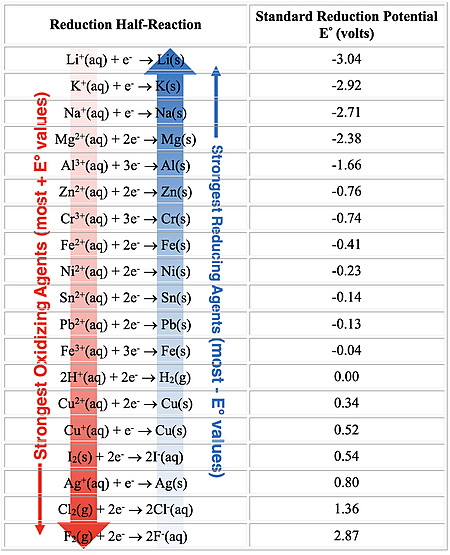 The concept of a reduction potential was introduced in Lesson 2b. Every half-cell has a unique reduction potential that gives an indicator of that half-cell's tendency to undergo reduction. Half-cells with the most positive reduction potentials are most likely to be reduced. Those half-cells with the smallest reduction potentials (meaning most negative or the least positive) are most likely to be oxidized. A reduction potential table like the one at the right allows one to predict the half-reactions that will spontaneously occur when two half-cells are combined. A larger version of this table (with more half-cells) can be found in the Reference section of this Chemistry Tutorial.
(If necessary, review how to identify the half-reactions that occur.)
Consider the following galvanic cell:
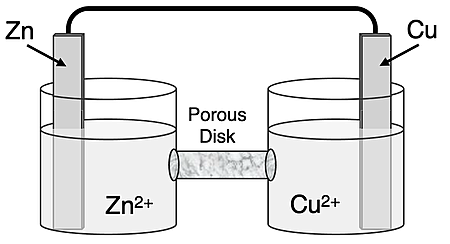
The two possible reduction half-equations are:
Zn2+(aq) + 2 e- → Zn(s) E° = -0.76 V
Cu2+(aq) + 2 e- → Cu(s) E° = +0.34 V
Only one of these reduction reactions can occur. Because copper ions have a more positive reduction potential than zinc ions, the Cu2+ ions are reduced. Thus, the oxidation half-reaction will involve Zn(s) losing two electrons to become Zn2+(aq). The overall reaction becomes:
Zn(s) + Cu2+(aq) → Cu(s) + Zn2+(aq)
Identifying Reduction and Oxidation Potentials
A reduction potential table lists standard reduction potentials. The half-equations are written as reduction half-equations. The substance being reduced (a.k.a. the oxidizing agent) is located as the reactant to the left of the reaction symbol. It is shown gaining electrons and the E° value is the potential for the reduction reaction. We will represent this by the symbol Ered°.
The substances on the product side of the half-equations are reducing agents that can be oxidized. They have an oxidation potential; we will represent this value by the symbol Eox°. To determine the oxidation half-equation and the oxidation potential, the half-equation listed in the table must be reversed and the sign on E° must be inverted (i.e., changed to its opposite).
As an example, the reduction of zinc ions (Zn2+) has a reduction potential of -0.76 V.
Zn2+(aq) + 2 e- → Zn(s) Ered° = -0.76 V
The reverse of this half-equation shows the oxidation of solid zinc - Zn(s) . It has an oxidation potential of +0.76 V; the sign has been inverted.
Zn(s) → Zn2+(aq) + 2 e- Eox° = +0.76 V
The reduction potential table allows one to determine both reduction potentials (exactly as written in the table) and oxidation potentials (for the reverse reaction with an inverted +/- sign) for any of the half-cells.
How to Determine the Cell Voltage
A galvanic cell has a cell voltage that is the sum of the potential or voltage values of its two half-cells. Adding the reduction potential and the oxidation potential, while keeping track of the individual signs, results in the cell voltage (Ecell°).
Ecell° = Ered° + Eox°
The value that results is the standard cell voltage, applicable to standard conditions - solute concentrations of 1.00 M, gas pressures of 1.00 atm, and a temperature of 25°C.
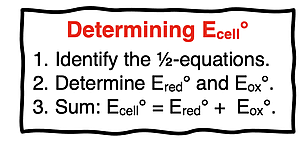 The following procedure can be used to determine the standard cell voltage.
- Use the schematic diagram with the reduction potential table (or the balanced redox equation, if given) to identify the two half equations.
- Determine the values of Ered° and Eox° from the reduction potential table (as discussed in previous section).
- Sum the reduction potential and the oxidation potential to determine the cell voltage.
When this procedure is applied to the Zn-Cu galvanic cell (shown once again at the right), we can identify the half-equations to be:
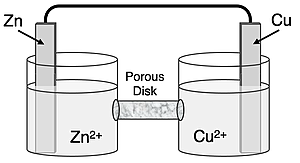
Reduction: Cu2+(aq) + 2 e- → Cu(s)
Oxidation: Zn(s) → Zn2+(aq) + 2 e-
The values of Ered° and Eox° are:
Ered° = +0.34 V (exactly as it reads in the table)
Eox° = +0.76 V (with an inverted sign of the value from the table)
The cell voltage is calculated as:
Ecell° = 0.34 V + 0.76 V
Ecell° = +1.10 V
A galvanic cell involves a spontaneous reaction. It will always have a positive cell voltage.
Example 1 - Determining the Cell Voltage
Consider the following schematic diagram of a galvanic cell.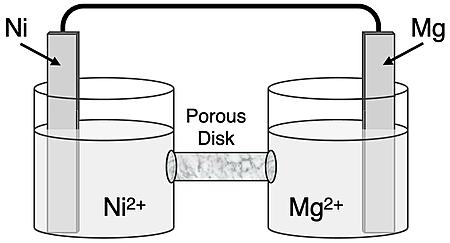
- Determine the reduction half-equation.
- Determine the oxidation half-equation.
- Determine the E° value for the cathode half-cell (i.e., Ered°).
- Determine the E° value for the anode half-cell (i.e., Eox°).
- Determine the overall cell voltage.
Solution:
The two possible reduction half-equations and their respective E° values are:Ni2+(aq) + 2 e- → Ni(s) E° = -0.23 V
Mg2+(aq) + 2 e- → Mg(s) E° = -2.38 V
The cathode will be the Ni electrode since its reduction potential is less negative (or closer to being positive). The anode will be the Mg electrode.
a. Reduction: Ni2+(aq) + 2 e- → Ni(s)
b. Oxidation: Mg(s) → Mg2+(aq) + 2 e-
c. Ered° = -0.23 V (exactly as it reads on the reduction potential table)
d. Eox° = +2.38 V (with an inverted sign of the value from the reduction potential table)
e. The cell voltage is the sum of the potentials for the two half-cells.
Ecell° = -0.23 V + 2.38 V
Ecell° = +2.15 V
Example 2 - Determining the Cell Voltage
For the following redox reaction:2 Fe(s) + 3 Sn4+(aq) → 2 Fe3+(aq) + 3 Sn2+(aq)
- Determine the reduction half-equation.
- Determine the oxidation half-equation.
- Determine the E° value for the cathode half-cell (i.e., Ered°).
- Determine the E° value for the anode half-cell (i.e., Eox°).
- Determine the overall cell voltage.
Solution:
From the given equation, we observe that the oxidation state of iron changes from 0 to +3; it is being oxidized. The oxidation state of tin changes from +4 to +2; it is being reduced.a. Reduction: Sn4+(aq) + 2 e- → Sn2+(aq)
b. Oxidation: Fe(s) → Fe3+(aq) + 3 e-
c. Ered° = +0.15 V (exactly as it reads on the reduction potential table)
d. Eox° = +0.04 V (with an inverted sign of the value from the reduction potential table)
e. The cell voltage is the sum of the potentials for the two half-cells.
Ecell° = +0.15 V + 0.04 V
Ecell° = +0.19 V
Example 3 - Determining the Cell Voltage
A galvanic cell is made by placing aluminum metal and chromium metal in a solution of their respective ions - Al3+ and Cr3+. Determine the cell voltage and write the line notation for the resulting galvanic cell.Review: Line Notation for Galvanic Cells.
Solution:
The two possible reduction half-equations and their respective E° values are:Al3+(aq) + 3 e- → Al(s) E° = -1.66 V
Cr3+(aq) + 3 e- → Cr(s) E° = -0.74 V
The cathode will be the Cr electrode since its reduction potential is less negative (or closer to being positive). The anode will be the Al electrode. The half-equations are:
Reduction: Cr3+(aq) + 3 e- → Cr(s)
Oxidation: Al(s) → Al3+(aq) + 3 e-
The values of Ered° and Eox° are:
Ered° = -0.74 V (exactly as it reads on the reduction potential table)
Eox° = +1.66 V (with an inverted sign of the value from the reduction potential table)
The cell voltage can now be calculated:
Ecell° = -0.74 V + 1.66 V
Ecell° = +0.92 V
A line notation shows the anode first, followed by double vertical lines (||), followed by the cathode. The solid and aqueous phase are separated by a single vertical line (|). The ions are placed closest to the double vertical line. The line notation for this galvanic cell is:
Effects of Concentrations and Pressures on Cell Voltage
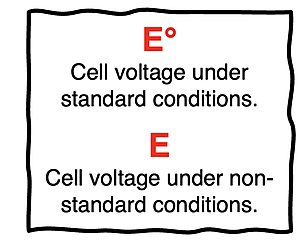 Standard cell voltage values are specific to a narrow set of conditions: solute concentrations of 1.00 M, gas pressures of 1.00 atm, and a temperature of 25°C. These are referred to as standard conditions. Alterations in these conditions lead to changes in the cell voltage. This results in a non-standard value, denoted by the symbol Ecell (without the °).
The exact manner in which concentrations and gas pressures affect the cell voltage depends on whether the alteration was made to the reactant or the product. The following effects can be reliably predicted.
- If the concentration of a reactant is increased, the cell voltage will increase.
- If the concentration of a reactant is decreased, the cell voltage will decrease.
- If the concentration of a product is increased, the cell voltage will decrease.
- If the concentration of a product is decreased, the cell voltage will iccrease.
- The same patterns exist for changes in gas pressures.
The Nernst Equation
For non-standard conditions, the dependence of the cell voltage upon concentrations, pressures, and temperature is given by the Nernst equation.
 where R = 8.314 J/mol/K, T = Kelvin temperature, n is the number of moles of electrons transferred in the balanced chemical equation, F is 96485 C/mol (known as Faraday's constant) and Q is the reaction quotient. In the equation, ln represents a mathematical function known as the natural logarithm. You likely have a button on your scientific or graphing calculator for determining the natural logarithm of the numerical value for Q.
The reaction quotient includes concentrations and pressure values of aqueous-state solutions and gas-phase reactants and products. Its numerical value is determined using an expression of the same format as the equilibrium constant expression. This means product concentrations and pressures are in the numerator with reactant values in the denominator. Each concentration or pressure is raised to a power equal to the coefficient in the balanced chemical equation. Solid and liquid-state reactants and products are not included in the expression.
(To learn more about reaction quotient, visit Generic Expressions for Reaction Quotient.)
At a standard temperature of 25°C, R•T/F evaluates to 0.0592 and the Nernst equation simplifies to

Examples 4 and 5 demonstrate the use of the Nernst equation to calculate the cell potential for non-standard concentrations.
Example 4 - Using the Nernst Equation
Consider the following redox reaction occurring in a Galvanic cell:Cu(s) + 2 Fe3+(aq) → Cu2+(aq) + 2 Fe2+(aq)
- Use the Table of Standard Reduction Potentials to calculate the cell voltage for this reaction at standard conditions.
- Suppose all ion concentrations are 0.145 M. Calculate the reaction quotient for these conditions.
- Determine the cell voltage with these non-standard concentrations at 25°C.
Solution:
Part a:The two half-cell equations can be determined by inspection of the balanced chemical equation:
Reduction: Fe3+(aq) + e- → Fe2+(aq)
Oxidation: Cu(s) → Cu2+(aq) + 2 e-
The values of Ered° and Eox° are:
Ered° = -0.77 V (exactly as it reads on the reduction potential table)
Eox° = -0.34 V (with an inverted sign of the value from the reduction potential table)
The cell voltage can now be calculated:
Ecell° = 0.77 V + -0.34 V
Ecell° = +0.43 V
Part b:
Applying the rules for writing a reaction quotient (Q) expression, we can state
All concentration values are 0.145 M. By substitution, we can determine the value of Q
Q = 0.145
Part c:
Since the temperature is 25°C, we can use the simplified form of the Nernst equation to calculate the cell potential. The value of n is 2. There are two moles of electrons transferred from the Cu(s) to the 2 Fe3+(aq). By substitution, the non-standard E value can be determined:
E = 0.43 V - 0.0592 / 2 • ln(0.145)
E = 0.43 V - (-0.057 V)
E = 0.49 V
(rounded to the second decimal place)
Example 5 - Using the Nernst Equation
Consider the following redox reaction occurring in a Galvanic cell:3 Ni2+(aq) + 2 Al(s) → 3 Ni(s) + 2 Al3+(aq)
- Use the Table of Standard Reduction Potentials to calculate the cell voltage for this reaction at standard conditions.
- Suppose the cathode and anode half-cells have the following ion concentrations:
Al3+: 0.027 M.
- Determine the cell voltage with these non-standard concentrations at 25°C.
Solution:
Part a:The two half-cell equations can be determined by inspection of the balanced chemical equation:
Reduction: Ni2+(aq) + 2 e- → Ni(s)
Oxidation: Al(s) → Al3+(aq) + 3 e-
The values of Ered° and Eox° are:
Ered° = -0.23 V (exactly as it reads on the reduction potential table)
Eox° = 1.66 V (with an inverted sign of the value from the reduction potential table)
The cell voltage can now be calculated:
Ecell° = -0.23 V + 1.66 V
Ecell° = +1.43 V
Part b:
Applying the rules for writing a reaction quotient (Q) expression, we can state
By substituting concentrations into the above expression, we can determine the value of Q
Q = 2.34798 x 10⁻⁵
Part c:
Since the temperature is a standard 25°C, we can use the simplified form of the Nernst equation to calculate the cell potential. The value of n is 6. There are six moles of electrons transferred from the 3 Ni2+(aq) to the 2 Al3+(aq). By substitution, the non-standard E value can be determined:
E = 1.43 V - 0.0592 / 6 • ln(2.34798 x 10⁻⁵)
E = 1.43 V - (-0.10517… V)
E = 1.54 V
(rounded to the second decimal place)
Galvanic Cells, Free Energy, and Useful Work
The fact that electrons flow through a wire from the anode to the cathode of a galvanic cell has tremendous technological implications. This electron flow can power machines and devices ranging from automobiles to cell phones. The cell voltage of a galvanic cell gives it the ability to do useful work on any device placed between the anode and the cathode.We discussed free energy in Chapter 17 of our Chemistry Tutorial. Gibb's free energy (G) is often defined as the amount of energy that can be freed or extracted from a system to do useful work. All reactions involve a Gibb's free energy change (∆G). The value of ∆G is equivalent to the amount of useful work that the system can perform. The sign on ∆G is an indicator of whether the reaction is spontaneous or not. A negative ∆G indicates a spontaneous reaction.
We can think of the work done by the moving electrons as being energy that is transferred from the chemical system to external devices such as light bulbs, motors, etc. We always represent the transfer of energy from the system to the surroundings by a negative quantity. This means that ∆G = - Work. In Physics, the work done by electrons moving between two points is equal to the quantity of charge (Q) that moves between those two points multiplied by the electric potential difference (∆V) between those two points.

The electric potential difference between the anode and the cathode is the cell voltage (Ecell). The quantity of charge that moves between the two points is the number of moles of electrons (n) multiplied by Avogadro's number (NA) and multiplied by the charge on a single electron (Qone electron).

The product of NA • Qone electron is equal to Faraday's constant (F) - 96485 C/mol.
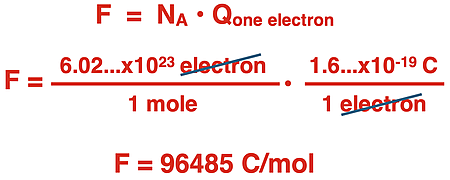
(Note: the standard metric unit of charge is the Coulomb, abbreviated C. Faraday's constant, F, indicates the quantity of charge in Coulomb on a mole of electrons.)
Putting this all together, we can say

Example 6 - Gibbs Free Energy Change
A Galvanic cell is based on the following two half-reactions, written here as reduction reactions. The corresponding standard reduction potential is listed.S2O82-(aq) + 2 e- → 2 SO42-(aq) E° = 2.01 V
Ag+(aq) + e- → Ag(s) E° = 0.80 V
The balanced equation for the Galvanic cell is
S2O82-(aq) + 2 Ag(s) → 2 SO42-(aq) + 2 Ag+(aq)
- Determine the cell voltage of the Galvanic cell. Assume standard conditions.
- Use the cell voltage to determine the Gibbs free energy change (in kJ) for this reaction.
Solution
Part a:The oxidation of S2O82- has the more positive reduction potential; it will be reduced. The Ag(s) will be oxidized.
The values of Ered° and Eox° are:
Ered° = +2.01 V (exactly as given)
Eox° = -0.80 V (with an inverted sign of the value that was given)
The cell voltage can now be calculated:
Ecell° = +2.01 V + -0.80 V
Ecell° = +1.21 V
Part b:
Use the equation ∆G = -Work = - n•F•Ecell to calculate the Gibbs free energy change. The variable n represents the number of moles of electrons. For the chemical equation, n = 2. There are two moles of electrons transferred from 2 Ag(s) to S2O82-(aq).
∆G° = - (2 mol)•(96485 C/mol)•(+1.21 V)
∆G° = -2.23493 ... x105 V•C
The unit V•C is equivalent to 1 joule. Thus,
∆G° = -2.33 ... x102 kJ = -233 kJ
(rounded to three significant digits)
Before You Leave - Practice and Reinforcement
Now that you've done the reading, take some time to strengthen your understanding and to put the ideas into practice. Here's some suggestions.- Try our Concept Builder titled Cell Voltage. Any one of the three activities provides a great follow-up to this lesson.
- Our Calculator Pad section is the go-to location to practice solving problems. You'll find plenty of practice problems on our Oxidation and Reduction page. Check out the following problem sets:
Calculating Cell Voltage 1 | Calculating Cell Voltage 2 | Calculating Cell Voltage 3
Cell Voltage at Non-Standard Conditions 1 | Cell Voltage at Non-Standard Conditions 2
Cell Voltage and Gibbs Free Energy - The Check Your Understanding section below includes questions with answers and explanations. It provides a great chance to self-assess your understanding.
- Download our Study Card on Cell Voltage. Save it to a safe location and use it as a review tool.
Check Your Understanding of Cell Voltage
Use the following questions to assess your understanding of cell voltage. Tap the Check Answer buttons when ready.
1. A galvanic cell consists of copper and tin electrodes immersed in solutions of Cu2+ and Sn2+ respectively. Use the reduction potential table to ...
- ... determine the oxidizing agent
- ... determine the reducing agent
- ... determine the values of Ered° and Eox°.
- ... determine the standard cell voltage.
2. Consider the following schematic diagram for a galvanic cell:
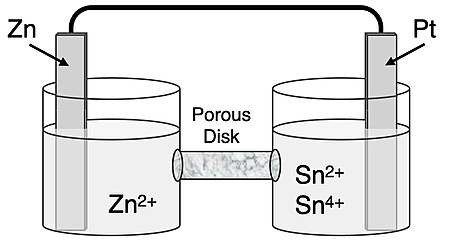
Use the reduction potential table to ...
- ... determine the oxidizing agent
- ... determine the reducing agent
- ... determine the values of Ered° and Eox°.
- ... determine the standard cell voltage.
3. Consider the following line notation for a galvanic cell:
- Write the two half-equations.
- Write the balanced equation for the overall redox reaction.
- Determine the standard cell voltage.
4. Observe the schematic diagram of the galvanic cell. The electrodes and solutions in the two half-cells are shown.
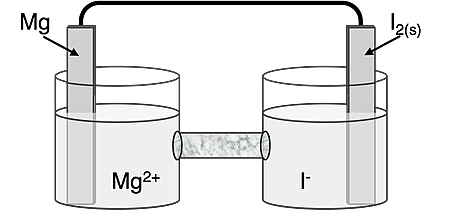
Use the reduction potential table to ...
- ... write the half-equation that takes place at the cathode.
- ... write the half-equation that takes place at the anode.
- ... determine the values of Ered° and Eox°.
- ... determine the value of Ecell°.
5. The reaction below occurs in a galvanic cell at a temperature of 25°C:
The cell voltage under standard conditions is 0.265 V. Determine the cell voltage at 25°C with the following non-standard concentrations:
- H2O2: 1.535 M
- H+: 1.535 M
- Au3+: 0.140 M
6. A lead storage battery operates by the following oxidation-reduction reaction:
Pb(s) + PbO2(s) + 2 H2SO4(aq) → PbSO4(s) + 2 H2O(l)
The cell voltage is 2.04 V under standard conditions. Calculate the cell voltage when the sulfuric acid concentration is 8.27 M.