Chapter 19: Nuclear Chemistry and Radiation - Lesson 3: Nuclear Bombardment Reactions
Nuclear Fission and Fusion
Hold down the T key for 3 seconds to activate the audio accessibility mode, at which point you can click the K key to pause and resume audio. Useful for the Check Your Understanding and See Answers.
The Big Idea
Nuclear fission and nuclear fusion are reactions in which changes within the atomic nucleus release energy millions of times greater than typical chemical reactions. By comparing how these processes work and how they are used—or may one day be used—to generate electricity, we gain insight into both the power and challenges of nuclear energy.
Nuclear Fission Reactions
Nuclear fission is the process of splitting a heavy nucleus into two lighter nuclei. The process is initiated by neutron bombardment. Uranium-235 is the isotope that is most often used in fission processes.

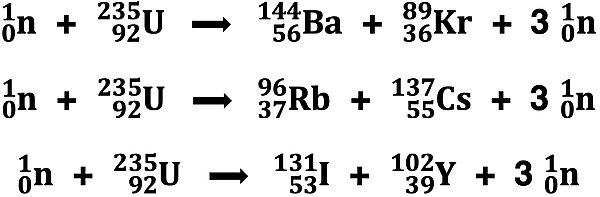
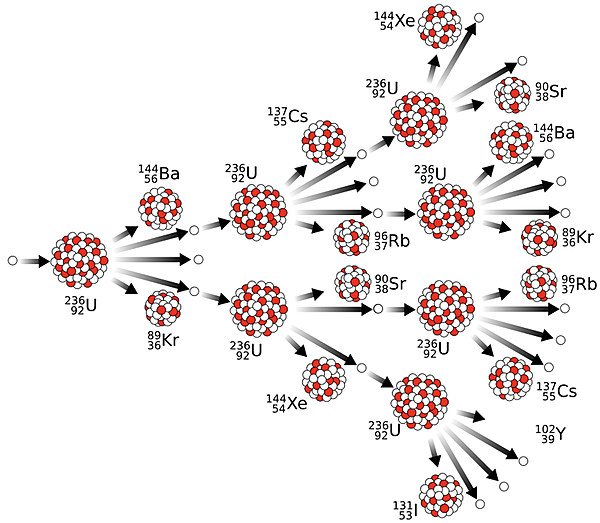
The products of fission are always two lighter isotopes, like barium-141 and krypton-92. But these are not the only two possibilities. Other daughter isotope pairs include strontium-94 and xenon-140, rubidium-96 and cesium-137, barium-144 and krypton-89, yttrium-102 and iodine-131, etc. Two or three neutrons and gamma radiation are also released during the fission of uranium-235. It is not possible to predict the actual products. But one can be certain that there will be a balance of mass numbers and atomic numbers.
 Nuclear Energy
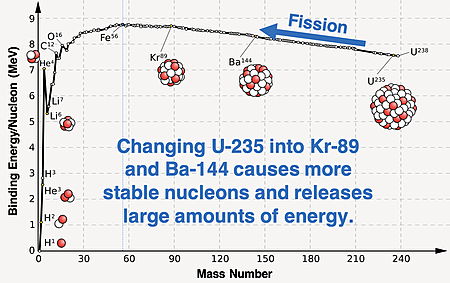
We discussed nuclear binding energy curves in Lesson 3b. The binding energy curve at the right displays the binding energy per nucleon for hundreds of isotopes. A larger binding energy/nucleon value is associated with more stable nucleons (protons and neutrons). As shown on the curve, splitting uranium-235 into lighter isotopes results in two nuclei with much stable nucleons. The result is that a large amount of energy is released in the process.
Image Source: Wikimedia Commons (public domain)
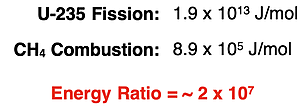 The energy released by the fission of uranium-235 is approximately 1.9 x 10¹³ J/mole. In contrast, the energy released by the combustion of a hydrocarbon such as methane gas is 8.9 x 10⁵ J/mole. A comparison of these two numbers reveals the striking potential of nuclear power as a source of energy. The energy released by fission is millions of times greater than the energy released by hydrocarbon combustion.
 The Chain Reaction
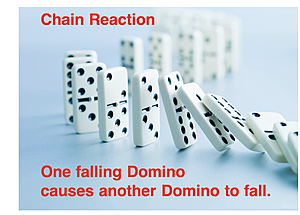
Each U-235 nucleus that fissions releases two to three high-energy neutrons. If absorbed by a nearby U-235 nucleus, these neutrons can initiate another fission reaction. If at least one released neutron causes another fission event, then the nuclear reaction will be self-sustaining and continued bombardment is not necessary. A chain reaction is said to occur. Like a long, continuous chain of Dominoes, the falling of one Domino will cause another Domino to fall.
Source: Wikimedia Commons
The sustaining of a chain reaction within a nuclear reactor is dependent upon two important conditions.
- The neutron must be moving slow enough to be absorbed by the nucleus.
- One neutron from each fission must cause another nucleus to fission.
The neutrons released by a fission event are high energy neutrons, known as fast neutrons. Fast neutrons will frequently pass through a uranium atom without being absorbed by the nucleus. In nuclear reactors, these fast neutrons are slowed down by the use of a moderator (usually water or graphite). Collisions with atoms of the moderator cause the neutron to slow down to speeds that allow the U-235 nucleus to absorb it.
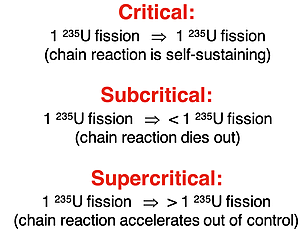 In order to insure that the chain reaction is self-sustaining, a critical mass of uranium must be available. The nuclear reactor is in a critical state when each fission event causes, on average, one more fission event. Under this condition, the chain reaction is safely self-sustained. If each fission event causes, on average, less than 1 other fission event, then the chain reaction will eventually die out. This is referred to as a subcritical state. On the other end of the scale, if each fission event causes, on average, three other fission events, then the chain reaction will accelerate out of control and the rapid build-up of heat can lead to a dangerous explosion. This is referred to as a supercritical state.
The "critical" of critical mass does not mean ...
- about to explode
- dangerously large
- at maximum power
Instead, critical simply means one fission event, on average, leads to another fission event. Critical infers steady and controlled. A reactor operated with a critical mass is not accelerating out of control. It is not a runaway reactor. Besides using a critical mass of uranium-235 in the fuel, nuclear reactors also use moderators to slow neutrons down and control rods to absorb excess neutrons.
Nuclear Power Plants
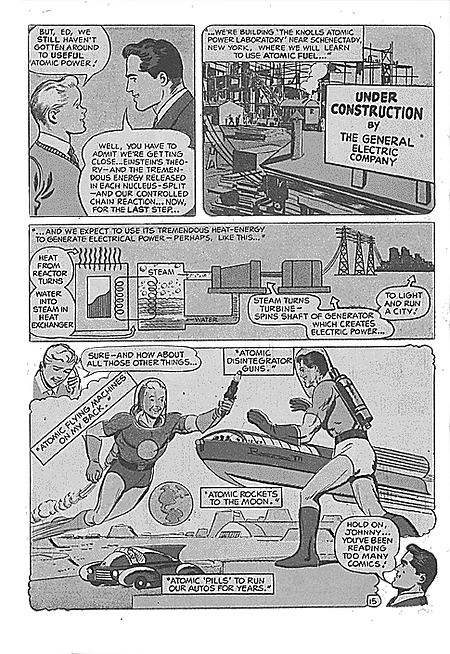 Nuclear power plants utilize a uranium fission process to generate approximately 20% of the electricity in the United States. As of 2025, there are 94 commercial reactors located at 54 power plants in 28 different U.S. states. This fleet of reactors operates at high capacity, providing the most reliable, large-scale electrical generation of all power plants. There is no CO2 emissions associated with nuclear power generation.
Comic Source: Adventures Inside the Atom (Public Domain)
The U.S. has built and operated more power plants than are currently in use. There were more than 100 nuclear power facilities in operation during the 1990s and early 2000s. The nuclear power industry is, for obvious reasons, a highly regulated industry. As a power plant ages, the operating and maintenance costs required to meet safety regulations and to replace aging infrastructure becomes crippling to the ability of the plant to make a profit. With the price of natural gas declining and with increased competition from government-subsidized renewable sources of energy (wind, solar, etc.), the ability of the nuclear power industry to survive is being threatened. And with accidents at Three-Mile Island (1979), Chernobyl (1986), and Fukushima (2011), nuclear power isn't exactly riding high on the waves of public opinion.
How a Nuclear Fission Power Plant Works
The animation below depicts a nuclear power plant that utilizes a pressurized water reactor (PWR). Two-thirds of all operating power plants in the United States are of this type. The remaining plants utilize boiling water reactors (BWR). Our discussion will be restricted to PWR-type reactors.There are two basic parts to the plant - the containment structure and the electrical power generator. The containment structure includes the reactor vessel with a circulating system of high-pressure water (shown in red, orange, and yellow). The electrical power generator consists of a steam generation system (shown in shades of blue), a mechanical turbine and electricity generator (shown in grey), and a condenser for turning the steam back to liquid water (shown in blue).
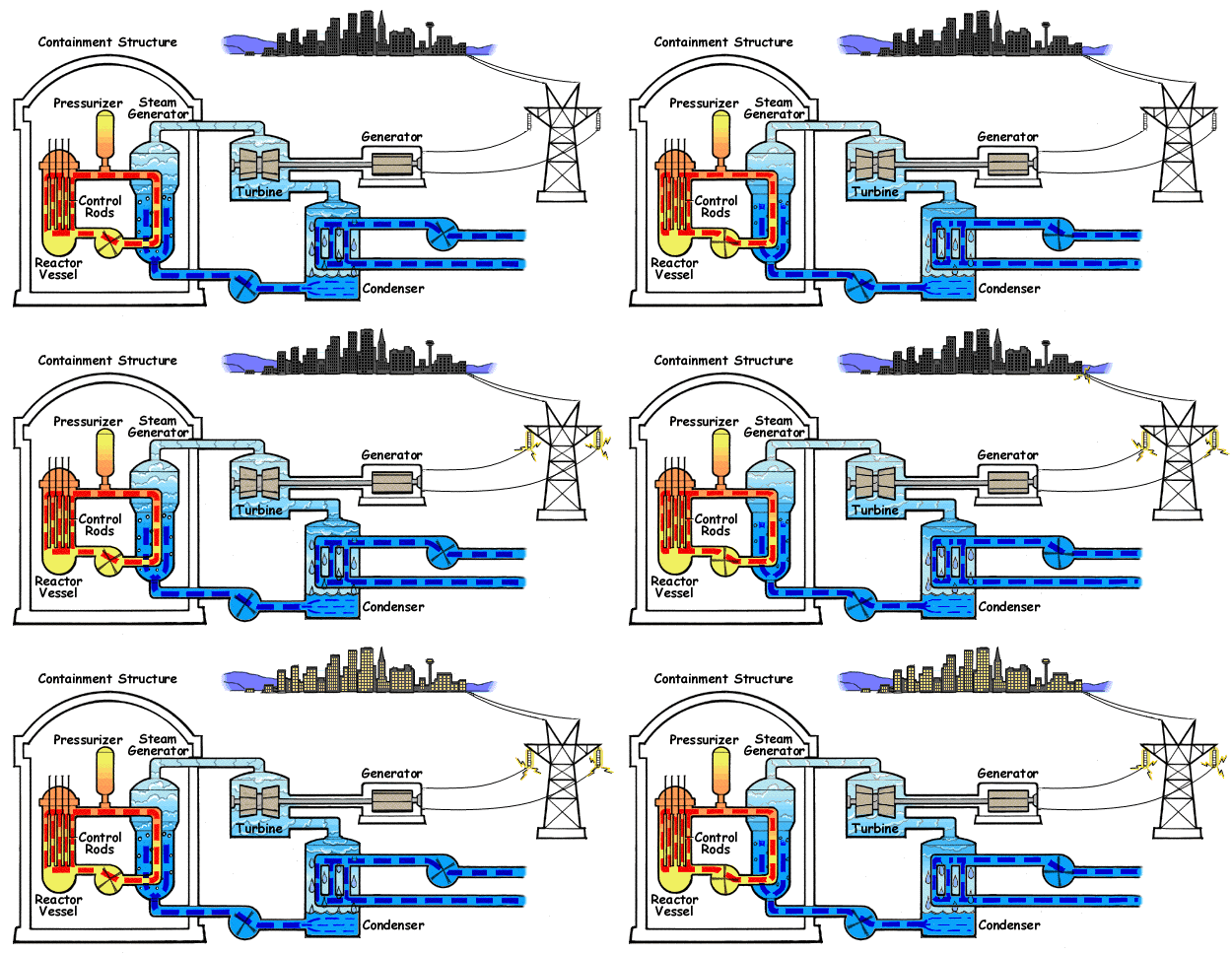
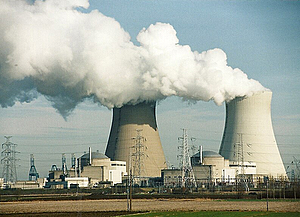 The electrical power generator of a nuclear power plant operates in much the same way as it does in a coal burning power plant. A circulating system of water absorbs heat, turns to steam, passes by a turbine to turn the blades, and generate electricity. The condensing system is used to change the steam back into water. The water used to cool the steam enters the condenser as cold water, absorbs heat from the steam, and leaves the condenser as hot water. It is circulated to an on-plant lake or a cooling tower where it is cooled back down and prepared for re-entry to the condenser.
Image of Cooling Towers: Wikimedia Commons
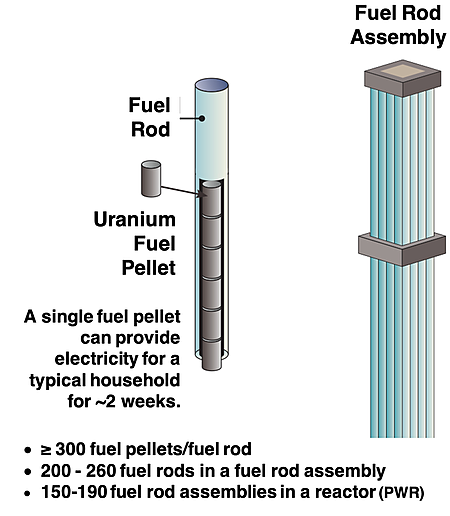 The nuclear reactor vessel consists of an elaborate system of fuel rods and control rods. The fuel rods are approximately 1-cm in diameter, constructed of a zirconium alloy, 14-feet long, and packed with uranium fuel pellets. The pellets are cylindrical in shape and about 1-cm in length. They consist of uranium oxide, enriched to about 3% uranium-235 in order to allow for a critical mass. A single fuel pellet has sufficient energy to provide power for an average household for about two weeks. There are as many as 300 fuel pellets in a single fuel rod. A bit more than 200 fuel rods are joined together to form a fuel rod assembly. And there can be as many as 150-190 of these fuel rod assemblies in a single nuclear reactor. (Exact values can vary with reactor design and fuel vendor.)
In a pressurized water reactor, fuel rod assemblies are open on their sides. Pressurized water flows between the fuel rods, acting as both a coolant and a neutron moderator. The water absorbs heat from the reactor, circulates through the reactor vessel to the steam generator and back to the reactor vessel. In the steam generator, heat is transferred from the pressurized water to the circulating H2O in the steam generator. The pressurized water remains sealed in its own set of pipes; it never makes physical contact with the water in the steam generator. This contains the radiation within the containment building.
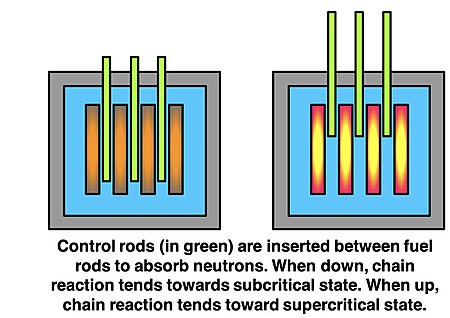 In a pressurized water reactor, control rods are inserted from above into guide tubes within the fuel assemblies to regulate the chain reaction. This is the means by which the critical mass state is maintained. While the moderator slows down the neutrons, the control rods absorb the neutrons altogether. If the power output decreases (reactor state becoming subcritical), the control rods are pulled upward so that less neutrons are absorbed. If the power output increases above the critical state, the control rods are pushed down into the reactor to absorb more neutrons and return the reactor to its critical state. Control rods help to insure a more uniform power output from the reactor.
Image Source: Wikimedia Commons
Nuclear Waste
A fuel assembly has a lifetime of 3-6 years. Near the end of its lifetime, the concentration of fissionable uranium-235 is too low to sustain efficient power generation. Even though there is still U-235 in the fuel rod assembly (about 20% of the original amount), it is replaced with a new fuel rod assembly. Proven technologies exist to recycle the un-fissioned uranium and are used by France, Russia, the United Kingdom, and Japan. Uranium recycling involves separating the unused U-235 (1%) from the other contents of the fuel rod - U-238 (95%), plutonium-239 (1%, created during plant operation), and the fission products (3%). The unused uranium-235 is then recovered and used to enrich future uranium fuel. Recycling has not been used in the U.S., primarily out of fear that plutonium isolation will lead to nuclear weapons proliferation. Spent fuel rods are considered high-level nuclear wastes. Once removed from a reactor, they are stored onsite for several years while they cool down in deep, steel-lined storage pools filled with recirculating water. Once cooled, the fuel rod assemblies are transferred to a heavily shielded, above-ground, steel-and-concrete container known as a dry cask storage container. The dry casks are stored onsite or transferred to a more permanent high-level waste disposal facility. As of this date (2025), the U.S. does not have any deep geologic repository for high-level radioactive waste. Every effort to establish such a permanent site has been met with political opposition.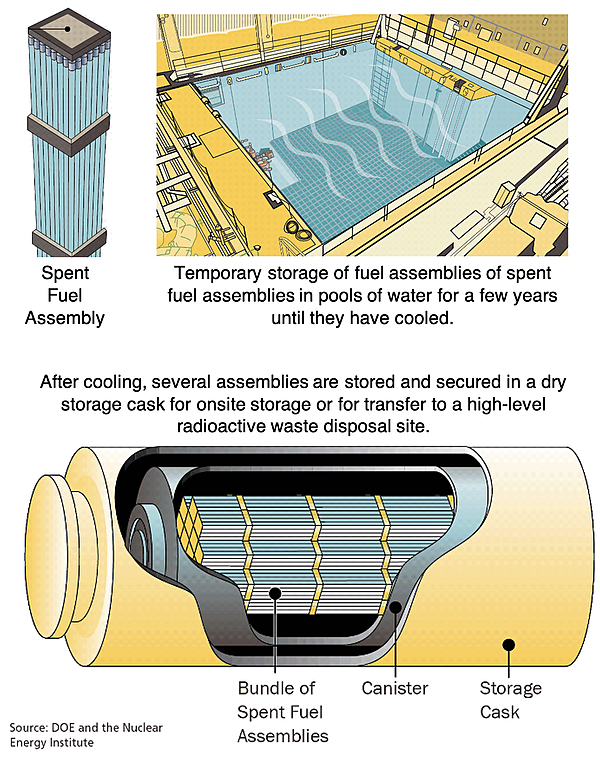
Nuclear Fusion and the Sun
Nuclear fusion is the combining of two lighter nuclei to form a heavier nuclei. The process occurs on our Sun and other stars. In the Sun's core, hydrogen nuclei (i.e., protons) fuse together to produce a helium nucleus through a series of sophisticated steps.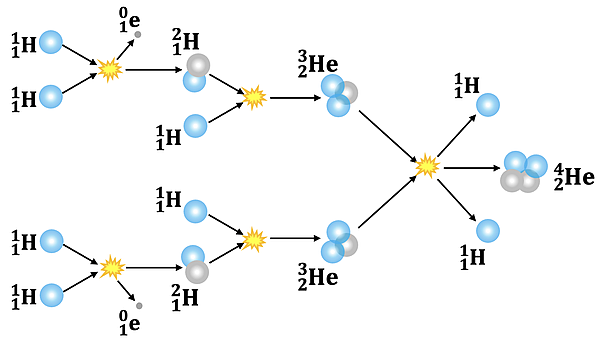
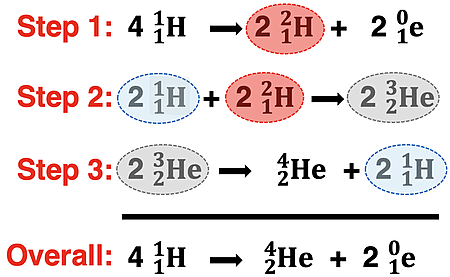
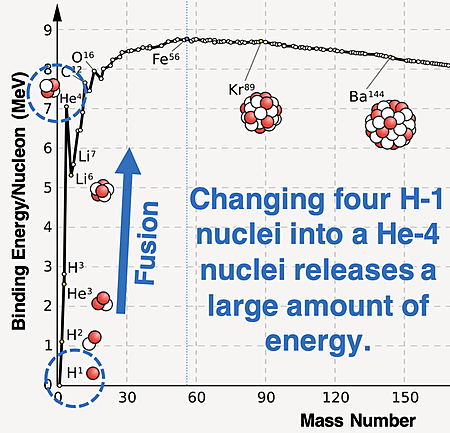 The overall result of the three steps is the formation of a helium nucleus, two positron particles, and a large amount of energy. As seen in the graphic at the right, the binding energy curve is very steep in the region of the lighter nuclei. As such the fusion of lighter nuclei to form larger nuclei has a high potential as an effective energy source. The fusion of hydrogen on the Sun occurs at a pressure of 2.5 x10¹⁰ atm and a temperature of 1.5 x10⁷ K, conditions not easily attained on Earth. The task of attaining such high temperatures and pressures has traditionally required more energy than is produced by the fusion event. It is like spending nickels to make pennies; while that make cents, it doesn't make sense ... nor does it make profits.
In recent years, scientists have surpassed the break-even point, known as Q =1, where Q represents the fusion energy gain factor. When Q is greater than 1, the energy produced by the fusion reaction exceeds the energy expended to attain the fusion conditions and sustain the process. As Q values increase above 1, nuclear fusion becomes an economically viable means of producing electricity.
Nuclear Fusion Power Plants
Current efforts to incorporate fusion into nuclear power plants have focused on the so-called D-T fusion process (D = deuterium; T = tritium). The process involves the combining of deuterium (an isotope of hydrogen having one neutron) with tritium (another isotope of hydrogen having two neutrons).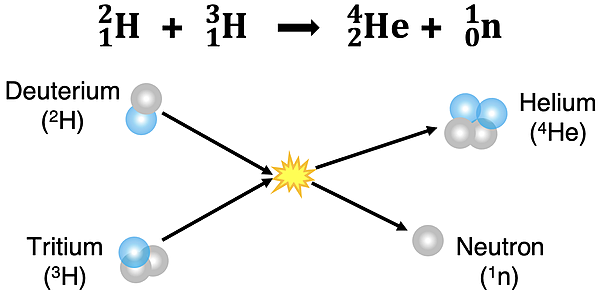
Both hydrogen isotopes are widely available and/or can be produced from widely available resources. The products are non-radioactive. There are no direct carbon emissions. There are no long-lived, high-level radioactive wastes. And compared to hydrocarbon combustion, the energy output per mole of fuel is about a millions times greater with fusion power.
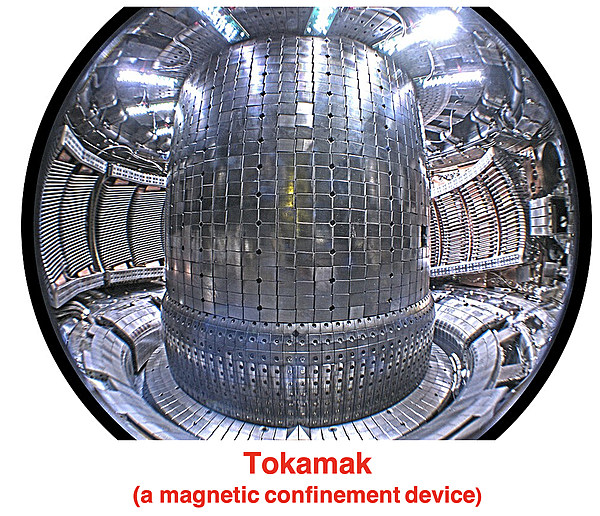
As of this writing (2025), several companies are actively engaged in research and development of the first nuclear fusion power plants. Helion Energy has the ambitious goal of producing fusion-generated electricity by 2028. Commonwealth Fusion Systems expects their first commercial fusion power plants to come online in the early 2030s. Other companies like Tokamak Energy, First Light Fusion, and General Fusion expect fusion-generated power in the 2030s.
Before You Leave - Practice and Reinforcement
Now that you've done the reading, take some time to strengthen your understanding and to put the ideas into practice. Here's some suggestions.- The Check Your Understanding section below includes questions with answers and explanations. It provides a great chance to self-assess your understanding.
- Download our Study Card on Nuclear Power Plants. Save it to a safe location and use it as a review tool.
Check Your Understanding of Fission and Fusion
Use the following questions to assess your understanding. Tap the Check Answer buttons when ready.
1. Explain how uranium-235 fission can result in a chain reaction.
2. Describe what a moderator is and what role it plays in a nuclear power plant.
3. Make an argument to convince a friend that the United States needs to increase the reliance upon nuclear fission as a means of generating electricity. (Oh ... and be kind when making your argument. There's plenty of Nasty out there to go around.)
4. Make an argument to convince a friend that the United States needs to reduce the reliance upon nuclear fission as a means of generating electricity. (Once more, practice being kind and reasonable as you make your argument.)
5. Explain what D-T fusion is and how it is different than the fusion that occurs on the sun.
6. Describe the promise and roadblocks to nuclear fusion power plants.