Lesson 4: Nuclear Radiation - The Good, the Bad, and the Ugly
Part a: Nuclear Technologies - The Good
Part a: Nuclear Technologies - The Good
Part b:
Radiation Exposure - The Bad
Part c:
Nuclear Accidents - The Ugly
The Big Idea
By tracking radiation emitted from specific radioisotopes, doctors can gather information about organs and tissues inside the body. These medical applications demonstrate the beneficial side of nuclear chemistry.
 The Good
In the first three lessons of Chapter 19 of this Chemistry Tutorial, we’ve addressed the fundamentals of nuclear stability, nuclear radiation, nuclear decay, and nuclear reactions. In Lesson 4, we will explore the good, the bad, and the ugly side of radiation. Many will be taken back by the idea that there is a good side of radiation. What can possibly be good about something that seems so bad? When you’re clear about the chemistry, you’ll quickly recognize that radiation can be used as a technology that provides positive benefits. In Lesson 4a, we will explore the use of radiation technologies in medicine and other industries.
Radiotracers and Radio Imaging
A radioactive tracer (or radiotracer) is like a tiny, glowing tracker for your body. A small dose of the radioisotope is ingested or injected. Using sensitive cameras, medical doctors can detect where the isotope has migrated to and accumulated at. By examining the movement of the radiotracer, doctors can non-invasively diagnose organ disfunction and other problems.
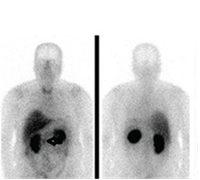 One of the most widely used radioisotopes in medicine is technetium-99m (Tc-99m). Tc-99m is a metastable (excited state) radioisotope that emits gamma radiation as it relaxes back to the ground state. Because gamma rays easily pass through body tissue, they can be detected by sensitive cameras from outside the body. Its short half-life of about 6 hours means it provides useful information while it quickly decays away, limiting radiation exposure. By attaching Tc-99m to different chemical compounds, doctors can study blood flow, organ function, and bone structure.
Image Source: Wikimedia Commons
External Beam Radiation Therapy
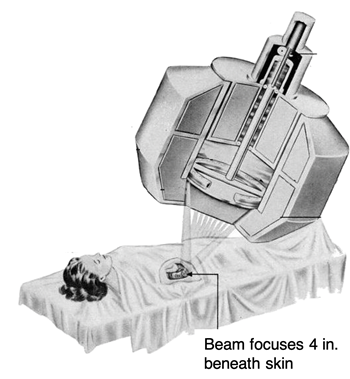 External beam radiation therapy is a form of radiotherapy in which ionizing forms of radiation are used to kill or control the growth of cancer cells. A beam of particles or rays is directed at the target, the cancerous growth, from a machine outside the body. Cobalt-60 (Co-60) is a radioisotope that has been used for decades in external beam radiation therapy. It emits high-energy gamma rays that can penetrate deep into the body. These gamma rays damage the DNA of rapidly dividing cancer cells, preventing them from reproducing. Co-60 has a half-life of 5.3 years, making it a reliable and predictable radiation source. This application highlights how the enormous energy released in nuclear changes can be carefully directed to destroy harmful cells while sparing surrounding tissue.
Image Source: Wikimedia Commons
 Radiopharmaceuticals
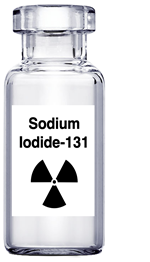
Some radioisotopes are used as radiopharmaceuticals meaning that treat disease from inside the body. A radiopharmaceutical is like a guided missile, designed to target cancerous growth in a specific organ of the body. Iodine-131 (I-131) is a great example. Because iodine is chemically absorbed by the thyroid gland, I-131 naturally concentrates there. As it decays, it emits beta particles, which release energy over short distances and damage nearby cells. This allows doctors to target thyroid disorders with great precision. The success of I-131 depends on both chemical behavior (where the iodine goes) and nuclear properties (how it decays).
Radium-223 (Ra-223) is a second example of a radiopharmaceutical. Ra-223 is used to treat cancer that has spread to bones. Radium is an element in the alkali-earth family of the periodic table. As such, it has a chemical behavior that is similar to calcium. Like calcium, radium-223 collects in bone tissue. It emits alpha particles that are highly energetic, travel short distances, and destroy nearby cancer cells while minimizing the damaging to surrounding healthy tissue. Because it has a short half-life of 11 days, even a low dose would deliver sufficient alpha particles to the target, while it decays quickly and limits long term exposure.
PET Scans
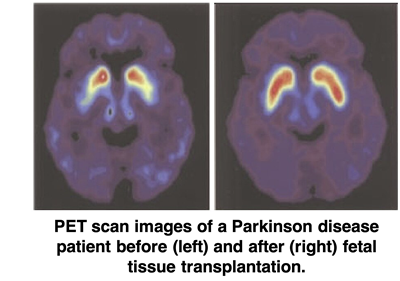 Positron Emission Tomography (PET) use radioisotopes and imaging equipment to monitor and diagnose medical issues. A PET scan is often used to detect disfunctions in metabolic and brain activity. Fluorine-18 (F-18) is an often-used radioisotope for PET scans. F-18 decays by positron emission. The positron will quickly meet up with an electron, producing gamma rays that are detected in the scan. The more metabolic and brain activity that there is, the more vivid that the colors will be in the resulting 3D image. F-18 is often incorporated into glucose-like molecules, allowing doctors to observe how actively various body tissues are using energy. Its short half-life of about 110 minutes makes it ideal for diagnostic imaging.
Image Source: National Institute of Health (Public Domain)
 Radiotracers in Industry
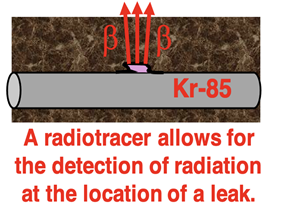
Radiotracers are also used in industry. For instance, krypton-85 (Kr-85) is an inert, radioactive gas that is used to detect the location of leaks in underground and sealed pipe systems. Kr-85 is injected into the system. As it flows through the system, it will accumulate at the location of a leak. As it decays by beta emission, sensitive equipment can be used to detect its presence at the location of the leak. This allows engineers to locate leaks without digging or cutting into the system. The usefulness of Kr-85 comes from its gaseous state, chemical inactivity, and detectable nuclear decay.
Smoke Alarms
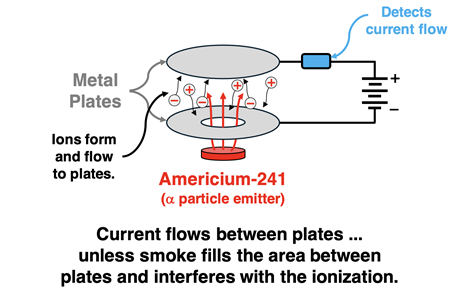 Many household smoke alarms use americium-241 (Am-241). A small amount of the radioisotope is present as a thin foil inside the smoke detector unit. The Am-241 undergoes alpha decay. The alpha particles ionize the air inside the unit, allowing a small, detectable electric current to flow. If smoke particles accumulate in the detector, the current is interrupted and the alarm sounds. Am-241 has a very long half-life, so it remains effective for decades. This everyday application shows how a small amount of radioactivity can be used safely to protect lives. That’s Chemistry for Better Living!
Food Preservation
Radioisotopes such as cobalt-60 are also used to preserve food. Foods such as fresh meat, fruit, and spices arrive at the irradiation facility and pass through an irradiation chamber. Gamma radiation from Co-60 kills bacteria, parasites, and insects by damaging their molecular structures. The food itself does not become radioactive. Removing harmful organisms makes the food safer and extends its shelf life. This is one more example of using Chemistry for Better Living!
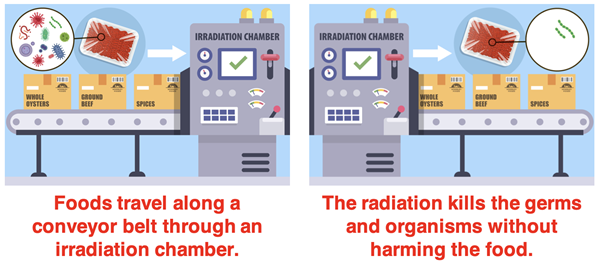
Image Source: Center for Disease Control
Next Up
We’ve discussed the Good - science using what is known about radiation to provide services that make our lives better and healthier. But there’s more to the story ... unfortunately. In Lesson 4b, we discuss the Bad. But before you tap that link, take some time to ensure that you understand the lesson by using one of the ideas in the Before You Leave section.
Before You Leave - Practice and Reinforcement
Now that you've done the reading, take some time to strengthen your understanding and to put the ideas into practice. Here's some suggestions.
- The Check Your Understanding section below includes questions with answers and explanations. It provides a great chance to self-assess your understanding.
- Download our Study Card on Nuclear Medicine and More. Save it to a safe location and use it as a review tool.
Check Your Understanding of Radiation Technologies
Use the following questions to review half-life and the balancing of nuclear equations. Tap the Check Answer buttons when ready.
1. Radium-223 has a half-life of 11 days. If 50.0 mg is injected into a patient, then approximately how much will be remaining after about one-month.
Check Answer
Answer: Approximately 7 - 8 mg
One month is approximately 30 days. That is more than two half-lives and less than three half-lives. That means that the initial amount of 50.0 mg will be halved two times but not quite three times. So we can think of the changes occurring like this:
t = 0 days ==> 50.0 mg
t = 11 days ==> 25.0 mg
t = 22 days ==> 12.5 mg
t = 33 days ==> 6.25 mg
The final amount is less than 12.5 mg and more than 6.25 mg and closer to the 6.25 mg. An exact amount can be calculated using the formula
N = (50.0 mg)/2n where n = 30 days/11 days
2. We’ve done it before. Let’s try it again. Write balanced nuclear equations for the following:
a. Iodine-131 undergoes beta decay.
Check Answer
Answer:
Iodine-131 is the reactant (the parent nucleus). Using a periodic table, we learn that iodine (I) has an atomic number of 53. One of the products is an electron. The other product is the
daughter nucleus. We don’t know what the daughter nucleus is; we can figure that out through a mass and charge analysis. We can set up the nuclear equation with a blank for the daughter nucleus:
A mass analysis or mass number (A) balance would lead to this simple mathematical statement:
131 = Adaughter nucleus + 0
The mass number of the daughter nucleus is 131. A charge analysis or atomic number (Z) balance would lead to the statement:
53 = Zdaughter nucleus + -1
The atomic number of the daughter nucleus is 54. Using the periodic table, we can identify the daughter nucleus as being xenon (Xe). The nuclear equation can be written as ...
b. Radium-223 undergoes alpha decay.
Check Answer
Answer:
Radium-223 is the reactant (the parent nucleus). Using a periodic table, we learn that radium (Ra) has an atomic number of 88. One of the products is an alpha particle. The other product is the
daughter nucleus. We don’t know what the daughter nucleus is; we can figure that out through a mass and charge analysis. We can set up the nuclear equation with a blank for the daughter nucleus:
A mass analysis or mass number (A) balance would lead to this simple mathematical statement:
223 = Adaughter nucleus + 4
The mass number of the daughter nucleus is 219. A charge analysis or atomic number (Z) balance would lead to the statement:
88 = Zdaughter nucleus + 2
The atomic number of the daughter nucleus is 86. Using the periodic table, we can identify the daughter nucleus as being radon (Rn). The nuclear equation can be written as ...
c. Fluorine-18 undergoes positron emission.
Check Answer
Answer:
Fluorine-18 is the reactant (the parent nucleus). Using a periodic table, we learn that fluorine (F) has an atomic number of 9. One of the products is a positron. The other product is the
daughter nucleus. We don’t know what the daughter nucleus is; we can figure that out through a mass and charge analysis. We can set up the nuclear equation with a blank for the daughter nucleus:
A mass analysis or mass number (A) balance would lead to this simple mathematical statement:
18 = Adaughter nucleus + 0
The mass number of the daughter nucleus is 18. A charge analysis or atomic number (Z) balance would lead to the statement:
9 = Zdaughter nucleus + 1
The atomic number of the daughter nucleus is 8. Using the periodic table, we can identify the daughter nucleus as being oxygen (O). The nuclear equation can be written as ...