Lesson 4: Nuclear Radiation - The Good, the Bad, and the Ugly
Part c: Nuclear Accidents - The Ugly
Part a:
Nuclear Technologies - The Good
Part b:
Radiation Exposure - The Bad
Part c: Nuclear Accidents - The Ugly
The Big Idea
This page discusses the stories of The Radium Girls and the Cherbobyl and Fukushima nuclear power plant accidents. We learn how high levels of radiation exposure in a short period of time have severe impact upon health. And we also learn how education and insight are the best ways to combat unhealthy fears and unhealthy exposures.
 The Radium Girls
In 1922, the Illinois Radium Dial Company set up operations in the quiet river town of Ottawa, Illinois. The company hired mostly young women to paint the glow-in-the-dark dials on the clocks used by the Westclox Clock Company. Radium Dial advertised good pay, a learning environment, and clean and attractive work. The pay was as much as three times higher than competing employers, providing the young ladies enough cash to purchase high-heeled shoes and silk dresses. What could be wrong with a job like that?
Image Source: Library of Congress
The girls were given a vial of paint and a brush. The paint was a powdery mix of zinc sulfide and radium sulfate. A precise point on the brush was the key to a cleanly-painted dial. After a few strokes of the brush, the tip lost its point and the girls were encouraged by the company to “lip, dip, and paint”. That’s right! They were encouraged to stick the tip of their radium-laced brush between their lips in order to re-form a fine tip for precision painting. They were told that the technique was safe, with the added benefit that it “might even make your cheeks rosy.”
 The young girls were enamored by the glow-in-the-dark nature of the paint. As the powdered paint went airborne, their workstation, clothing, and bodies would assume a milder version of the glow-in-the-dark dials they were painting. Having been assured by management of its safety, they would occasionally sneak a paint vial home, where they painted their nails and used it like makeup. One girl even reported painting her teeth before a date in order to “knock him dead.”
Image Source: Wikimedia Commons
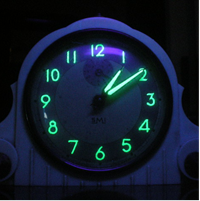 The zinc sulfide in the paint was known to be a scintillator. When struck by a high-energy particle, it would emit light. The radium in the paint was the radium-226 radioisotope. The isotope undergoes alpha decay with a half-life of approximately 1600 years. When the alpha particles from the Ra-226 decay strike the ZnS, it emits light and glows. That’s cool chemistry ... but a despicably bad work environment. The girls in Ottawa, Illinois (and the many at other locations in New Jersey, New York, and Connecticut) became known as the Radium Girls. Their fate is more popularly told in a movie and a Broadway musical by the same name and in a book titled The Radium Girls: The Dark Story of America's Shining Women.
Image Source: Wikimedia Commons
The element radium is in the same elemental family as calcium. As such, it shares similar properties as calcium (with an added punch). Wherever calcium goes, radium goes. Once ingested by the body, radium is quickly absorbed into the teeth, the jaws, and the bone structure. The high-energy alpha particle it emits is the most ionizing of all forms of radiation. Over time, the Radium Girls experienced severe dental pain, lost teeth, suffered from necrosis of the jaw, experienced pain in their hips, ankles, and joints, and many died of cancer. the Radium Girls were the victims of radiation poisoning and died of radiation sickness.
What Can We Learn from The Radium Girls?
The story of the Radium Girls has much to teach us about the evils of corporate greed, the importance of workplace ethics and protection, and the need for a public understanding of basic science. As a native of Ottawa, Illinois, now turned science teacher, I am aware of the cover-up and “impressive” array of deceit associated with this story. The Radium Dial Company dissolved during the public trials in which the Radium Girls sought compensation. Within a year, the owner opened Luminous Processes Inc. and moved a few blocks away, promising safer work conditions while producing the same product and spreading the same mess about town. The company was finally closed in 1978 when the friendly town of Ottawa became an Environmental Protection Agency (EPA) Superfund Site.
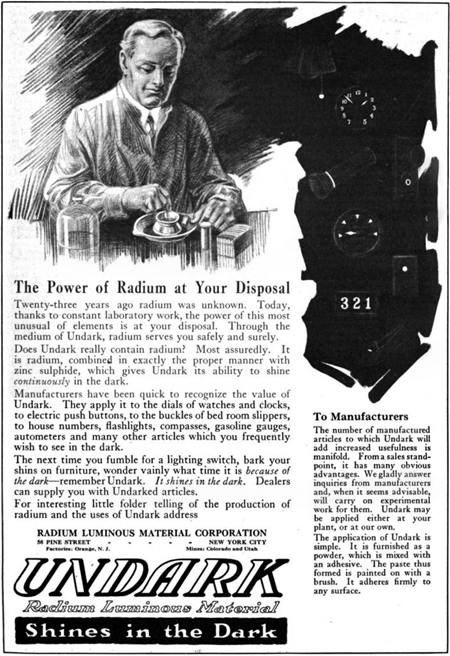 The use of radium in consumer products was surprisingly common in the 1910s and 1920s. It was marketed as a health tonic and for its unique glow. Radium-infused products showed up as facial creams and powders, cosmetics, back pain remedies, hair tonics, toothpaste, tonic water, glow-in-the-dark house numbers, and more. Product marketers even included the word radium on non-radium containing products to take advantage of the radium craze. It was out of this background of widespread ignorance regarding radioactivity that the Radium Girls emerged.
Image Source: Wikimedia Commons
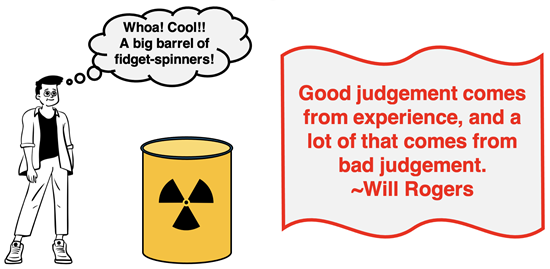
Deceit and ignorance are difficult to combat. Education and healthy skepticism is perhaps the best weapon for combatting each. Lesson 4 of our Nuclear Chemistry chapter is titled Radiation - The Good, the Bad, and the Ugly. There is no question that The Radium Girls exemplify the Ugly side of radiation. Unfortunately, it was an Ugly that didn’t have to be. By 1922, knowledge was getting around that radium-infused consumer products was not the most glowing idea of the twentieth century. It seems so often that we earthlings have to be alarmed by tragedy before we are illuminated by wisdom. It is said that hindsight provides 20/20 vision. True. But foresight and education provide the same vision with less pain. As Will Rogers put it: Good judgement comes from experience, and a lot of that comes from bad judgement.
Radiation Sickness
The Radium Girls suffered from radiation sickness. The human body has the ability to defend itself against the low levels of background radiation. Radiation sickness occurs when the body absorbs a large amount of ionizing radiation over a short period of time. The radiation damages a large numbers of cells faster than the body can repair them. Dose matters. And exposure time matters. Low doses may cause no immediate effects, while very high doses in a short amount of time can damage organs, disrupt the immune system, and interfere with cell division.
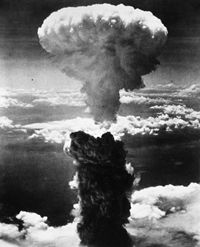 Most often, we think of radiation sickness as being the result of sudden, unexpected exposures to intense and uncontrolled radiation that occur from major accidents and critical failures. The use of the atomic bombs at Hiroshima and Nagasaki in 1945 and the catastrophes at the Chernobyl (1986)and Fukushima (2011) nuclear power plants are most often associated with the extreme effects of radiation sickness. While the Radium Girls did not experience sudden and extreme exposures like these accidents, they did experience a relentless, day-to-day radiative insult that most assuredly led to their injury. Their bodies were unable to repair themselves during the timeframe over which they were exposed.
Image: National Archives
Nuclear Accidents and Radiation Exposure
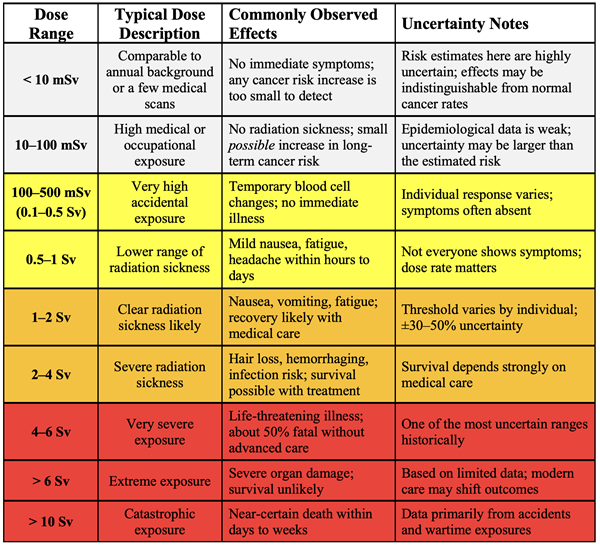
The incidents occurring at Hiroshima, Nagasaki, Chernobyl, and Fukushima have contributed to our understanding of radiation exposure and its connection to radiation sickness. Radiation exposure from nuclear accidents cannot be measured perfectly. Instead, scientists combine direct measurements, environmental data, computer models, and biological evidence to estimate doses. Because each step involves assumptions, reported exposure levels often differ between sources. For high doses, uncertainty levels can be as high as 30-50%. This explains why different sources will report different data as to exposure levels and the symptoms of radiation sickness.
The table below shows several ranges of radiation doses over a duration of hours or days and the associated health effects. These are not intended to be sharp boundaries. It is not unusual for two people receiving the same dose to experience different symptoms. The time over which the exposure occurs is critical. A large dose delivered in minutes or hours is most dangerous. The same dose spread over months and years may cause no immediate illness.
(The unit on dose is the millisievert (mSv). Review: millisievert and radiation units.)
What Happened at Chernobyl?
 The Chernobyl nuclear power plant accident occurred in 1986 in Northern Ukraine, near the border of Belarus and Russia. Chernobyl represents what can happen when flawed reactor design is combined with poor safety culture and secrecy. The accident occurred during a poorly designed safety test. A combination of reactor design flaws, operator error, and a lack of safety oversight led to a runaway reaction and explosion. Unlike US reactors, the Chernobyl reactor was not enclosed in a containment building, widely regarded as a second line of defense that protects the public from radiation exposure. When the reactor core melted, large amounts of radioactive material were released into the environment.
The nearby town of Pripyat (population of 49,000) was completely evacuated within 36 hours. An estimated total of 200,000 people were relocated within months of the accident. Many emergency responders received extremely high radiation doses, leading to radiation sickness and death. Long-term effects included increased cancer rates in exposed populations and widespread environmental contamination. Chernobyl serves as a reminder that nuclear technology without transparency and a safety culture can be dangerous.
What Happened at Fukushima?
In March of 2011, a massive magnitude-9 earthquake occurred off the coast of Japan, initiating a 15-meter tsunami that took aim at the Fukushima nuclear power plant. The accident illustrates how even a well-designed system can fail when overwhelmed by natural forces. As intended, the Fukushima reactors shut down immediately. But the tsunami wall protecting the plant was only 6 meters high. The waters penetrated the wall, flooded the plant, and disabled the cooling systems that were intended to cool the reactors. The reactors overheated, leading to a hydrogen explosion inside reactor vessel. The explosion damaged the containment building and led to the release of radioactive material.
Radiation exposures to the public were much lower than in the Chernobyl disaster. Evacuations and emergency responses helped limit health effects, and no deaths have been directly attributed to radiation exposure. Fukushima highlights the importance of planning for extreme events and understanding how complex systems can fail under unexpected conditions.
Nuclear Power Plants Takes a Hit
The Chernobyl nuclear power plant was both scary and ugly. But the nuclear industry could make a strong argument that the reactor design at Chernobyl was nowhere as safe-minded as those that were built elsewhere. It lacked the backup safety protocols that were inherent to most nuclear power plants.
But the Fukushima disaster was even more chilling. It raised the question as to how safe does a nuclear power plant have to be in order to protect the public from any unexpected natural tragedy? The year 2011 marked the closure of a number of nuclear power plants. Worldwide nuclear power generation diminished considerably and has yet to make a comeback.
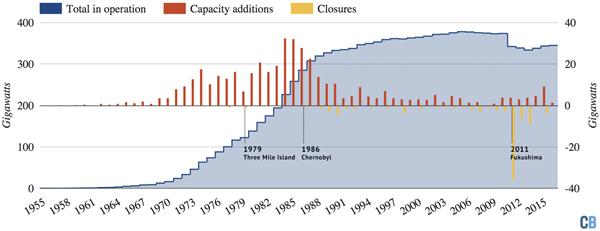
Source: International Atomic Energy Commission
What Happened at Three Mile Island?
The United States has its own disaster. But unlike the disasters at Chernobyl and Fukushima, it was a disaster that spread at lot of fear and not much radiation. In March of 1979, a cooling malfunction at the Three Mile Island nuclear power plant in Pennsylvania resulted in the melting of part of the reactor core. The accident resulted in the release of radioactive gas. The amount of radiation released was small, and studies found no measurable increase in cancer rates among nearby residents. The Nuclear Regulatory Commission has conducted detailed studies in the aftermath of the accident and have concluded that in spite of serious damage to the reactor, the actual radiation release had negligible effects on the physical health of individuals or the environment.
The accident led to widespread public fear regarding the safety of nuclear power plants. Three Mile Island demonstrates that not all nuclear accidents result in major radiation exposure. Public perception of risk can differ greatly from the actual measured risk. The response of the Nuclear Regulatory Commission was to both tighten and heighten regulations. The effect of the accident and the public reaction to the accident on the nuclear power industry is obvious when you look at the statistics below. Whatever trouble the nuclear industry was having prior to 1979 were accentuated in the years that immediately followed the Three Mile Island (TMI) accident.
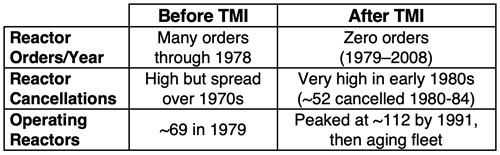
To learn more about Three Mile Island, watch the Nuclear Regulatory Commission’s short video on the Three Mile Island accident.
Turning Unclear Chemistry into Nuclear Chemistry
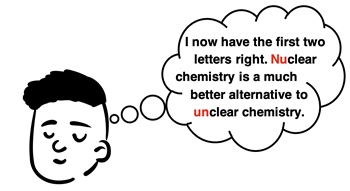 The story of radiation’s Ugly side is not simply a story about dangerous particles or invisible rays. It is a story about what happens when knowledge is incomplete, when risks and public safety are ignored, and when information is withheld. Whether the Ugly side include the Radium Girls, Chernobyl, Fukushima, or Three Mile Island, the greatest harm comes when radiation is misunderstood or mismanaged. Understanding radiation - how it works, how it is measured, and how it affects living systems - is the best protection against these mistakes. Such understanding replaces 20/20 hindsight with educated foresight. Good judgement certainly does come from experience. But it is a whole lot less painful when good judgement emerges from a good education.
Check Your Understanding
Now that you've done the reading, take some time to strengthen your understanding and to put the ideas into practice. These questions to assess your understanding of this lesson. Tap the Check Answer buttons when ready.
1. Which one of the following would NOT have saved the Radium Girls from the impending disaster?
- A society that understood radiation and its effects on health.
- Enforced factory practices for safely handling radioactive materials.
- If employees had done what they were told, none of this would have happened.
- Workplace laws that required employers to make chemical hazards clear to employees.
Check Answer
Answer: C
The Radium Girls did do what they told. They were told to "lick, dip, and paint." Had they refused to do what they were told, they would have lost their jobs and saved their lives.
Safe workplace practices for handling radiactive materials, clear and transparent information about the dangers of handling radioactive materials, and a cultural understanding of radioactivity and radioactive substances would have also saved their lives.
2. Suppose that your friend states the following: “Closing the Luminous Processes, Inc. factory in 1979 was necessary. But declaring the town of Ottawa, IL as an EPA Superfund site is a huge over-reaction.” How would you respond to this statement?
Check Answer
Answer:
As their name implies, the Environmental Protection Agency is vested with the responsibility of protecting the environment. The practices in Ottawa, Illinois had been going on for over 50 years in two different locations. The radium-226 has a half-life of 1600 years, meaning that the radioisotope will be around for a long time and radiating whatever is in its immediate location. Over time, the radium will seep into the soil, likely be rinsed into the underground water supply, undergo radioactive decay to produce radon gas, and be present in the air and breathed into the lungs. None of this is good. All of it is known to present a reasonable threat to the environment and the people that wish to enjoy it.
The EPA has practices and standards for testing various environments and declaring it a Superfund site. Their studies found that the radium had been scattered across the entire town, found in landfills, and in groundwater. Radiation is quite easy to test for and counts at various locations (e.g., landfills and the two factory sites) were well above the expected and qualified the town as a Superfund site.
3. How was the plight of the Radium Girls different than the plight of workers at the Chernobyl nuclear power plant disaster?
- The Chernobyl workers deserved what they got. The Radium Girls were taken advantage of.
- The Chernobyl workers died of radiation sickness. The Radium Girls died of radiation exposure.
- The exposure time was short for the Chernobyl workers. The exposure for the Radium Girls was continuous but stretched over a long period of time.
- The Chernobyl workers were not part of any practical endeavor. The Radium Girls were contributing to a societal cause.
Check Answer
Answer: C
C is the answer. The Radium Girls received their dose on a near daily basis. Not any one by itself would have been large enough to cause death. But the continuous daily "insult" (an epidemiology term) was sufficient to build-up to poisonous levels and cause "injury" (another epidemiology term) and death.
Regarding Option A: nobody deserves radiation poisoning! And yes, the Radium Girls were taken advantage of.
Regarding Option B: Both workers died of over-exposure to radiation and radiation skickness.
Regarding Option D: Both workers were contributing to a societal cause.
4. How was the nuclear power plant accident at Chernobyl different than that at Fukushima?
Check Answer
Answer:
The accident at Chernobyl was largely due to a poor reactor design, a poorly designed safety test, and operator error. In the end, "us humans should do better" would be a reasonable conclusion. The Fukushima accident was largely due to a natural disaster (an earthquake and tsunami), the magnitude of which had not been planned for. In the end, "we didn't expect that" would be a reasonable conclusion ... along with What else are we not expecting?
5. How was the nuclear power plant accident at Three Mile Island different than that at Chernobyl?
Check Answer
Answer:
The disaster at Chernobyl resulted in the release of large amounts of radiation that could be measured in the immediate area and even globally. There were many deaths and illnesses and even an increase in genetic defects in the coming years. The accident at TMI released a small amount of radiation; there were no deaths and studies led to the conclusion that the health effects from the radiation release were not detectable. In the end, the TMI accident seemed to spread more fear than it spread radiation and illness.
View:
Chapter Contents