Hold down the T key for 3 seconds to activate the audio accessibility mode, at which point you can click the K key to pause and resume audio. Useful for the Check Your Understanding and See Answers.
Center of Mass
When we studied projectile motion, we discovered that a thrown object follows a parabolic path. Up to this point, however, we treated all objects—regardless of their shapes—as a point in order to describe their position, velocity, and acceleration at any time. What if the object that we throw has some irregular shape, however? What if the object is rotating after we throw it? How do we make sense of this motion? After all, we saw in Lesson 1 that each point on a rotating object actually has a different velocity. Add in the fact that the object is translating (that is, moving sideways) while rotating, and we have a very complicated motion indeed.
There is one point on an object that is unique. That point is the center of mass. The center of mass is an average position of mass where we can consider all the mass of the object to be located for purposes of analyzing its motion. In other words, if we toss a screwdriver in the air so that it rotates end over end, it is the center of mass of the screwdriver that follows a perfectly parabolic path and obeys all the physics we’ve learned so far.
Center of Gravity
Now, let’s take the same screwdriver and balance it on our finger. If we find just the right point, our finger can be the pivot point where the CCW torques due to the force of gravity on one side exactly equal the CW torques on the other side. This balance point is what we’ll call the center of gravity.
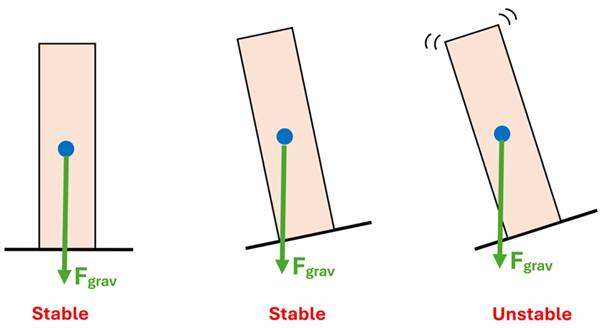
All objects have a center of gravity. For example, when you stand, you have a place close to your belly button that is your center of gravity. The reason you don’t tip over is because your center of gravity is directly above a base of support (your feet and the area between them). Just like the screwdriver is balanced when its center of gravity is directly above a point of support, you are balanced when your center of gravity is above a support.
The center of gravity is the point where we can consider all the force of gravity to act on the object. It is the point where we can imagine all the weight to be located for purposes of determining whether or not the object will rotate. As long as the center of gravity is directly above a point of support, the object is in stable equilibrium. However, once the center of gravity is no longer directly above a base of support, the CCW torques on one side relative to the base are no longer equal to the CW torques on the other side. That is what makes an object unstable and tip.
Are They the Same?
You might be asking the question, "Are center of mass and center of gravity the same thing?" For everyday objects they are located in exactly the same place. The only time they would not be in exactly the same place is if the gravitational field on one side of the object is different from that on the other side. While that might sound absurd, that is the case with the moon as it feels the Earth’s gravitational pull. While the center of mass of the moon is essentially located in its geometric center, its center of gravity is shifted slightly closer to the Earth since the Earth’s gravitation field on the 'near side' of the moon is a little stronger than it is on the 'far side' of the moon.
Because we’ll be talking about everyday-sized objects as we investigate conditions for equilibrium in an upcoming section, we’ll choose to use the term ‘center of mass’ to refer to the point where we imagine all the mass to be located and where we can consider all the force of gravity to be acting. We can do this because, for our situations, the center of mass and center of gravity will be in exactly the same location.
Check Your Understanding
Use the following questions to assess your understanding. Tap the Check Answer buttons when ready.
1: If you toss a screwdriver straight up in the air, it appears to wobble as it rotates. What point on the screwdriver doesn’t wobble but merely moves straight up and then back down?
Check Answer
Answer: center of mass
The center of mass is an average position of mass where we can consider all the mass of the object to be located. This is the point that will travel straight up and down and even accelerate at 9.8 m/s2.
2: Where is the center of mass of a hollow volleyball?
Check Answer
Answer: at its center
Interestingly, there doesn’t actually have to be mass at the center of mass of an object. Center of mass is merely a point in space where we can consider all the mass to be located for purposes of studying an object’s motion.
3: Consider the “L” shaped block of wood in four different orientations. The blue dot represents the block’s center of gravity. Which of the following are not in stable equilibrium? Why are these not in equilibrium?

Check Answer
Answer: c and d, because center of gravity is not above a base of support.
4: Why can’t you stand with your heels and back to the wall, bend over and touch your toes, and then return to the standing position? Try it!
Check Answer
Answer: The upper part of your body causes a net torque on you since your center of gravity is no longer above your feet.
Some images created using some MS Word Iconography