Conditions for Equilibrium
In physics, static equilibrium often refers to situations where an object is at rest—it has neither translational motion (it is not moving side to side) nor rotational motion. In a unit on rotational motion, it might seem strange to analyze situations where objects are not rotating. Studying such situations, however, is pretty important. After all, we don’t want light poles, or buildings, or bridges rotating, do we!? That is what this section is about. We’ll investigate objects in equilibrium.
There are two conditions that are true of objects that are in equilibrium: (1) the net force on the object is zero, and (2) the net torque on the object is zero. Both conditions will prove to be helpful as we analyze objects in equilibrium.
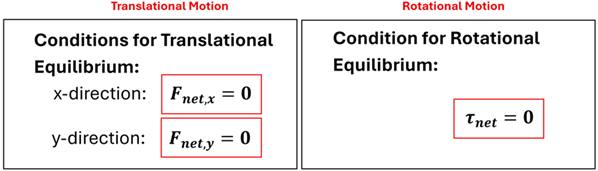
In analyzing situations where forces may act in two dimensions, we have two translational force equations and one rotational torque equation. Not every situation will require us to use all three equations in any one problem, but with these simple equations, we can analyze just about any equilibrium situation. Let’s dive right in and see how this works by applying these conditions in some example problems.
Example 1: Diving Right In
Problem: Onthi Edge, a 450 N diver, is positioned at the right end of the 4.0 m long diving board. The uniform 50 N diving board is fastened to the pool deck by a large bolt and supported by a pivot 1.3 m from the bolt. Find (a) the force that the bolt exerts on the board, and (b) the force the pivot exerts on the board in order to hold Onthi in place.
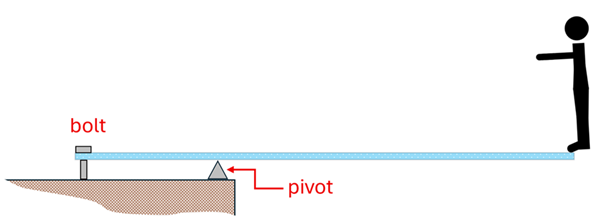
Solution: Let’s begin with a force diagram for the diving board. What makes force diagrams in this chapter a bit different from those in previous chapters is that now we need to draw the forces at the locations where they act. This will be important when we calculate torques and apply the condition for rotational equilibrium. Let’s also include two coordinate systems—one showing the positive x and y-directions for forces and one showing the positive direction of torque. (a) To find the force that the bolt exerts on the board, let's apply the condition for rotational equilibrium by writing the torques about the pivot. Doing so give Fb = 962 N in the downward direction. (b) To find the force that the pivot exerts on the board, we could apply the condition for rotational equilibrium again and take the torque about any point other than the pivot. What is probably easier, however, is to use the y-direction equation for translational equilibrium. Doing so give Fp = 1462 N in the upward direction.
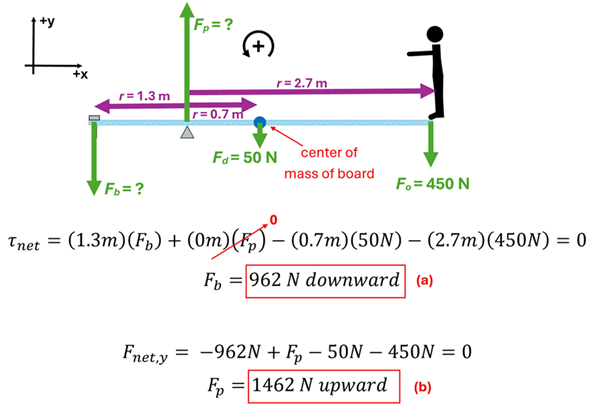
It's important to note that we can write the condition for rotational equilibrium (τnet = 0) taking the torques about any point. It doesn’t have to be the actual pivot point. However, the reason it was advantageous to write the torque about the pivot point for part (a) was that we did not know the force that the pivot applied. Since the lever arm distance that the pivot force is from the pivot is zero, it cancels out of the equation.
Example 2: Where's my Center?
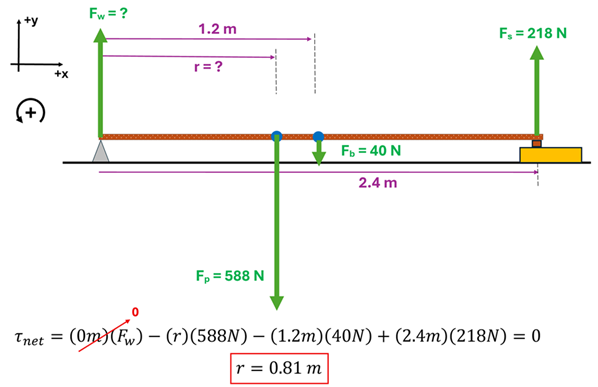
Problem: Indy Middle, a 588 N student, was interested in finding out where his center of mass is (measured down from the top of his head). He balanced a 40 N, 2.4 m long board with a wedge on one end and a scale on the other. He then lay down on the board so that the top of his head was directly above the wedge. He had a friend tell him that the scale read 218 N. Where is Indy’s center of mass?
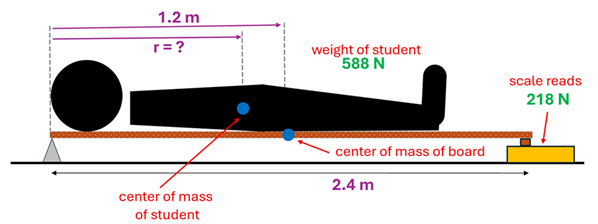
Solution: To find the location of Indy’s center of mass, we’ll begin by making a force diagram for the board on which he is lying. We can put all the weight of the board at its center of mass. We can put all of Indy’s weight at his center of mass. We’ll then apply the condition for rotational equilibrium and solve for r, the distance from the top of his head to his center of mass. The result is that r = 0.81 m. For most of us, this is about 45% of the way down from the top of our head. Pretty close to being 'in the middle.'
So far, our examples have required us to use only one equilibrium condition to solve for an unknown. Because we have three equations, however, we can actually have up to three unknowns in a problem. Our next example will require us to tackle something like this.
Example 3: Mystery Sign
Problem: You come across a building with an interesting sign (shown below) hanging from the end of a 2.0 m pole attached to the building. The pole is also supported by another cable that makes an angle of 30o above the horizontal pole. The pole weighs 100 N, and the sign weighs 300 N. The pole is hinged at the building such that it supplies both a vertical normal force (Fnorm, y) and a horizontal normal force (Fnorm, x). Find these two forces and the tension (Ftens) in the cable.
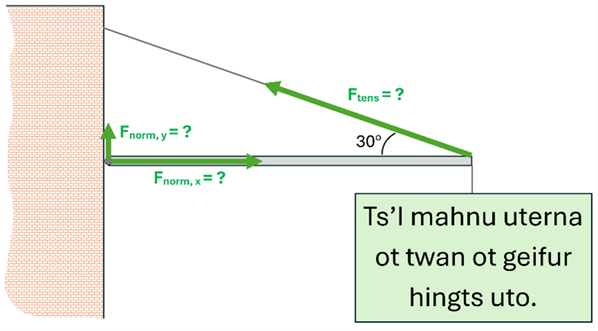
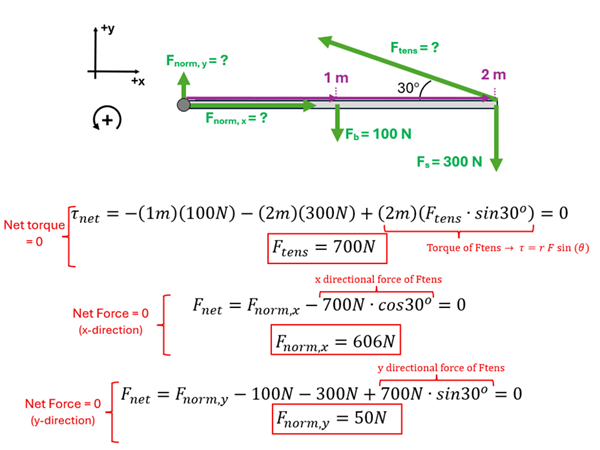
Solution: Like we usually do, let’s start with a force diagram with all our givens and unknowns clearly labeled. With this, let’s find the tension in the cable by applying the equation. We’ll take the torque about the hinge since we don’t know either of these normal forces (they will drop out of this equation since they act at the pivot). We know from our unit on torque that an angled force vector's torque = r • F • sin (θ), or in our case 2m • Ftens • sin(30). With Net torque = 0, we can add up all the forces and discover Ftens = 700 N. Next, let’s apply the equation to find the normal force that the building provides on the pole in the x-direction. We can get the x-direction of our Ftens by using trigonometry (treating Ftens as our hypotenuse and using Cosine to solve for the 'adjacent' x-value). With the net force (x-direction) = 0, we discover Fnorm, x = 606 N. Finally, we apply the equation to find the normal force that the building provides in the y-direction. Again, we find the y-direction of our Ftens force using trigonometry (treating Ftens as the hypotenuse and solve for the 'opposite' y-value). With the net force (y-direction) = 0, we discover lastly that Fnorm, y = 50 N.
Check Your Understanding
Use the following questions to assess your understanding. Tap the Check Answer buttons when ready.
1: A uniform meterstick is supported at the 25 cm mark and balances a 2 N weight hanging from the 0 cm end. What is the weight of the meterstick?

Check Answer
Answer: 2 N
The hanging weight supplies a CCW torque of (0.25 m)·(2 N) = 0.50 N·m. If balanced, the meterstick must supply an equal torque in the CW direction so that the net torque is zero. Since the center of mass of the meterstick is 0.25 m to the right of the pivot, 0.50 N·m = (.25 m)·x, therefore x = 2 N.
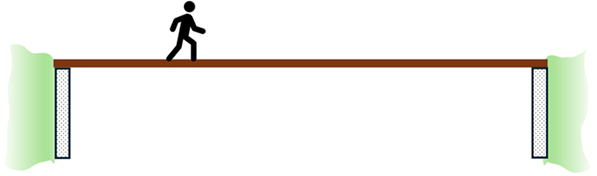
2: A 500 N hiker crosses a 12 m long uniform bridge weighing 1500 N. The bridge is supported on each end. When the hiker makes is ¼ of the way across, what is the force that each support is providing now?
Check Answer
Answer: Fleft = 1125 N, Fright = 875 N
Selecting the left support as our pivot allows us to find the force of the right support using the net torque = 0 equation. If CCW torques are positive, we get –(3m)·(500N) - (6m)·(1500N) + (12m)·(Fright) = 0. Solving gives Fright = 875 N. Knowing this, we can either use the net torque with a pivot on the other side, or know that the y-direction netforce should be 0 and add up our forces to find the unknown Fleft. Using either method, the net force is found to be Fleft = 1125 N.
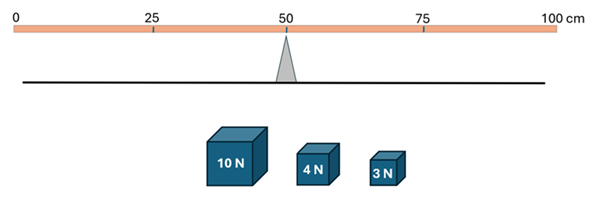
3: A 100 cm long bar is balanced at its center. You hang the 10 N weight from the 25 cm mark. Where can you hang the other two weights (4 N and 3 N) to rebalance the bar?
Check Answer
Answer: 4 N at 75 cm, 3 N at 100 cm is one solution, or 4 N at 100 cm and 3 N at 66.66 cm is another
While there are nearly infinite solutions, here are the two that you get by placing one of the weights at the end first. As long as the torques on the right add up to 2.5 N·m CW. You can also represent this in an equation: (2.5 - 3 · r3NWeight / 4) = r4NWeight where the r values must be below 0.75
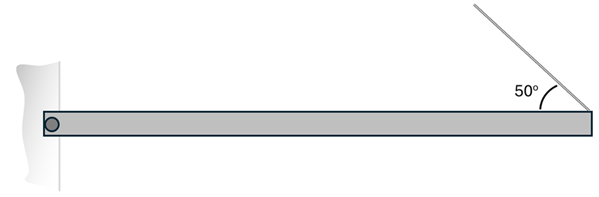
4: A uniform metal beam weighs 2500 N. It is supported by a large bolt on the left end and a cable on the right end (forming a 50 degree angle). What is the tension in this cable?
Check Answer
Answer: ~1630 N
Taking the torques about the bolt, the CCW torque provided by the bar’s weight must equal the CW torque provided by the cable. Thus, (L/2)·(2500 N) = (L)·(Ftens·sin 50o), where L is the length of the bar. Since L cancels, we can solve for the tension and find Ftens = 1630 N.
Looking for additional practice? Check out the CalPad for additional practice problems.
We Would Like to Suggest ...

Why just read about it and when you could be interacting with it? Interact - that's exactly what you do when you use one of The Physics Classroom's Interactives. We would like to suggest that you combine the reading of this page with the use of our
Torque Balancer Interactive and the
Balance Beam Interactive +
Concept Checker You can find it in the Physics Interactives section of our website.
and the
Balance Beam