Finding Center of Mass
In the previous section of this lesson, we introduced the concept of center of mass. We described the center of mass as an average position of mass where we can consider all the mass of the object to be located for purposes of analyzing its motion. But how do we find the center of mass of an object? Answering this question is the purpose of this section.
Imagine a sphere. It makes sense that its center of mass is located at its center. Now imagine two spheres whose centers are separated by a distance 2L. Where do you suppose the center of mass of this system of spheres is located? If you said right in the middle—at L—you’re right on. What if, however, the right sphere had twice the mass of the left sphere? Where would the center of mass be located now?
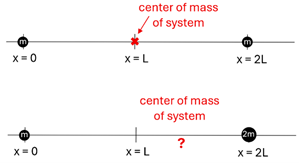
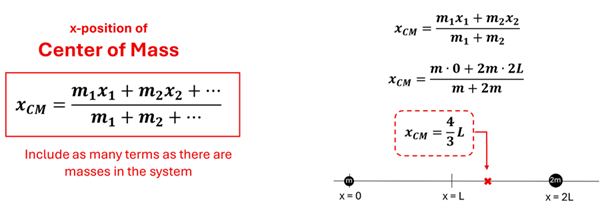
We can find the location of the center of mass by taking a weighted average of the masses at their locations. If we consider m to be the mass of the first sphere and 2m to be the mass of the second sphere, we see that the center of mass is indeed shifted to the right of center. In fact, xcm = 4/3 L.
Example 1: A Three-Mass System
Problem: The centers of two spheres, one of mass 1 kg and one of mass 2 kg, are located at the ends of a 2-meter-long bar. The bar also has a mass of 1 kg. Where is the center of mass of this three-mass system?
Solution: The key to solving these problems is that we can treat each sphere as a point with all its mass located at the coordinate of its center. We do the same for the bar. Its center of mass is located at its center. Thus, using the center of mass equation, we find the center of mass of this three-mass system to be at xcm = 5/4 meters.
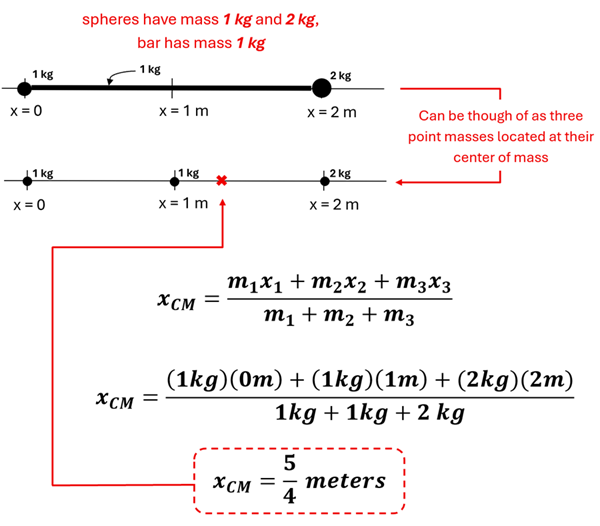
We can see that each time we add a mass to our system, we can merely add another term to our center of mass equation.
Finding Center of Mass in Two-Dimensions
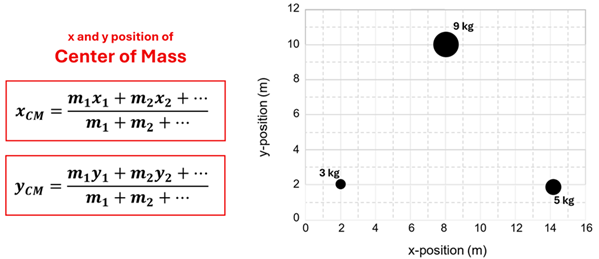
So far, we’ve encountered situations where we’ve put all our masses in a line along the x-axis. What if, however, they are not all in a straight line? Imagine a situation like the one shown in this figure. How would we find the center of mass of this system of masses?
The good news is that we can treat the x-position of the center of mass and the y-position of the center of mass independently. That means that we just focus on the x-coordinates to get the x-position of the center of mass and then focus on the y-coordinates to find its y-position. As a result, we’ll need two equations to find the exact location of the center of mass of our system.
Example 2: Finding Center of Mass in 2-D
Problem: Consider the three-mass situation shown above: 3kg at (2,2), 9kg at (8,10), and 5kg at (14,2). Apply the xcm and ycm equations to determine the center of mass of this system of masses.
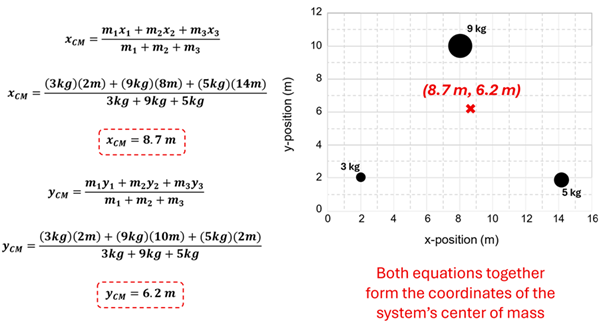
Solution: Let’s begin by applying the xcm equation to find the x-coordinate of the system’s center of mass. While doing this, we ignore the y-coordinates. It’s as if all three masses were along the x-axis. Next, we’ll apply the ycm equation to find the y-coordinate of the system’s center of mass. Similarly, while doing this, we ignore the x-coordinates. Finally, we put these two values together to identify the coordinates of the system’s center of mass as (8.7m, 6.2m).
The good news is that we can treat each object as a point object with all its mass located at its center. Using this idea, we can even find the center of mass of objects with interesting shapes.
Example 3: Center of Mass of the Letter "L"
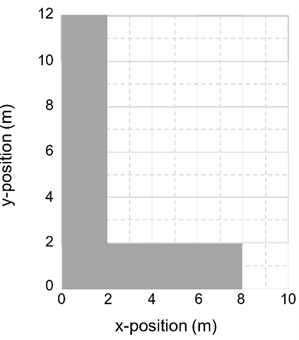
Problem: Finding the xy-coordinates of the center of mass of the letter “L” shown in the figure below.
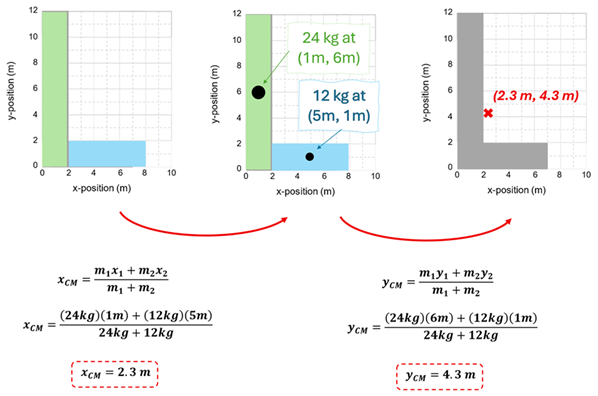
Solution: Let’s think of the “L” as two rectangles (see left figure below). The center of mass of each rectangle will be in its geometric center. We’ll have to ‘weight’ each rectangle by its area to represent the mass of that portion of the shape. Let’s imagine, for example, that each square meter has a mass of 1 kg. While this is arbitrary, as long as we are consistent throughout the problem, it doesn’t matter what mass we assign to each square meter. Since the area of the green rectangle is 24 m2, we’ll say that this has a mass of 24 kg. Similarly, we’ll say that the mass of the blue rectangle is 12 kg since its area is 12 m2 (see the middle figure). Finally, applying the center of mass equation to each of the point masses that represent each of the rectangles, we are able to find the coordinates of the center of mass as (2.3 m, 4.3 m). It is interesting to note that the center of mass is actually outside of the letter “L” itself.
Why is Knowing the Center of Mass So Useful
We already saw in the previous section that knowing the position of an object’s center of mass is useful in determining if an object will be stable or if it will tip over when placed on a surface. We also saw that it is the center of mass that follows a parabolic path when an irregularly shaped object is tossed in the air. It turns out, however, that there are many other ways that we can use the location of a system’s center of mass to predict the motion of the system. Let’s consider how knowing the location of the center of mass applies to collisions and explosions within a system.
Collisions
Back in the Collisions in Two Dimensions lesson in our chapter on Momentum and Its Conservation, we encountered a problem where two cars collided and stuck together. We used conservation of momentum to predict the velocity and path of the cars after the collision. That is not the only way to tackle a collision problem, however. We can actually approach this from a center of mass perspective as well.
Newton’s First Law states that an object in motion will continue its motion until a net force acts on it. The same is true for the center of mass of a system. Let’s say, for example, that the two cars are our two-mass system.
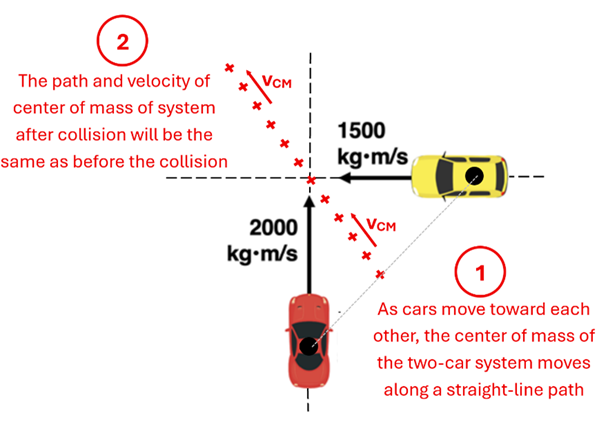
There will surely be internal forces as the cars collide with one another; but if there are no external forces, then Newton’s First Law implies that the center of mass must continue in the same direction with the same velocity after the collision takes place. So, as the center of mass moves along a straight line before the collision (as in ①), it will continue to move in the same straight line with the same velocity after the collision (as in ②). Like the conservation of momentum, this is how we can use the center of mass to predict motion after a collision.
"Explosions" Within a System
We saw in our chapter on Momentum and Its Conservation that momentum is helpful in analyzing explosion situations in addition to collisions. It turns out that we can also use a system’s center of mass to predict motion after an explosion. We’ll use the term ‘explosion’ rather loosely here to refer to any situation where parts of a system push off one another in opposite directions. While an ‘explosion could refer to an exploding firework, it can also apply, for instance, to a boy walking across a raft in the water. When the boy pushes the ramp back in one direction, the raft pushes him forward in the other.
As is the case with collisions, in explosions, there are internal forces on one object within the system by another object in the system. Newton’s First Law yet again suggests that, as long as there are no external forces acting on the system, if the system’s center of mass is at rest before the explosion, it must stay at rest after the explosion. This can be a powerful way of analyzing such situations. Let’s look at an example to illustrate how using the system’s center of mass can help us predict the motion within a system.
Example 4: Walking on a Raft
Problem: Ivgot Probblam, a 50 kg boy, stands on the right side of a 100 kg raft that is 6 meters long. The left end of the raft is floating at the end of the dock. Ivgot walks to the left side of the raft to step onto the dock. Upon doing so, however, Ivgot realizes he’s in trouble. (a) What is the predicament that he is in? (b) How far is Ivgot from the dock when he gets to the left end of the raft?
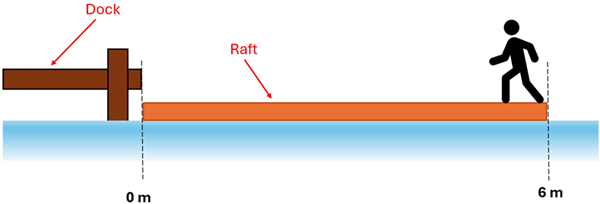
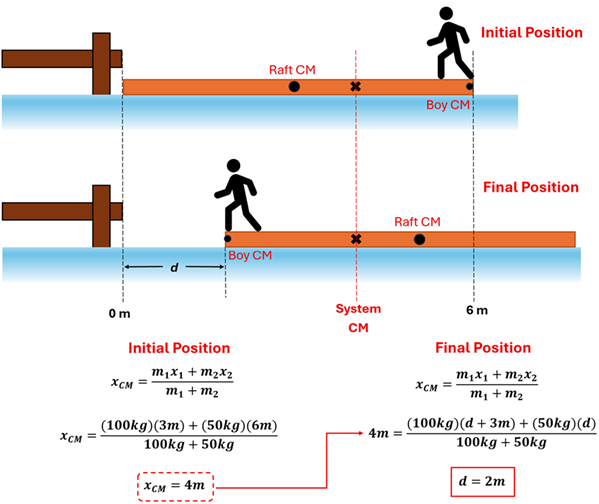
Solution: Let’s consider our system as two masses: Ivgot and the raft. We loosely consider this an ‘explosion’ type problem since as Ivgot walks to the left, he pushes the boat to the right. These are internal forces, however, since they are between two objects within our system. Provided there is no external net force, Newton’s First Law tells us that the center of mass must stay in the same position even after Ivgot starts walking. (a) Let’s begin our analysis by finding the center of mass of our system before Ivgot starts walking. We’ll attach a coordinate system and call the dock the origin. Next, we’ll use the center of mass equation to find the system’s center of mass as xcm = 4 m. Since the center of mass of the system must stay put, as Ivgot starts walking to the left the raft must start moving to the right—away from the dock. Ivgot is in a predicament as the raft will no longer be next to the dock for him to get off! (b) To find how far the raft is from the dock when Ivgot walks to the left end of the raft, we’ll use the fact that we know that the center of mass of the system must remain at xcm = 4 m. We can then write a new center of mass equation to solve for the d, the distance the raft is from the dock. Doing so, we find d = 2 m.
We’ve seen a few examples of how knowing the location of the center of mass of a system of objects can be helpful in predicting the motion of objects within the system after these objects exert forces on one another. These are not the only reasons it is helpful to know the center of mass, however. We’ll see that the center of mass of an object (or a system of objects) will be important as we continue to analyze both equilibrium and rotational motion situations in the lessons yet to come.
Check Your Understanding
Use the following questions to assess your understanding. Tap the Check Answer buttons when ready.
1: A 2 kg mass hangs from the left (zero) end of a meterstick while an 8 kg mass hangs from the right end. If the mass of the meterstick is negligible, where should the pivot be placed to balance this meterstick?
Check Answer
Answer: At the 80 cm or 0.80 m mark

2: A 4-meter-long uniform bar has a mass of 100 grams. Two masses (100 and 300 grams) are placed at the 0 m mark and 3 m mark, respectively. What is the location of the center of mass of this three-mass system?

Check Answer
Answer: 2.2 m

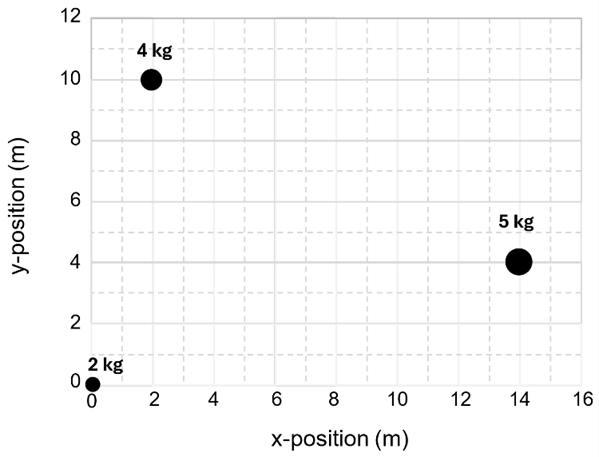
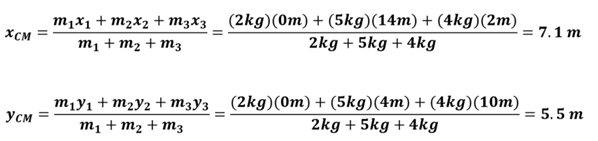
3: Find the xy-coordinates of the center of mass for this system of three masses.
Check Answer
Answer: (7.1 m, 5.5 m)
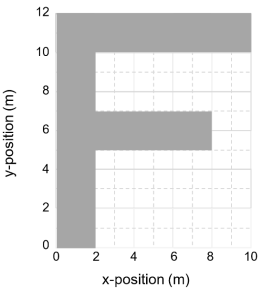
4: Consider the two-dimensional letter “F” shown below.
(A) Find the coordinates of its center of mass.
(B) Determine if it will be stable or unstable when placed on the ground in this orientation.
Check Part A Answer
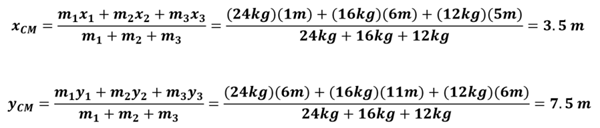
Answer: (3.5 m, 7.5 m)
Check Part B Answer
Answer: Unstable
Since the x-coordinate of the center of mass is not directly above the base (that is, between 0-2 m), it will be unstable.
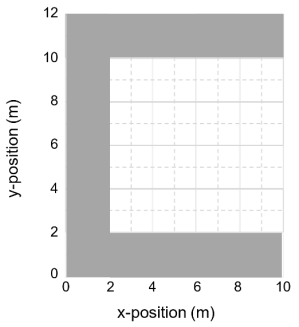
5: Consider the two-dimensional letter “C” shown below.
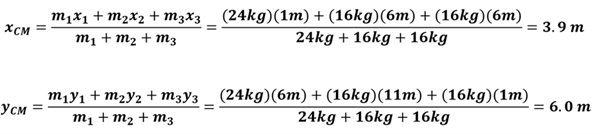
(A) Find the coordinates of its center of mass.
(B) If this were rotated 90o clockwise, would the center of mass be in the same (X,Y) location? Why or why not?
Check Part A Answer
Answer: (3.9 m, 6.0 m)
Check Part B Answer
Answer: No
This is only true when the object is symmetric about the line y = x. In other words, it must look identical when rotated 90o.
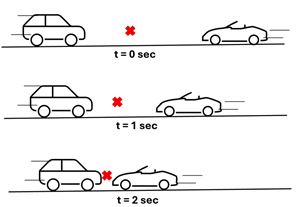
6: The figure below shows two cars as they approach a collision. The red "x" represents the systems center of mass. If the cars hit and stick together, after the collision will they be traveling to the left, right, or will they both come to rest? Assume there are no net external forces on the system.
Check Answer
Answer: Left
Since the center of mass of the system is moving leftward over time, it will continue to move in the same direction after the collision.
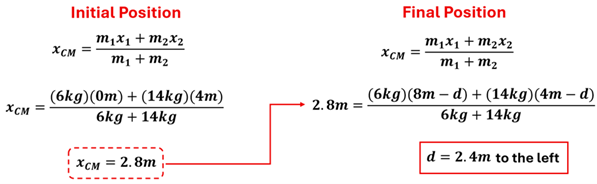
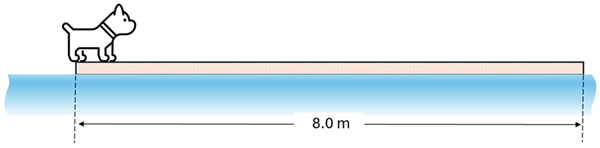
7: Bruiser, a 6.0 kg dog, runs from the left end to the right end of an 8.0 m long board floating in a lake. The board has a mass of 14.0 kg.
(A) Which direction does the board move in this scenario?
(B) How far does the board move relative to the still water in the lake?
Check Part A Answer
Answer: Left
Since the center of mass of the system must remain in the same location, if Bruiser moves to the right, the board must move to the left.
Check Part B Answer
Answer: 2.4 m
Taking the origin to be the original left end of the board.