Chapter 9: Rotation and Balance - Lesson 1: Rotational Kinematics
Centripetal Angular and Tangential Acceleration
Hold down the T key for 3 seconds to activate the audio accessibility mode, at which point you can click the K key to pause and resume audio. Useful for the Check Your Understanding and See Answers.
Keeping Acceleration Straight
Previously in this lesson, we explored the concept of angular acceleration, the kind of acceleration that comes about as a rotating object increases or decreases its angular velocity. A child standing on a rotating platform experiences an angular acceleration when the platform is pushed to speed it up or when friction causes it to slow down. Earlier in this lesson, we also saw that a point on a rotating object that is experiencing an angular acceleration is also experiencing a tangential acceleration. We call it a tangential acceleration since it points in a direction tangent to the circle. For example, if the rotating platform with the child on it is speeding up, we would say that the child also has a tangential acceleration.
In Lesson 2 of Circular Motion and Satellite Motion, we also explored centripetal acceleration, the kind of acceleration experienced by any object moving in a circle. When the child is rotating on the platform, she experiences a centripetal acceleration—whether she is speeding up, slowing down, or spinning at a constant speed. So, we have three kinds of acceleration? We do. How do we keep them straight? That's the purpose of this part of our lesson.
Let's consider a child on a rotating platform that is speeding up while spinning counterclockwise. Here are a side view and a top view to help us 'see' these accelerations.
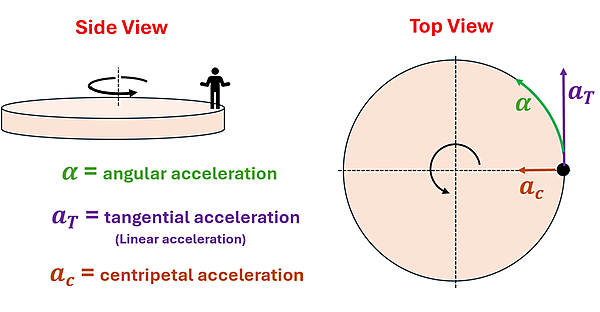
Earlier in this lesson, we saw that angular acceleration and tangential acceleration are related through one of our link equations (aT = r ⍺). In a sense, they are describing the same speeding up (or slowing down) type of rotational motion. However, the tangential acceleration depends on the child's location on the platform, whereas his angular acceleration does not. Centripetal acceleration, on the other hand, cannot be directly calculated from either of the other two types of accelerations. This third type of acceleration points radially inward and has nothing to do with the fact that the platform is speeding up or slowing down but instead depends on the instantaneous speed of the child and how far he is from the center of the platform. Let's summarize what we know about these three kinds of acceleration in a chart.
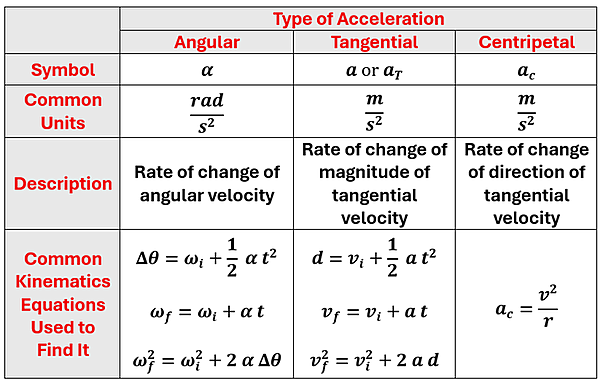
Let's try an example where we calculate all three.
Example 1: Three Kinds of Acceleration
Problem: A driver steps on the gas while rounding a curve with a constant radius of 38 m. The data table provides the car's speed while taking this curve. At t = 3.0 s, what are the driver's
(A) tangential acceleration
(B) angular acceleration
(C) centripetal acceleration?
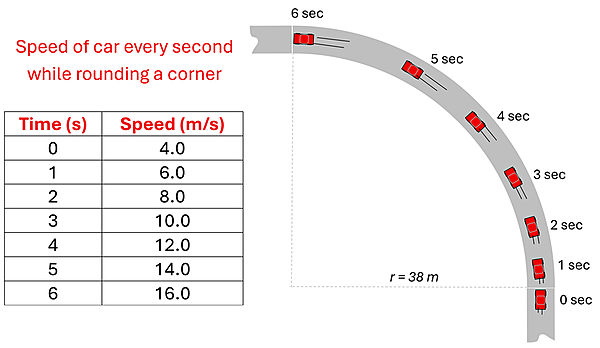
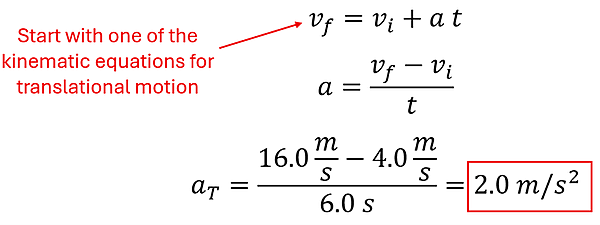
Solution: (a) The tangential acceleration can be found by noticing that each second the magnitude of the car's velocity increases by 2.0 m/s. Thus, the aT = 2.0 m/s2.
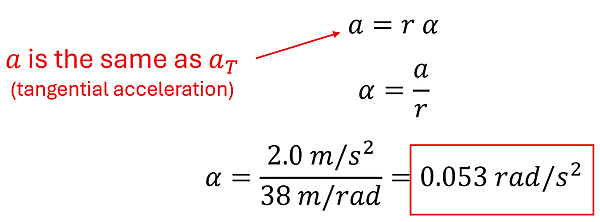
(b) To find the angular acceleration, we'll use the tangential acceleration and one of our link equations. We find ⍺ = 0.053 rad/s2.
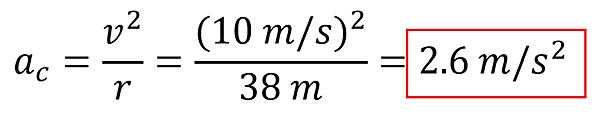
(c) To find the centripetal acceleration, we use the magnitude of the velocity at t = 3.0 seconds and the radius of curvature to find the centripetal acceleration to be ac = 2.6 m/s2.
Check Your Understanding
Use the following questions to assess your understanding. Tap the Check Answer buttons when ready.
1. Identify which type of acceleration is experienced by a driver in each of these scenarios. Write "Yes" or "No" for each of the 3 types of acceleration (Angular, Tangetial/Linear and Centripetal).
(A) A driver in a car takes a curve in the road traveling at a constant speed
(B) A drive in a car speeds up along a straight road
(C) A drive in a car turns round a corner while breaking.
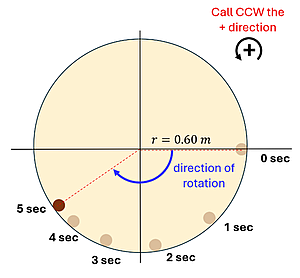
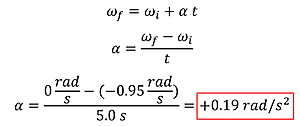
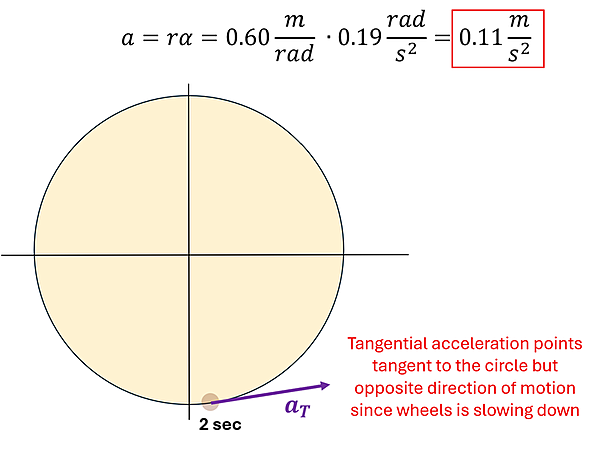
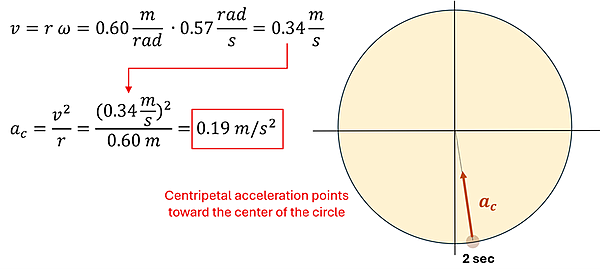
2. A potter's wheel (radius = 0.60 m) has a ball of clay stuck at the very edge of the clockwise rotating disk. When turned off, the rotating wheel slows uniformly from 0.95 rad/s to rest in 5.0 seconds. Determine the magnitude and direction of the:
(A) Angular Acceleration
(B) Tangetial Acceleration at 2.0 seconds
(C) Centripetal Acceleration at 2.0 seconds